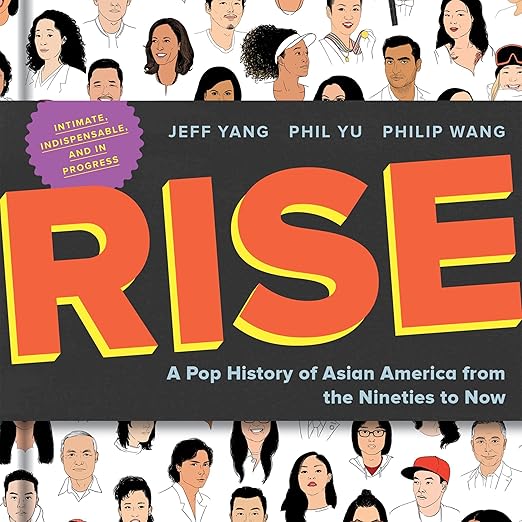
Jeff Yang, Phil Yu, and Philip Wang open Rise with a declaration: this audiobook is a love letter, and it does not apologize for that. Across 19 hours and 49 minutes, narrated by Brittany Ishibashi, the three co-authors chronicle the transformation of Asian American culture from the aftermath of the Hart-Celler Act of 1965 through the 2010s, decade by decade, touchstone by touchstone. Kirkus called it "imaginative," Min Jin Lee called it "essential," and Celeste Ng said it was "a book we've needed for ages." Those blurbs feel earned rather than promotional once you actually sit with the material.
Momentum and Precariousness at the Same Time
What separates Rise from other cultural histories is the way it refuses to separate the celebratory from the uncomfortable. The same book that includes a step-by-step guide to a night out in K-Town also features a pointed "Appreciation or Appropriation?" discussion and essays from AAPI artists navigating an entertainment industry that has long treated Asian faces as interchangeable props or punchlines. This is not nostalgia dressed as scholarship. The co-authors are working journalists and critics who lived through the periods they document, and that insider vantage gives the decade-by-decade narrative structure real texture. When they chronicle the rise of BTS or the cultural shock of Crazy Rich Asians, they situate those moments inside a longer arc of erasure, stereotype, and incremental visibility rather than treating them as standalone victories.
One reviewer from B Woon noted that the book provided "over 400 pages of insight that would satiate anyone who wants a base understanding of how Asian American culture has evolved." That word "satiate" feels right. Rise is constructed to fill a gap, and it does so with genuine thoroughness. It also refuses to pretend that the gap is nearly closed. The book's closing sections on the 2010s are marked by the same sense of momentum and precariousness simultaneously, the awareness that the gains represented by an Asian American Vice President or by the global dominance of K-pop are real without being permanent.
Ishibashi Carries the 1990s Timing and Rhythm
Brittany Ishibashi is a smart casting choice. Her voice carries authority without stiffness, and she navigates between the three authors' extended insider narratives, the essay contributions from outside voices, and the roundtable conversations with consistent clarity. The roundtable sections, which feature Asian American cultural icons in conversation, are among the most memorable stretches of the audiobook, and Ishibashi handles them with the kind of tonal precision that keeps listeners oriented even as the format shifts.
At nearly 20 hours, this is a substantial listening commitment, but the decade-based structure gives it natural pause points. The audio format actually serves the more conversational sections better than print might, particularly the anecdote-heavy passages about the 1990s and early 2000s that rely on timing and rhythm for their humor. Several reviewers noted the book's blend of "scholarly writing and graphic novel pages, anecdotes and serious lessons." The audio cannot replicate the visual elements, and listeners should be aware that some of the book's most celebrated features are print-native. What remains, however, is rich enough to stand independently. The section on "founding fathers and mothers" of AAPI culture is especially effective in audio form, building a sense of accumulated voices across time in a way that a single reader moving through a printed page cannot quite replicate.
Serious Substance, Also, I'm in It
The book's treatment of the 1990s is particularly strong, anchored in the rise of internet communities, the explosion of Asian American zines and independent media, and the complicated cultural politics of that decade's martial arts film craze and its relationship to Black cultural borrowing. The authors do not smooth over these tensions. The section addressing the history of the model minority myth and its use as a political wedge is handled with precision and evident frustration.
One reviewer observed that the book "validates so much of what Asian Americans have experienced and internalized, but until now, was not captured in any way like this book does." That validation function is real, but Rise also asks questions that do not have comfortable answers, particularly around the ongoing debates about who gets to claim Asian American identity and how coalition politics across different ethnic groups within the AAPI umbrella actually function. Ronny Chieng's blurb at the front of the book, "This book has serious substance...Also, I'm in it," captures the book's particular achievement: it is serious scholarship that also manages to be funny and specific enough for people who were there to recognize themselves.
Shea Serrano Says Get Two Copies
Non-AAPI listeners who want a rigorous, entertaining, and honest account of the last five decades of Asian American cultural history will find this indispensable. AAPI listeners who grew up with these touchstones will find recognition and context in equal measure. The book moves quickly enough to reward casual listening but repays close attention across its full runtime. Listeners who prefer linear narrative history over scrapbook-style cultural commentary may find the format occasionally sprawling, but that looseness is largely intentional, mirroring the diversity of the community it represents. Skip this one if you are looking for a focused biography or a single-subject deep dive; Rise works by accumulation and breadth rather than by depth on any one figure or moment, and that is precisely what makes it distinctive. Shea Serrano's blurb instruction to get two copies captures the book's dual function: it works equally well as a personal reading and as something to press into the hands of someone who does not yet understand what they have been missing from the historical record.
At a Glance
- Read by: Brittany Ishibashi brings warmth and cultural fluency to a book that ranges from earnest celebration to sharp political commentary, handling the roundtable voices and essay sections with clear differentiation.
- At its heart: Asian American identity, pop culture as political history, generational representation
- Vibe: Celebratory and urgent, occasionally nostalgic
- Short version: Jeff Yang, Phil Yu, and Philip Wang have assembled something genuinely encyclopedic about AAPI cultural history, and Ishibashi's narration honors its scope.
Common Questions
Does the audiobook of Rise include the graphic novel pages and visual elements from the print edition?
No. The visual components, including the graphic novel sections and photograph-style layouts, are print-native and do not translate to audio. The narration references them but cannot replicate them. Listeners who want the full visual experience will need a copy of the print book alongside the audio.
At nearly 20 hours, does the audiobook sustain momentum across its full length?
Broadly yes. The decade-based structure provides natural checkpoints, and the rotating format between extended co-author narratives, outside essays, and roundtable transcripts keeps the texture varied. The 2000s and 2010s sections tend to move faster than the foundational 1990s chapters.