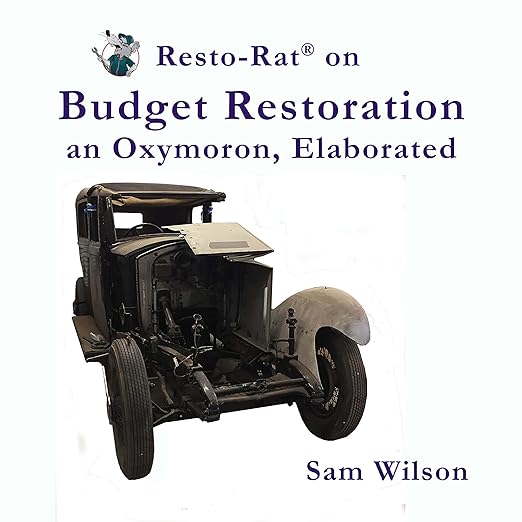
Resto-Rat on Budget Restoration arrives as an audiobook that earns its credibility in the first chapter and then keeps earning it for nine hours. Sam Wilson's central thesis, that the phrase budget restoration is, for most projects, a contradiction in terms, is not a click-bait provocation. It is the distilled judgment of fifty years of hands-on work across 33 projects totaling more than 13,000 hours of documented labor. That documentation matters. Wilson is not offering opinion; he is offering evidence.
The title itself signals the author's approach. A resto-rat is someone who lives in the shop, who cannot walk past a project without picking up a tool, whose relationship with vintage vehicles is compulsive rather than calculated. Wilson does not present himself as a detached consultant. He is a participant who has made the mistakes he is warning against, who has watched enthusiasts enter the hobby with unrealistic expectations and exit with depleted savings and unfinished projects, and who has decided that honest information serves the community better than enthusiasm.
The structure is methodical and well-sequenced. Wilson begins with project selection, the most consequential decision in any restoration, and makes a point that cuts against most hobbyist instincts: unless a project holds deep sentimental value or serves a specific purpose, pedigree, prominence, and provenance are the realistic paths to a profitable financial return. Emotional attachment to an interesting but obscure vehicle is a costly starting point. This is advice that will save some listeners significant money if they absorb it before committing to a project rather than after.
The OEM versus resto-mod debate is handled with genuine analytical depth. Wilson does not declare a winner, both approaches are legitimate, and both carry specific costs and complexities that he details carefully. The discussion of chassis rebuilding, engine building, and achieving show-quality paint addresses not just technique but the decision points around when to do the work in-house versus hiring professionals. The section on evaluating restoration shops and being a communicative client is practical information that most restoration guides skip entirely, and it reflects Wilson's understanding that most enthusiasts will eventually need professional help on at least some portion of a serious project.
Why Listen to Resto-Rat on Budget Restoration
Sam Wilson narrating his own material is the right choice for content of this nature. The technical specificity and the personal anecdotes that illustrate the book's arguments require a voice with evident ownership of the subject, and Wilson delivers that. The narration is direct rather than polished, this is a shop conversation, not a performance, and that quality suits the material well. Listeners will recognize the voice of someone who has spent decades in garages and auction houses rather than in recording studios, and the authenticity it carries compensates for any lack of conventional narration technique.
The 9 hours and 18 minutes runtime is well-calibrated for the scope of the material. Wilson covers project selection, chassis and engine work, paint, tooling requirements for a properly equipped shop, documentation strategies, and mentorship, a comprehensive pass through the full lifecycle of a restoration project. Each section has sufficient depth to be genuinely instructive without overstaying its welcome. A PDF companion is included with the audiobook, which is worth accessing for the equipment lists and workshop setup guidance that translate better to reference documents than to audio.
What to Watch For in Resto-Rat on Budget Restoration
The book's central message, that restoration almost always costs more than the finished vehicle is worth on the open market, will be familiar to anyone with experience in the hobby. For those listeners, the value is in Wilson's systematic documentation of where the overruns come from, which is more useful than the general warning. The chapters on provenance documentation and auction value optimization are particularly worth careful attention; the gap between a well-documented vehicle and a poorly-documented one of identical mechanical condition can be substantial.
Wilson's advocacy for mentorship and passing on skills to younger builders is one of the book's most engaging threads. The framing of restoration as a practice that preserves shared automotive heritage rather than merely a financial or hobbyist activity elevates the work's purpose beyond the transactional, and it reflects an understanding of why people restore vehicles that purely economic analyses miss. This dimension of the content gives the book a character it would otherwise lack.
Listeners without any prior exposure to automotive restoration should be aware that this is not an introductory text. Wilson assumes basic familiarity with vehicle terminology and the general arc of a restoration project. He is writing for enthusiasts who have at least considered a project seriously, not for people who are curious about the hobby at a surface level.
Who Should Listen to Resto-Rat on Budget Restoration
Experienced enthusiasts who are weighing their next project, or reconsidering one already underway, will find Wilson's financial and project-selection analysis genuinely valuable. First-time restorers who have not yet committed to a vehicle should treat this as required listening before writing any checks, the project-selection chapter alone may be worth the runtime. Classic car collectors interested in understanding how to document provenance effectively for auction purposes will find specific, actionable guidance.
Casual automotive readers looking for inspiring transformation stories should note that Wilson's approach is deliberately unsentimental about costs and complexity. The passion for the craft is evident throughout, but the book's purpose is clarity rather than inspiration. Download the PDF companion before starting to have the equipment and documentation references close to hand.
Does the Resto-Rat on Budget Restoration audiobook come with any supplementary materials given the technical subject matter?
Yes, a PDF companion is included with the audiobook. Given that the book covers workshop equipment requirements, tool lists, and documentation strategies that are easier to reference visually, downloading this companion before listening is advisable. It functions as a practical reference layer alongside the audio content.
How does Sam Wilson's self-narration in this audiobook affect the listening experience compared to a professional narrator?
Wilson narrating his own material adds direct credibility, the fifty years of experience he describes comes through in the voice, and the technical passages carry the authority of someone who has actually done the work. The delivery is direct rather than polished, which suits the shop-conversation tone of the content. Listeners expecting a conventional production finish should adjust expectations accordingly.