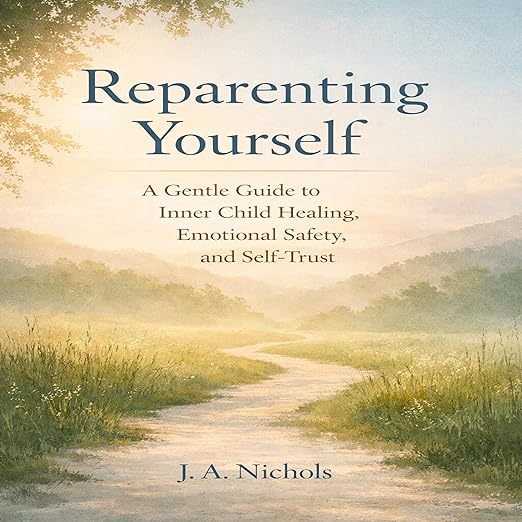
Reparenting Yourself arrived on my radar during a conversation with a reader who described it as the first audiobook on inner child healing that had not made her feel like a project requiring urgent repair. That framing, the book's active refusal to treat healing as a performance target, is what distinguishes J.A. Nichols's approach from a crowded field of self-help titles that claim gentleness while still operating on a productivity logic underneath the warm language. The distinction is worth paying attention to, because it shapes every structural and tonal decision in the audiobook.
The audiobook runs just over an hour, which is either a limitation or a kindness depending on your relationship to the subject matter. Nichols addresses this directly: this is not a workbook, a quick-fix program, or a clinical manual. It is positioned as a supportive companion for listeners who are already doing their best and are ready to stop pushing themselves toward healing and start allowing it. That distinction between pushing and allowing is the organizing premise of everything that follows, and Nichols has the discipline to stay inside it for the entire runtime without reverting to the urgency she has explicitly renounced.
Capable on the Outside, Unsure Within
The synopsis is specific about its intended reader in a way that earns notice: adults who appear capable on the outside but feel emotionally unsure, overwhelmed, or unsupported on the inside. This describes a recognizable formation, people who learned to be strong, independent, or responsible before they felt truly safe, and who carry the behavioral competence of that early adaptation while still running the emotional operating system of a child who never quite got what they needed. Nichols does not dramatize this or treat it as pathology. She names it clearly and moves forward without making the naming into an accusation.
The material covers inner child work without the jargon overload that makes some psychology-adjacent self-help inaccessible to general readers. The practical sections, on rest, boundaries, asking for help, shifting from self-criticism to compassionate inner guidance, are grounded and concrete rather than aspirational and vague. The audiobook does not promise transformation. It promises a steady path forward, one gentle step at a time, and it has the formal discipline to stay inside that promise rather than inflating it for marketing purposes.
Berger Avoids Both Patronizing and Clinical Tones
Narration tone is particularly loaded for self-help content about emotional safety. Voices that are too warm tip into patronizing. Voices that are too professional create clinical distance that undercuts the material's intent. Berger navigates this better than most. She reads at a pace that does not rush the listener past any single idea, and her voice carries the quality of someone who has actually sat with this material rather than simply performed it on the recording day.
At just over an hour, the narration does not have the time to outstay its welcome, and Berger makes the most of the concentrated format. There are no tonal lurches between sections, which is a real accomplishment in a genre where pacing shifts can undermine the cumulative effect of a gentle argument. The consistency of her register across the full runtime is itself an enactment of the book's central promise, that it will stay with you at the pace you need rather than accelerating past your capacity to absorb what it is offering.
One Hour Cannot Cover Seven Topics Deeply
The honest limitation of Reparenting Yourself is runtime. The seven areas it covers, understanding the inner child, why rest and boundaries feel unsafe, shifting from self-criticism to compassionate guidance, responding versus reacting, rebuilding self-trust, creating emotional safety, becoming a reliable presence for yourself, are each substantial enough to warrant a full chapter, and the book gives each one genuine attention. But an hour is not enough to do clinical depth on any of them individually, and listeners who arrive with significant trauma histories or who are in active therapeutic work will likely find the material useful as reinforcement or reframing rather than as a primary intervention.
That scope limitation is the book's stated position, and the positioning is honest. Reparenting Yourself does not oversell. For the listener who needs permission to stop treating their own healing as an efficiency problem, the hour asks exactly the right question in exactly the right register. The book's value is not in the quantity of what it delivers but in the quality of the stance it models, and that quality is present consistently across its brief runtime.
Matching the Reader's State Rather Than Covering More
There are longer treatments of inner child work in the self-help genre. Some of them are excellent and some of them replicate the same urgency and self-improvement pressure that Nichols is actively working against. The argument for Reparenting Yourself specifically is not that it covers more ground, but that it covers its ground in a way that matches the emotional state of its intended audience. A listener who is already overwhelmed does not need more overwhelm packaged as care. They need something that demonstrates through its own form that gentleness is a viable mode, not just a marketing claim but an actual operating principle. This audiobook does that, and it does it without apology for its brevity.
Listen if you recognize yourself in the description of someone who functions capably on the outside while feeling emotionally adrift on the inside. Listen if you want a compassionate introduction to inner child concepts that does not weaponize urgency against you. Skip if you are looking for clinical depth, structured exercises, or a workbook with measurable outcomes, this is deliberately not that, and the book tells you so before you begin.
The Short Version
- Narrator: Myriam Berger delivers the material with a gentle, grounded quality that suits the book's explicit intent as a supportive companion rather than a clinical guide
- Subjects: inner child healing, emotional safety, the gap between external competence and internal distress
- Tone: Soft, unhurried, and deliberately non-pressuring
- Bottom line: A short and compassionate listen for adults who feel emotionally unsupported despite appearing capable, honest about its scope and well-matched to its intended audience.