In Brief
- Narration: Dick Hill is the institutional voice of the Pendergast series, and his performance here builds directly on The Relic's foundation - his FBI agent Pendergast has the right combination of Southern aristocratic drawl and cold intelligence.
- Themes: Civilization's hidden infrastructure and what lives in it, obsession as both investigative asset and human flaw, the museum as a container for things that cannot be displayed
- Mood: Relentlessly atmospheric, building dread through physical descent and institutional pressure simultaneously
- Verdict: Reliquary delivers on the promise of The Relic by expanding both the underground geography and the returning ensemble while adding complications the first book could not have anticipated.
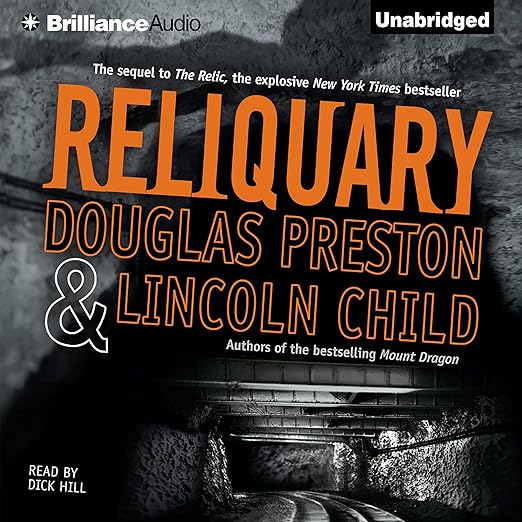
Margo Green returns in Reliquary, the second Pendergast novel from Douglas Preston and Lincoln Child, narrated by Dick Hill, and the audiobook opens by placing her back in exactly the wrong position: called in to help identify two grotesquely deformed skeletons found in the mud off the Manhattan shoreline, she is being drawn back into the orbit of something that almost killed her once already. At thirteen hours and forty-eight minutes, this audiobook gives Preston and Child the time to build their underground world with the density it requires, and Dick Hill gives that world its voice.
The great structural achievement of The Relic's sequel is the expansion of its geographic imagination. The first book was fundamentally contained: the Museum of Natural History, its collections, and the creature moving through its tunnels. Reliquary opens that container by moving the investigation into the tunnels, sewers, and forgotten galleries beneath Manhattan itself. The underground city that Preston and Child construct beneath the known city is not simply a setting; it is a complete social and biological ecosystem with its own logic, its own inhabitants, and its own dangers that compound rather than simply replace the threat from the first book. The deformed skeletons at the book's beginning are a symptom rather than a mystery, and the investigation's movement downward through layers of the city's forgotten infrastructure is one of the more imaginative thriller architectures in the genre.
Margo's return is handled with enough care that the audiobook functions independently for listeners who have not read The Relic. One reviewer confirms this explicitly: the book is a sequel of sorts but stands as its own independent novel. The relationship web between Margo, Lieutenant D'Agosta, FBI agent Pendergast, and Dr. Frock is sketched efficiently rather than requiring prior knowledge to engage with, though readers who have already spent time with these characters will find the reunion scenes carrying additional weight. Pendergast, who becomes the defining figure of the series, receives characterization here that clarifies the particular kind of brilliance and unsettling focus he brings to investigations. His presence in the tunnel sequences is one of the audiobook's narrative assets.
The black humor that surprised one reviewer is a genuine and consistent element of the book's tone rather than an accidental byproduct. Preston and Child have always understood that horror and dark comedy share structural DNA, and Reliquary exploits this connection throughout. The moments of levity do not undercut the dread; they intensify it by demonstrating how close the narrative is willing to come to absurdity while maintaining genuine stakes.
Why Listen to Reliquary
Dick Hill's narration is part of the Pendergast series' institutional identity, and his performance in this audiobook has the specific quality of a narrator who understands the world he is describing from the inside. The underground sequences are where Hill's voice work is most important: the audiobook must create the physical experience of moving through spaces that have no visual equivalent for most listeners, and Hill's measured delivery of the environmental description creates the atmospheric compression that those scenes require. His Pendergast voice, with its particular Southern formality deployed in contexts that make that formality strange, is one of the series' defining audio assets.
The ensemble dynamic across Margo, D'Agosta, and Pendergast also benefits from Hill's ability to differentiate voices without making the distinction theatrical. The investigation is a genuinely collaborative one in this audiobook, with each character bringing a different kind of knowledge to the problem, and the audio format makes those contributions feel like a team rather than a list of witness statements.
What to Watch For in Reliquary
The audiobook's management of the underground community that has formed in Manhattan's forgotten spaces is more substantive than the thriller framing requires. Preston and Child are interested in what happens to human social organization in spaces that official civilization has abandoned, and the inhabitants of the deep tunnels are not simply monsters or victims but a society with its own internal logic. That dimension of the book, present throughout but most explicit in the mid-audiobook sequences before the investigation descends into the deepest levels, rewards careful listening and distinguishes Reliquary from genre contemporaries that use underground settings purely as horror backdrop.
The twist that surprised several reviewers is genuinely well-constructed and recontextualizes earlier elements without violating the audiobook's internal logic. Listeners who attend to the specific details of the deformed skeletons in the opening sequences will find the mid-book reveal landing with more force than a casual listen would produce. The humor in that sequence, when it arrives, is so unexpected that it functions as a kind of pressure release that makes the subsequent horror more effective by contrast.
Who Should Listen to Reliquary
Readers already invested in the Pendergast series who want to hear how Preston and Child expanded their world after The Relic will find Reliquary the more ambitious and satisfying of the two early entries. Listeners new to the series can begin here, as reviewers confirm it stands independently, but the emotional payoff of the ensemble reunion is considerably stronger for those who have read The Relic first. Fans of atmospheric thriller fiction with genuine horror elements, particularly those who have enjoyed the intersection of institutional settings and physical horror, will find this audiobook a strong genre example. Listeners who want their thrillers to stay in familiar above-ground geography should approach with the understanding that the book is structurally committed to going underground and staying there.
Before You Listen
How much of this audiobook takes place underground, and does the setting become claustrophobic?
The investigation moves progressively deeper into Manhattan's underground tunnels as the audiobook advances, and Preston and Child deliberately build the claustrophobic pressure as a narrative tool. The setting is central to the book's horror architecture, not incidental.
Is Dick Hill's narration in this audiobook consistent with his performance in other Pendergast series entries?
Hill is the series' defining narrator, and his Pendergast voice is consistent across the volumes he has narrated. His performance in Reliquary has the settled authority of someone who has inhabited these characters across multiple entries.