Before You Press Play
- Narrator: Steven Randolph delivers clean, undramatic legal-nonfiction authority well suited to comparative regulatory material.
- Subjects: AI regulation across the EU, UK, and US, compliance strategy, the tension between innovation and oversight
- Tone: Practical and efficient, more reference briefing than narrative nonfiction
- Bottom line: A genuinely useful, efficient primer for anyone who needs working fluency across three AI regulatory regimes at once.
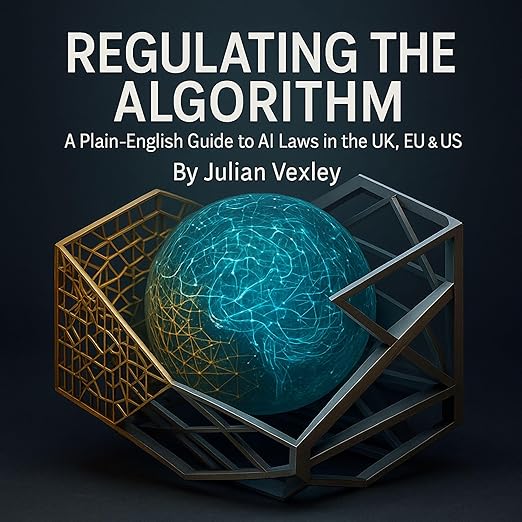
The European Union, the United Kingdom, and the United States are each writing their own rulebook for artificial intelligence at the same time, and Regulating the Algorithm exists to help business leaders, lawyers, and technologists stop guessing which one actually applies to them. Julian Vexley built this audiobook as a practitioner's map rather than an academic survey, covering the EU's risk-based AI Act, the UK's regulator-led approach, and the US's patchwork of executive orders and state laws in just two hours and forty-one minutes. Narrator Steven Randolph brings clean, no-nonsense legal-nonfiction delivery to material that could easily turn dry in less capable hands.
Randolph's Flat Delivery Fits a Comparative Structure
What distinguishes this from a general AI-anxiety book is its explicit refusal to pick a side in the regulation debate; Vexley's stated goal is helping readers 'comply without slowing innovation,' treating regulatory clarity as a practical business problem rather than a philosophical one. The book's structure mirrors that practicality, opening with why regulation is needed at all, bias, safety, deepfakes, privacy, IP disputes, security, liability, before mapping each jurisdiction's specific mechanics in turn, which gives listeners without a legal background a clear on-ramp before the more technical compliance material arrives.
The EU chapters carry real procedural depth: obligations across the AI lifecycle, conformity assessment, post-market monitoring, incident reporting, and penalties, giving compliance teams something closer to a checklist than a survey. The UK section takes a notably different approach, translating 'responsible innovation' into 'the day-to-day expectations of sector regulators' rather than a single omnibus law, while the US chapters decode a genuinely fragmented landscape of federal directives, agency guidance, and state-level rules on biometrics and automated decision systems. Randolph's flat, undramatic delivery is exactly right for this kind of comparative structure, letting listeners track which jurisdiction is under discussion without needing tonal cues to do it.
The EU's AI Act, formally entering into force in 2024 with obligations phasing in over the following several years, anchors the book's comparative structure, and Vexley's decision to walk through conformity assessment and post-market monitoring in detail reflects how genuinely procedural compliance with that law is, closer to product safety regulation than to a set of abstract ethical principles. Listeners without prior exposure to EU regulatory processes will find this section functions as a real crash course in how European compliance regimes work generally, not just how this one specific law operates.
Where the Regimes Overlap, Diverge, and Hide Grey Areas
The three-jurisdiction structure is the book's real value proposition, and it solves a genuine practical problem for anyone operating across borders: a compliance strategy built only around the EU AI Act will miss how differently the UK and US are approaching the same underlying risks, and vice versa. Vexley promises to show 'where the regimes overlap, where they diverge, and where the grey areas hide,' which is precisely the kind of cross-jurisdictional synthesis that is hard to find in single-country legal guides, and genuinely useful for founders, policy teams, and technologists working across more than one regulatory environment at once.
At under three hours, this is a remarkably efficient way to get oriented across three major regulatory regimes compared to reading three separate primers or wading through the source legislation directly. Randolph's plain-spoken delivery treats the listener as a competent professional who needs clear information rather than persuasion, which suits a book explicitly aimed at 'business leaders, policy teams, lawyers, technologists, founders,' a genuinely broad practitioner audience that benefits more from clarity than from rhetorical flourish.
The book's treatment of the real-world impacts grounding its argument, bias and discrimination, deepfakes and misinformation, security and export controls, liability, gives listeners a shared vocabulary for why each jurisdiction regulates the way it does, rather than presenting the three legal frameworks as arbitrary bureaucratic variation. Understanding that each jurisdiction chose its own regulatory philosophy, categorical risk tiers in one case, sector-specific oversight in another, a decentralized patchwork in the third, to solve the same underlying harms through different institutional traditions makes the comparative structure feel like a genuine argument rather than a dry checklist of differences.
Hard Prohibitions Get Buried Inside Procedural Chapters
No listener reviews are attached to this title yet, so this assessment leans more heavily on the synopsis and Randolph's general track record with legal and policy material than it would for a more widely reviewed book. Listeners should also know that AI regulation is a fast-moving target; a book this practitioner-focused is inherently more perishable than a history or memoir, and specific compliance details, especially around the fastest-changing US state-level rules, may drift out of date faster than the broader jurisdictional framework will.
This is also part of a broader Vexley series called The World of AI: Understanding Tomorrow, Today, though the entry number in that lineup is not specified here, so it is unclear whether this is the flagship title or one narrower installment within a larger planned set. Listeners looking for AI's technical or ethical dimensions rather than its legal and regulatory ones should also note this book stays tightly focused on law and compliance; anyone wanting a broader philosophical treatment of AI risk will need a different title entirely.
The synopsis also promises coverage of where regulators draw hard lines around unacceptable uses of AI outright, not just where they mandate disclosure or oversight, which is a meaningfully different and higher-stakes category of rule than the transparency and documentation requirements that make up much of the rest of the book. Listeners specifically trying to understand what is flatly prohibited, as opposed to merely regulated, should listen for those sections closely, since practitioner guides like this one often bury the hardest prohibitions inside broader procedural chapters rather than flagging them as a distinct category.
In-House Counsel Needs Fluency in Three Regimes
In-house counsel, compliance officers, founders operating across the EU, UK, and US, and policy professionals who need working fluency in all three regulatory frameworks are the obvious audience, along with technologists who want plain-language grounding in what these new rules actually require rather than a purely academic treatment of AI governance debates.
Anyone looking for a philosophical or technical deep dive into AI capabilities and risk, rather than the legal compliance landscape specifically, should look elsewhere, since this book stays disciplined about its practitioner-focused scope throughout. Given how quickly AI regulation continues to shift in all three jurisdictions, buyers should also treat the most granular state-level and agency-specific details as a snapshot rather than a permanent reference, and verify current rules directly before making major compliance decisions based on this book alone.
Does this audiobook cover AI regulation in the US, UK, and EU equally?
Yes, it dedicates dedicated chapters to each jurisdiction's approach, the EU's risk-based AI Act, the UK's regulator-led model, and the US's patchwork of executive orders and state laws, rather than favoring one system.
Is this audiobook useful for someone without a legal background?
The synopsis states it is written in plain language for founders and technologists as well as lawyers, and Steven Randolph's clear, jargon-light delivery supports that accessible framing.