Quick Take
- Narration: Nick Gallagher reads with calm, natural authority – exactly the right register for a book asking listeners to trust slow, invisible processes underground.
- Themes: Soil biology, working with rather than against nature, gardening as ecological act
- Mood: Quietly inspiring, practical without being dry
- Verdict: An accessible and genuinely well-structured introduction to regenerative principles for gardeners at any experience level.
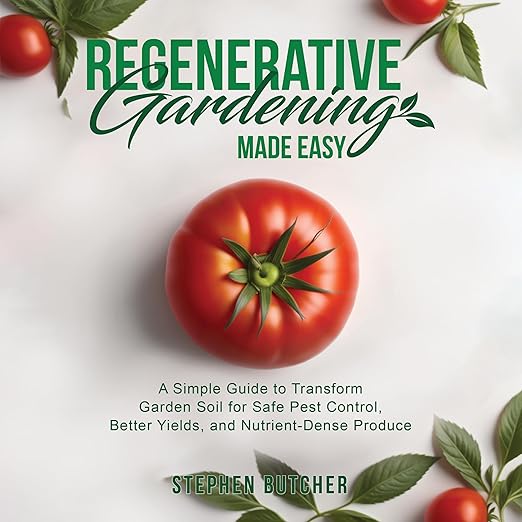
I came to Regenerative Gardening Made Easy at a specific moment: I had just killed my third attempt at a container herb garden and was starting to suspect the problem was not the plants but my entire approach to soil. I’d been treating the growing medium as a passive base rather than a living system, which, it turns out, was the root of every failure. Stephen Butcher’s book arrived in my library queue at exactly the right time.
The book opens with a comparison that I found unexpectedly striking: living soil, Butcher argues, has complexity on the order of astrophysics. That’s a big claim for something you track in from the backyard, but the analogy isn’t mere showmanship. The book’s central argument is that soil microorganisms operate in intricate, interdependent webs that conventional gardening methods disrupt rather than support, and that by reorienting toward those systems – through composting, thoughtful garden layout, and chemical-free pest management – the gardener gets a progressively stronger growing environment season after season.
Our Take on Regenerative Gardening Made Easy
What Butcher does well, and what separates this from a lot of gardening nonfiction, is his handling of the knowledge gap between beginner and advanced practitioner. An experienced gardener who reviewed this on Audible noted finding solid takeaways even without being the target audience, while the absence of glamorous photos is a minor limitation specific to the print edition. For the audio listener, that photo absence is irrelevant – the book translates naturally to the format because Butcher builds concepts through explanation rather than demonstration. The composting chapter, the pest management section, and the discussion of liquid fertilizer avoidance all work as pure audio because the logic is the point, not the image.
Why Listen to Regenerative Gardening Made Easy
Nick Gallagher’s narration is a strong match for this material. He reads with unhurried clarity and a conversational warmth that makes Butcher’s more technical passages feel approachable. Soil microbiology is genuinely complex subject matter – mycorrhizal networks, nitrogen cycling, microbial balance – and Gallagher never lets the science feel forbidding. His pacing gives listeners time to absorb concepts before the next one arrives. The runtime of just over five hours is well-calibrated for this scope: enough to be substantive, short enough to revisit seasonally as a reference listen before planting season.
What to Watch For in Regenerative Gardening Made Easy
The book is enthusiastic about its subject, and in places that enthusiasm tips into promotional language – the vision and map to a future framing in the synopsis is a fair warning about occasional excess. This doesn’t undermine the core instruction, but listeners looking for rigorous scientific sourcing and peer-reviewed citations will find the book more inspirational than academic. Butcher’s credentials, noted by one reviewer as genuine, come through in the practical advice. The conceptual claims about agriculture’s future are engaging but should be taken as argument rather than established fact.
The section on composting is where the book earns its title most fully. Butcher demystifies the process in a way that makes composting feel genuinely achievable rather than an aspirational practice for serious gardeners. His discussion of what goes into a healthy compost pile and why – the carbon-nitrogen balance, the role of moisture, the mechanics of microbial decomposition – is explained at exactly the right level of detail for someone starting from scratch.
What I appreciated most was Butcher’s insistence on patience as a gardening virtue. Regenerative gardening is explicitly a long game: the soil gets better each season, which means the first season is an investment in future harvests rather than an immediate return. That reframe – from transaction to relationship – is both philosophically interesting and practically useful for anyone who has felt frustrated by a garden that isn’t performing as expected.
Who Should Listen to Regenerative Gardening Made Easy
This audiobook suits beginning to intermediate home gardeners who are curious about organic and regenerative approaches but haven’t found a clear entry point. The practical focus on composting, pest management, and soil health means it’s immediately applicable – one reviewer who listened while actively planting cucumbers, tomatoes, brassicas, and peppers for the first time found the soil microbe information directly useful in the field. Experienced gardeners will find review value and possibly a few reframing concepts. Skip this one if you’re looking for a deep scientific treatment of soil biology – this is the accessible gateway book, not the graduate-level text.
Frequently Asked Questions
Does Regenerative Gardening Made Easy work as an audiobook, or does it rely on diagrams and photographs?
It works well in audio. The book is built around explanation and concept rather than visual demonstration. Nick Gallagher’s clear narration makes the technical sections on soil biology and composting accessible without needing to see accompanying images. One print reviewer noted the absence of photos as a limitation of that format, but for audio listeners, this is a non-issue.
Is this book suitable for gardeners who have never tried regenerative or organic methods before?
Yes, and that appears to be the primary intended audience. The Made Easy framing reflects genuine accessibility – Butcher introduces soil microbiology, composting methods, and chemical-free pest control in a way that assumes no prior knowledge. Reviewers who were complete gardening beginners found it practical and actionable.
How does Regenerative Gardening Made Easy differ from a standard organic gardening guide?
The distinction Butcher draws is between organic gardening (avoiding synthetic chemicals) and regenerative gardening (actively building and supporting soil biology). The regenerative approach focuses specifically on soil microorganism health as the foundation of everything else. The book argues that healthy soil compounds its benefits season over season, whereas conventional approaches can deplete soil biology over time.
Does the book address pest control specifically, or is it focused purely on soil health?
Pest control is addressed directly, and it’s positioned as a downstream benefit of healthy soil rather than a separate intervention. Butcher covers how robust plant health through living soil reduces vulnerability to pests, and he discusses specific non-chemical approaches. It’s integrated into the regenerative framework rather than treated as a standalone chapter.