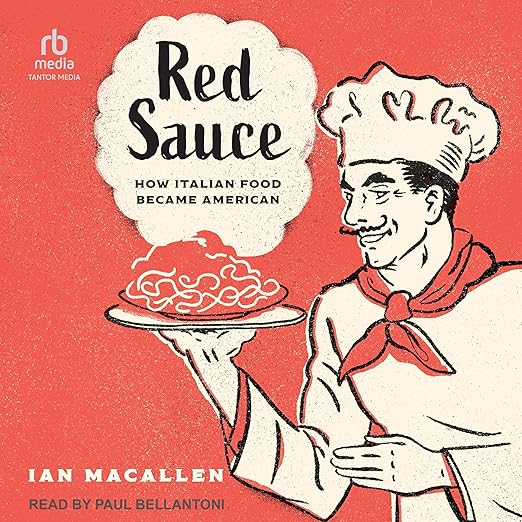
Quick Take
- Narration: Paul Bellantoni brings warmth and genuine affection to MacAllen’s food history, reading with the sensibility of someone who has eaten at every table being described.
- Themes: Italian-American culinary identity, immigrant assimilation through food, the invention of cuisine
- Mood: Warm, nostalgic, and intellectually curious
- Verdict: A generous and well-researched culinary history that reframes what it means for food to be authentic.
I started listening to Red Sauce on a Sunday afternoon while making a slow-cooked tomato sauce, which was either exactly right or too on-the-nose depending on your tolerance for that kind of coincidence. Ian MacAllen traces the full arc of Italian-American cuisine from the parlor restaurants of early twentieth-century immigrants to the red-checkered-tablecloth institutions of midcentury America to the casual dining chains that eventually absorbed and commodified the tradition. It is, unexpectedly, one of the most interesting immigration histories I have encountered disguised as food writing.
Paul Bellantoni narrates with the unhurried warmth the material deserves. This is not a book that benefits from urgency. It is a book about food as cultural memory, about dishes invented by people who were inventing themselves in a new country, and Bellantoni’s pacing honors that. He sounds like someone genuinely interested in what he is reading, which is the minimum you want in a narrator and the thing that surprisingly many fail to achieve.
Our Take on Red Sauce
MacAllen’s central insight is one that will reorganize several assumptions on first encounter: the Italian food most Americans love, spaghetti and meatballs, lobster fra Diavolo, veal parmigiana, pizza as most of the country knows it, is not Italian. It is Italian-American. It was invented or substantially transformed by immigrants from Southern Italy who arrived in America and adapted their food traditions to what was available and what their new neighbors would buy. The distinction matters because it complicates every conversation about culinary authenticity in a productively useful way.
A reviewer who grew up in New Jersey wrote that the book ripped apart the very notion of what it means for a cuisine to be authentic only to rebuild their perspective with a broader appreciation. That is an accurate account of the book’s effect. MacAllen is not debunking Italian-American food. He is elevating it by explaining its genuine origins as a creative, adaptive, specific cultural achievement rather than a diluted version of something purer.
Why Listen to Red Sauce
The story of Ettore Boiardi, who became Chef Boyardee, is one of the book’s best passages and a good test of whether the material will hold your interest. MacAllen takes what most people think of as a low-status brand and reveals the real person behind it: an immigrant chef who served Woodrow Wilson’s inaugural dinner at the Ritz-Carlton, then built a food manufacturing company that made Italian-American food accessible across the country during and after World War II. It is a genuinely remarkable story, and MacAllen tells it with the detail it deserves.
The audiobook runs 7 hours and 20 minutes, which is well-matched to the book’s scope. MacAllen covers pasta, pizza, veal, seafood dishes, and the rise and eventual standardization of the sit-down Italian-American restaurant without any section feeling rushed or padded. One reviewer flagged that roughly a third of the back pages in the print edition are notes and citations, but in audio that material is naturally condensed into the narrative flow, which actually benefits the listening experience.
What to Watch For in Red Sauce
The book is strongest when MacAllen is tracing specific dishes through their origin stories, and occasionally loses some momentum in the more broadly sociological middle chapters about assimilation and identity. Those chapters are intellectually interesting but feel slightly more academic compared to the vivid narrative of food itself. Push through them; the final third, which covers the rise of national chains and what was lost in the standardization of red sauce cuisine, is genuinely moving in a way that sneaks up on you.
The 4.2 rating with 34 reviews reflects a small but enthusiastic audience, and the minority negative review about too much filler and notes is almost certainly a print-edition grievance that does not translate to the audio format. This is a book that works better as a listen than as a read, precisely because Bellantoni keeps the pacing alive through the denser sections.
Who Should Listen to Red Sauce
Food history enthusiasts, Italian-American listeners who want their culinary heritage examined with real scholarly care, and anyone who has ever wondered why Italian food in America tastes so different from Italian food in Italy will find this deeply satisfying. It also works for readers interested in immigration history who want an unusual and concrete way into the subject. Those who want pure culinary instruction or recipes will need to look elsewhere; this is cultural history, not a cookbook supplement.
Frequently Asked Questions
Does Red Sauce cover Italian food beyond pasta and tomato-based dishes?
Yes. MacAllen covers pizza, seafood dishes like lobster fra Diavolo, veal preparations, and the broader restaurant culture that developed around Italian-American cuisine, not only tomato-sauce-based pasta dishes.
Is this book primarily about food or about immigration history?
Both, inseparably. MacAllen uses the evolution of Italian-American cuisine as a lens for examining immigrant assimilation, community formation, and the construction of ethnic identity in America. Neither subject dominates; they are braided throughout.
Do I need any specialized knowledge of Italian food history or Italian culture to follow the narrative?
None at all. MacAllen writes for a general American reader and provides context for all relevant Italian culinary traditions before tracing how they changed in the American context.
How does Paul Bellantoni handle the Italian words and phrases that appear throughout the text?
Bellantoni pronounces Italian terms with comfortable fluency rather than the stiff overcorrection that marks non-native narrators handling foreign vocabulary. It adds to the warmth of the listening experience.