Quick Take
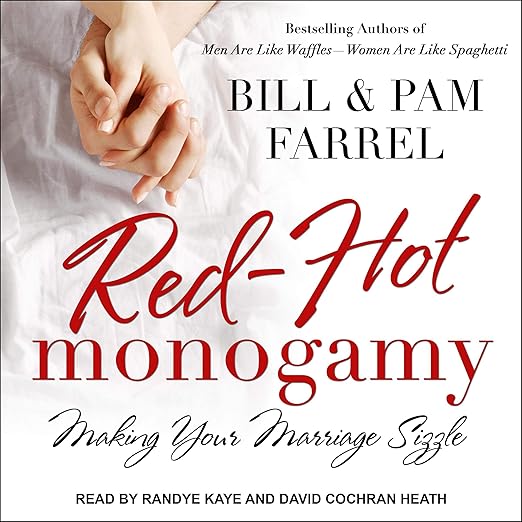
- Narration: David Cochran Heath handles this Christian marriage guide with the warmth and mild formality the material requires. He reads without irony or inappropriate levity, which is the right call for content that is simultaneously frank about sex and rooted in biblical faith.
- Themes: Long-term sexual intimacy in Christian marriage, emotional and physiological dimensions of desire, identifying and removing ‘pleasure thieves’
- Mood: Warm, encouraging, and faith-grounded, this reads as a friendly pastoral conversation about a subject many couples find difficult to discuss
- Verdict: Among the more balanced Christian marriage-and-sex guides available in audio, this works because Bill and Pam Farrel write with genuine humor and personal candor rather than clinical distance or moral lecturing.
I’ve listened to enough Christian marriage books to know that the genre spans a remarkable range from the genuinely thoughtful to the cringingly prescriptive. Red-Hot Monogamy lands considerably toward the former end. Bill and Pam Farrel have been writing about Christian marriage for decades, and the experience shows in how they handle the inherent difficulty of their topic: trying to discuss sex with candor and practical detail while maintaining a faith framework that many in their audience will hold very seriously. They manage this balance better than most.
The synposis promises trademark insight, humor, and candid personal perspectives, and those are delivered. The Farrels write from inside their own marriage, which gives the book a texture that purely theoretical guides lack. When they discuss emotional and physiological dynamics of sex, they’re not speaking abstractly; they’re speaking from a relationship that has apparently required exactly the kind of sustained attention they’re advocating. That personal grounding shows up in the writing and gets picked up well by David Cochran Heath’s narration.
The Fireworks Metaphor and What the Farrels Mean By It
The opening framework, sex is like fireworks, a little skill turns marriage into red-hot monogamy, is better developed than it first sounds. The book uses the metaphor to introduce the idea that sexual fulfillment is a craft, not a default. The default, the Farrels suggest, is for desire to gradually cool without deliberate maintenance. The fireworks metaphor is about the combination of chemistry and skill: what happens naturally is beautiful but brief; what you build together is what lasts.
This is not a novel insight, but the Farrels develop it with enough specificity to make it useful rather than merely motivational. The sections on what they call pleasure thieves, factors that steal the opportunity for sexual fulfillment in marriage, are the most practically valuable in the book. One reviewer who had been married sixteen years described using the book as a reboot, reading it with their spouse and discussing each section as they went. That use case is probably the ideal one: this is a better book to engage together than to absorb solo.
Faith Language and Universal Access
The Farrels describe their approach as presenting ‘biblical truths in universal language,’ which is an interesting formulation. The faith foundation is present throughout, there are references to God’s design for sex and to marriage as a covenant, but the practical content is delivered in language that doesn’t require extensive theological fluency to follow. One reviewer noted they’d skip the fantasy sections as inconsistent with their faith perspective while finding the overall book valuable. Another noted the book’s alignment with ‘God’s word’ as a primary positive. The faith framework is integrated rather than ornamental, but it doesn’t make the practical advice inaccessible to readers who hold it lightly.
David Cochran Heath reads the material with the warmth and stability it requires. He doesn’t bring comedy timing to the humor sections, which is probably right, the Farrels’ humor is dry and affectionate rather than joke-delivery, and Heath reads it with the same quality.
The Full Spectrum of Couples It Addresses
The synopsis explicitly addresses newlyweds through golden-anniversary celebrants, and the content does span that range. There are sections relevant to couples who are new to navigating sex together, sections for couples who have settled into routine and want to renew, and sections that address the physiological changes that come with age. The book is aware that ‘red-hot monogamy’ is a different challenge at year two than at year thirty, and it doesn’t flatten that difference. One reviewer preparing for marriage found the companion text The Act of Marriage useful first, then found this one deepened that foundation.
Who Should Listen and Who Should Skip
Listen if: you’re in a Christian marriage and want a candid, humorous, and practical guide to sustained sexual intimacy; you and your partner are willing to listen together and discuss; or you’re looking for a faith-based guide that doesn’t retreat from the practical dimensions of the subject.
Skip if: you want a secular guide, you’re uncomfortable with faith framing as a foundation for the advice, or you’re looking for explicit content rather than principled exploration within a biblical frame.
Frequently Asked Questions
Is Red-Hot Monogamy explicit, or does the faith framing keep the content modest?
It’s candid without being explicit in an erotica sense. The Farrels discuss sexual physiology, desire, and technique with specificity, but in the register of a trusted pastoral conversation rather than graphic description. One reviewer noted skipping the fantasy sections, which suggests some content will feel more comfortable for different readers; the core material is frank but not extreme.
Do you need to be a Christian to get value from this book?
The book is built on a Christian faith foundation and the Farrels don’t apologize for that. The practical content, communication about desire, maintaining intimacy over decades, identifying obstacles to fulfillment, is broadly applicable, but it’s delivered within a framework that treats biblical guidelines as authoritative. Non-religious listeners will encounter that framing throughout rather than just at the edges.
Is this better listened to as a couple or solo?
Reviewers describe the most satisfying experience as listening together and discussing as you go. The book is structured as a guide for married couples, not a solo self-help listen, and the exercises and discussion prompts implied throughout are designed for two people. Solo listening works, but misses what the content is actually designed to do.
Does David Cochran Heath’s narration work for co-authored material written by a husband and wife?
Heath narrates for both voices, which is the standard approach for a single-narrator audiobook of co-authored content. He distinguishes between the Farrels’ different contributions well enough, and the material doesn’t require dramatic character differentiation, it’s instructional writing rather than dialogue-heavy memoir.