Before You Press Play
- Performance: Suzie Althens reads with calm warmth - her tone matches the book's clinical empathy without feeling detached or overly therapeutic in register.
- What it covers: Emotional autonomy, boundary-setting, recovering selfhood from coercive family systems
- Feel: Compassionate and practically focused - less memoir, more workbook in audio form
- Our call: A genuine follow-up that builds actionable skills on the foundation the first book established - essential for anyone who worked through Adult Children of Emotionally Immature Parents and needed somewhere to go next.
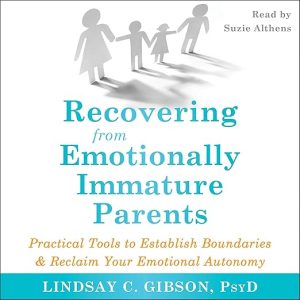
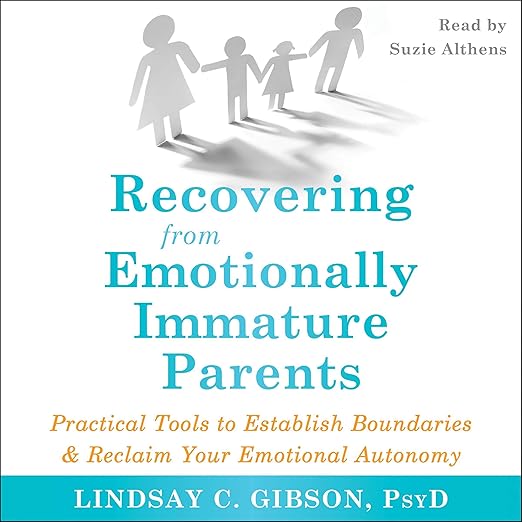
Lindsay Gibson's Adult Children of Emotionally Immature Parents has become one of the genuinely important self-help books of the past decade - not because it invented new therapeutic concepts, but because it named something precisely enough that readers who had spent years in and out of therapy suddenly found language for what they had been trying to describe. Recovering from Emotionally Immature Parents is the follow-up that readers of that book kept asking for. It shifts the frame from understanding what happened to developing practical skills for changing how things are.
I came to this book after recommending the first volume to several people over the years and repeatedly hearing the same frustration: the first book was clarifying and validating, but it left readers knowing more about their parents without knowing what to do about the relationship going forward. Gibson has written the second book to address exactly that gap. At seven hours and sixteen minutes, narrated by Suzie Althens, it is a practical guide rather than an explanatory text - focused on recognition, protection, and the recovery of what Gibson calls emotional autonomy.
How Recovering from Emotionally Immature Parents Holds Up
Gibson's category of emotionally immature is intentionally broad. She is not diagnosing parents with clinical precision - one reviewer notes approvingly that you do not really need to diagnose your bully or abuser to get out from under them, and that this book cuts through all the confusion and just calls them EIs. That simplification is a deliberate choice. The EI framework is useful precisely because it sidesteps the diagnostic rabbit holes - is she a narcissist, is he borderline - that can trap adult children in years of analysis without practical movement.
The book delivers on its promise of exercises and active tools. Reviewers describe concrete skills for recognizing the first signs of an emotional takeover - the moment when an EI parent's patterns pull you out of your own center - and for responding in ways that protect your emotional space without necessarily ending the relationship. That distinction matters: Gibson is not primarily advocating for no-contact, though she does not forbid it. Her project is emotional autonomy, which can coexist with an ongoing difficult relationship if the adult child learns to manage their own responses more deliberately.
Suzie Althens reads with the kind of calm authority that this material requires. Self-help audiobooks in the psychology space can go wrong in two directions: a narrator who sounds too clinical and detached, or one who sounds so warm and encouraging that the content feels soft. Althens navigates this balance well - she reads Gibson's prose with genuine care without infantilizing the listener or performing therapeutic sympathy. The effect is of a thoughtful person reading good material clearly, which is exactly right for content that requires the listener to think alongside the text rather than simply absorb it.
The format rewards audio specifically for the exercises. Being guided through reflective prompts in a narrator's voice has a different quality than reading them on a page - it is harder to skip past and easier to sit with. Several reviewers note the exercises as the most valuable part of this volume, more so than the explanatory content, which is largely covered in the first book.
Weak Spots in Recovering from Emotionally Immature Parents
One thoughtful reviewer identifies a genuine gap: the book provides substantial guidance on changing oneself to manage EI relationships better, but less validation for readers who are exhausted from that effort and considering no-contact. She felt there was a lot of information on how to change yourself to be with EIs, but not a lot of validation for someone who wants to stop trying. That is an honest criticism of scope. Gibson's model emphasizes emotional autonomy within relationship, and readers who have already decided that a relationship is not worth maintaining may find the frame less immediately applicable to their situation.
The book works best as a direct follow-on to Adult Children of Emotionally Immature Parents. Gibson builds on the vocabulary and framework established there, and while she provides sufficient context for the key concepts, readers who come in cold will benefit from starting with the first volume to fully absorb the second book's tools.
The Right Listener for Recovering from Emotionally Immature Parents
Anyone who found Adult Children of Emotionally Immature Parents clarifying and wanted a practical follow-on will find this the book they have been asking for. The exercises and active tools make it more workbook-like than the first volume, which suits listeners who are ready to move beyond diagnosis into change. Those who are currently in therapy and using the EI framework as part of that work will find the audio format useful for reinforcing the concepts between sessions. Readers who are considering no-contact and want explicit validation for that choice may find the book's emphasis on relationship navigation less suited to where they are. The broader principle that Gibson's insights apply to any emotionally immature person in one's life - not only parents - expands the book's usefulness well beyond its stated scope.
Common Questions
Do I need to read Adult Children of Emotionally Immature Parents before this one?
Gibson provides enough context to make the second book usable independently, but the practical tools in this volume build on the framework established in the first. Most reviewers who found both books valuable read them in sequence. Starting here is possible but less effective.
Does the book address the possibility of ending contact with an EI parent, or does it focus only on managing the relationship?
One reviewer specifically notes that the book emphasizes tools for maintaining emotional autonomy within relationship more than it validates the decision to cut contact. Gibson does not forbid no-contact, but her primary frame is managing one's own responses rather than ending the relationship.
How does Suzie Althens' narration handle the reflective exercises Gibson includes?
Reviewers find the narrated exercises effective - the audio format makes them harder to skip past and easier to sit with. Althens reads them with appropriate calm, which suits the self-reflective work they require.
Does the EI framework apply only to parental relationships, or does Gibson address other contexts?
Multiple reviewers note that Gibson explicitly addresses how the EI insights apply to any emotionally immature person in one's life - professional settings, religious communities, teams, and other family members. The parental focus is primary, but the framework extends naturally.