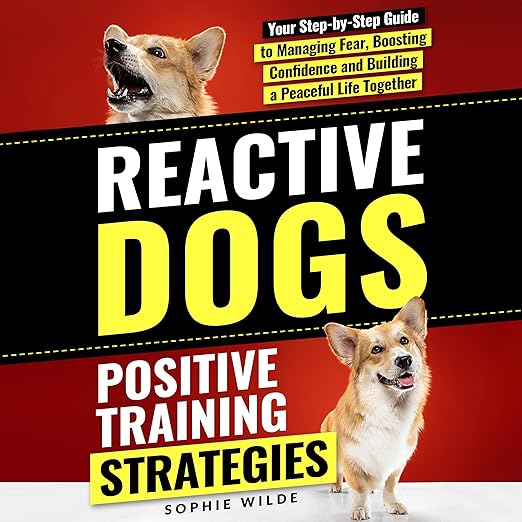
I don't have a reactive dog. I have a friend who does, and I spent an afternoon listening to her describe the experience of walking a dog who lunges at other dogs, the way it had shrunk her world to routes that avoided triggers, the social shame of other dog owners' reactions. She'd tried several training approaches and was starting to feel like the problem was her rather than a solvable behavioral pattern. I recommended she try this audiobook, and I listened to enough of it myself to understand why she found it useful.
Sophie Wilde's Reactive Dogs: Positive Training Strategies opens by naming the owner's experience, not just the dog's. The framing questions in the synopsis, are you tired of scanning the horizon for triggers? have you lost count of the training methods you've tried?, are not marketing copy, exactly. They're an acknowledgment that the person on the other end of the leash is also struggling, and that their anxiety and the dog's anxiety are in a feedback loop that needs to be addressed as a system rather than as two separate problems. That framing is the book's most important offering.
Named Techniques and Seventeen Hours of Rest
The behavioral science underlying Wilde's approach is sound. The emphasis on neuroplasticity, the argument that reactivity is not a permanent character trait but a learned pattern of response that can be reshaped through consistent new experience, is well-grounded in current behavioral research. The techniques the book introduces include TTouch, BAT (Behavior Adjustment Training), and LAT (Look at That), which reviewers appreciated being named specifically rather than discussed only in generic positive reinforcement terms. These are established, practitioner-developed methods with their own bodies of evidence and community, and identifying them gives listeners somewhere to go for deeper learning.
One reviewer noted a detail that I found genuinely interesting: dogs need approximately 17 hours of rest per day, and sniffing activities count as meaningful mental stimulation. These facts matter for reactive dogs specifically because management often focuses on exposure and desensitization without accounting for the cognitive exhaustion that over-stimulated dogs experience. Wilde builds the case that reducing arousal through adequate rest and appropriate mental engagement is part of the behavioral intervention, not separate from it.
Wade's Calm Delivery for Worn-Down Owners
Melinda Wade's narration is the right choice for this material. The target audience is anxious and often worn down, owners who have felt judged by strangers, let down by previous advice, and uncertain whether improvement is possible. Wade's delivery is calm without being detached, practical without being clinical. The nonjudgmental quality that multiple reviewers praised in the text itself is carried through in the narration in a way that makes the listening experience feel supportive rather than diagnostic.
At under 5 hours, this is a compact listen that could genuinely be absorbed in a single day. For a subject that often benefits from returning to ideas over multiple sessions, the length feels appropriate, detailed enough to be useful, short enough not to overwhelm the owner who is already managing a great deal.
Techniques Introduced, Success Stories Kept Brief
The book covers a wide range of reactivity triggers and behavioral management techniques, which is an asset in terms of comprehensiveness but means individual topics get limited depth. TTouch, BAT, and LAT are introduced rather than thoroughly instructed, listeners who want to implement these methods in detail will need to supplement with the dedicated resources each approach has developed. This is an orientation and framework book rather than a complete training manual.
The success stories referenced in the synopsis are motivationally useful but not the book's primary content. Listeners looking for detailed case studies will find them somewhat summary in treatment. The emotional comfort of knowing other dogs have recovered from severe reactivity is there, but the analytical detail of how those specific recoveries happened is not.
Early-Stage Help, Severe Cases Need More
Dog owners who are early in their experience with reactive behavior and need both conceptual grounding and practical starting points will find this genuinely helpful. The combination of behavioral science, specific named techniques, and attentive acknowledgment of the owner's emotional experience makes it a more rounded resource than many single-focus training guides.
Owners of dogs with severe aggression, complex trauma histories, or reactivity that has resulted in biting incidents may need resources beyond what this book offers, both in terms of professional in-person support and more specialized behavioral literature. Wilde is clear that this is a framework for management and gradual improvement, not a replacement for professional assessment in serious cases. That honesty is worth noting as a recommendation rather than a limitation.