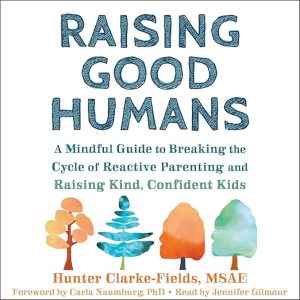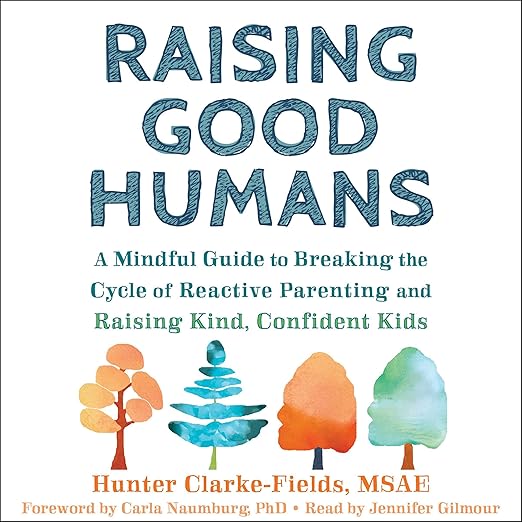
I do not have children, but I have spent enough time around parents who are struggling with reactive patterns to know what they are looking for in a parenting book: not judgment, not impossible standards, and not just theory. They want to know what to do at 7:30 in the morning when the school run is going wrong and everyone is running late and someone is crying. Hunter Clarke-Fields's Raising Good Humans understands this. It is a practically oriented book written by someone who teaches mindful parenting and has done the serious work of connecting meditation practice to the specific chaos of daily family life.
The book was published through New Harbinger Publications, which has a strong catalog in applied psychological self-help, and Jennifer Gilmour narrates the audiobook version at five hours and thirty-seven minutes. Tara Brach, whose endorsement opens the synopsis, describes it as a wise and fresh approach to mindful parenting. For listeners already familiar with Brach's work, that blurb locates the book accurately within a tradition of psychologically informed mindfulness practice applied to everyday life.
Autopilot Reactions Start With Your Own Parents
Clarke-Fields's central framing is that most parenting failures happen on autopilot. Parents yell, shut down, overreact, or disengage not because they have chosen to but because their stress response fires before their reflective capacity can engage. The book is organized around interrupting that cycle: building the capacity to pause between stimulus and response, and then using that pause to choose a different action with more intention and less reflexive reaction.
What distinguishes this from generic mindfulness advice is Clarke-Fields's attention to the generational dimension. She asks readers to examine where their own autopilot reactions came from, which typically means looking at how their own parents responded to stress and conflict. Breaking the cycle is presented not just as good parenting practice but as an act of intergenerational change. KJ Dell'Antonia's endorsement captures this precisely: to raise the children we hope to raise, we have to learn to become the person we hoped to be. That is a more demanding frame than most parenting books offer, and it is also a more honest and ultimately more useful one.
Meditation Made the Early Chapters Feel Unapproachable
One of the most honest reviews in this book's record comes from a reader with ADHD who noted that a solid chunk of the early material is on mindfulness practice, and that the book essentially says you have to be able to meditate to move forward with the rest of the content. She described this as making the book feel unapproachable, though she stuck it out and found the subsequent material valuable once that section was behind her.
This is a real tension in the mindful parenting genre. Clarke-Fields's approach is grounded in the assumption that parents can and will develop a regular mindfulness practice, because that practice is what builds the capacity to pause in the high-stress moments the book is designed to address. For parents who can integrate that practice, the payoff is real and the book delivers fully on its promise. For parents who find meditation genuinely inaccessible, whether due to neurodivergence, time constraints, or temperamental fit, the foundation of the approach may feel like an obstacle rather than a resource, and the book does not offer much of an alternative path forward.
Adults Are Mirrors to Their Children
Beyond the mindfulness foundation, Clarke-Fields covers respectful communication, conflict resolution, and reflective listening in ways that are practical and specific enough to apply directly. These sections draw on a tradition that includes Joanna Faber and Julie King's work, whose endorsement appears in the synopsis, and the communication tools Clarke-Fields offers are useful even for readers who engage less fully with the meditation components of the earlier chapters.
The book explicitly addresses the meltdown in the checkout line, the vegetable resistance at dinner, and the impossible school run morning. These specifics matter. Abstract parenting philosophy is easy to hold in theory and hard to apply under actual pressure. Clarke-Fields attempts the translation from principle to practice consistently, and reviewers noted this as a genuine strength. One reviewer described it as a good reminder that we as adults are mirrors to our children, which captures the feedback loop the book is trying to interrupt at its source rather than its symptoms.
Jennifer Gilmour's Warm, Unhurried, Even Pace
At under six hours, Raising Good Humans is one of the more accessible listens in the parenting self-help genre. Gilmour's narration reflects that accessibility: she reads as warm and unhurried, with the quality of someone explaining something she finds genuinely worth explaining. For a book that is asking readers to slow down and build self-awareness, the narration's even pace is itself a kind of modeling of the book's core practice. There is no urgency in Gilmour's delivery, which suits the material perfectly.
The audiobook format works well for parenting content because parents rarely have sustained reading time. The format allows the material to be absorbed in commutes, during nighttime feeds, or during exercise in a way that physical books rarely allow. One reviewer noted she would be reading it before the baby arrived, which suggests the book has found listeners at every stage of the parenting journey, from expectant through toddler years and beyond. Joanna Faber and Julie King's endorsement is apt: this is a book about parents learning alongside their children, and that spirit comes through in Gilmour's warm, undramatic performance throughout.
Questions Listeners Ask
Do I need an existing mindfulness practice to benefit from Raising Good Humans?
The book recommends building one, and one reviewer with ADHD noted that the early chapters present meditation as a prerequisite for the rest of the material. However, the communication and conflict resolution sections are practical enough to be useful independently. Listeners without a meditation practice will get less from the mindfulness sections but can still apply the parenting communication strategies throughout.
Is this book appropriate for parents of children of all ages, or does it target a specific developmental stage?
The book is primarily aimed at parents of young children, and one reviewer specifically recommended it for parents of one-to-three-year-olds. The examples and scenarios tend toward younger childhood. Parents of teenagers may find some of the material applicable but should expect the concrete examples to be more relevant to early childhood situations.
How does Jennifer Gilmour's narration handle both the instructional and more personally reflective passages?
Gilmour maintains a consistent warmth throughout both the instructional sections and the more personal passages about generational parenting patterns. She does not shift to a clinical tone for the practical strategies or an emotional tone for the deeper material. The consistency works for this book, where the line between technique and personal growth is intentionally blurred by the author's approach.
The synopsis mentions breaking generational patterns. How central is that intergenerational dimension to the book?
Quite central. Clarke-Fields asks readers to examine their own parents' reactive patterns and trace those patterns in their own behavior. This is not a sidebar but a core part of the book's framework: the idea that your autopilot reactions were shaped by how you were parented, and that changing them requires understanding where they came from. Reviewers responded to this dimension as one of the more valuable and honest aspects of the book.