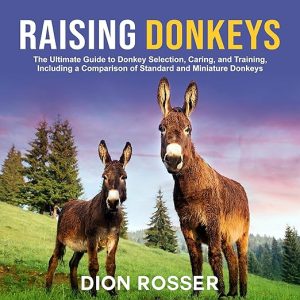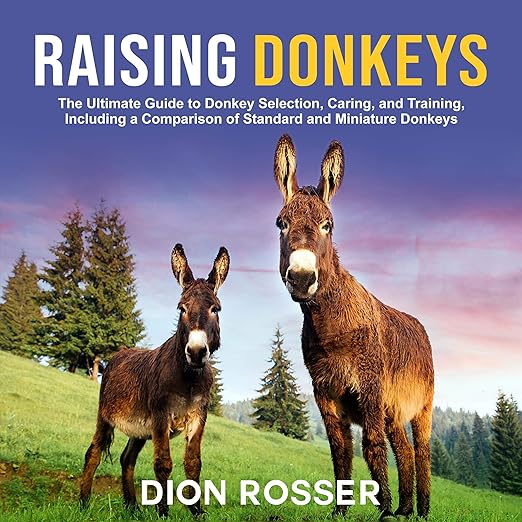
Raising Donkeys is part of the Raising Livestock series by Dion Rosser, and it does something rare for a practical animal care audiobook: it takes the donkey seriously as a subject. These animals have spent centuries being the butt of agricultural jokes while quietly serving as load-bearers, guard animals, and agricultural partners across the Silk Road and beyond. Rosser opens with the donkey's actual history, which is more interesting than most livestock primers bother to establish, before moving into the practical content that people who have come to this audiobook with a specific question, namely whether they should get a donkey and how to care for one if they do, will be looking for.
At just over three hours, this audiobook is a compressed but comprehensive guide. Rosser covers breeds, purchasing criteria, dietary needs, grooming, breeding, and the economics of donkey ownership, including the somewhat surprising section on donkey milk as a historical medicinal and cosmetic product. That last topic is a minor digression in terms of practical farming utility but illuminating as a signal of how underappreciated this animal has been in Western agricultural writing. The donkey's history as a working animal in cultures from ancient Egypt to medieval Europe is given enough space to make the practical sections feel grounded in something beyond a generic animal care template.
History Explains Why Donkeys Are Cautious
What Rosser gets right is the balance between historical context and practical utility. Many animal care guides either front-load too much history, which delays the information a prospective owner actually needs, or skip context entirely, which makes the care instructions feel disconnected from any understanding of the animal's nature. Rosser uses the historical material to explain why donkeys behave as they do, why their dietary needs differ from horses despite superficial similarities, why their social needs are specific, and why their reputation for stubbornness is a misread of their actual cognitive style. Donkeys are cautious rather than stubborn, an important distinction for anyone managing them.
The section on purchasing a healthy donkey is the most immediately practical for someone at the beginning of the process. Rosser covers what to look for in terms of conformation, temperament, and health indicators, and what the common pitfalls of buying an unsuitable animal look like. For first-time owners, this section alone justifies the runtime. The discussion of what not to feed donkeys is similarly concrete: donkeys metabolize certain common livestock feeds differently than horses do, and mistakes in this area can be genuinely dangerous. Rosser handles the dietary section with appropriate specificity rather than generic livestock feeding advice.
Busenius Guides Newcomers and Farm Owners Alike
Ivan Busenius narrates with a practical clarity that suits the instructional register of Rosser's writing. This is not literary nonfiction requiring interpretive performance. It is a how-to guide that benefits from a narrator who conveys information clearly and without embellishment, and Busenius delivers on that requirement. The pacing is even across the three-plus hours, and the organizational structure of the guide, moving from history to breed selection to care to economics, is followed consistently enough that listeners can mentally track where they are in the coverage without needing to pause and re-orient.
One reviewer with an existing farm noted buying this specifically to evaluate whether a donkey would be right for their property, finding the content useful and the information well-presented. Another reviewer came to the book as a complete newcomer to donkeys and found it taught them things they had not known to ask about. Those two testimonials together suggest the guide functions effectively across different levels of prior knowledge, which is the correct test for practical livestock literature.
Breadth Over Depth, with a Few Typos
The guide's ambition is breadth rather than depth. At three hours, it cannot provide the granular technical detail that an experienced veterinarian or donkey breeder would have. The breeding section in particular covers the fundamentals of donkey and mule reproduction without going deeply into the management of specific complications. For someone wanting a comprehensive breeding guide or a detailed reference on donkey health issues, this audiobook will function as an introduction that points toward additional resources rather than as a standalone technical manual.
One reviewer noted typos in the text that became audible as minor stumbles or awkward phrasing in the narration. This is a common artifact of self-published livestock guides produced at speed, and it surfaces occasionally in the audio without undermining the practical content. The information in those sections remains correct even where the sentence construction is imperfect. The reviewer who flagged this also noted that the information was straight to the point, which is an accurate description of Rosser's approach throughout: he is not a stylist, but he is informative and organized.
First Step for Anyone Considering a Donkey
Anyone who is seriously considering adding donkeys to a farm, smallholding, or rural property will find this audiobook a useful first step. It covers enough practical ground to help a prospective owner understand whether donkeys fit their setup, what the commitments involved look like, and what the economics of different ownership models might be. Existing small-scale livestock keepers who want to add donkeys specifically as guard animals for sheep or goats will find the relevant sections useful. Hobbyist farmers and homesteaders interested in the income potential of donkey breeding, milk, or companion animal sales will find Rosser's economics section informative at the introductory level. Listeners wanting a purely historical or cultural account of the donkey's role in human civilization should supplement with other sources, as the history here is a foundation for the practical content rather than the focus in itself.
Does the Raising Donkeys audiobook cover the financial side of keeping donkeys, including potential income streams?
Yes. Rosser includes a section on the economics of raising donkeys, covering breeding, milk production, companion animal sales, and other income models. This section is introductory in depth but gives prospective owners enough context to evaluate whether the economics could work for their situation.
Does the Raising Donkeys audiobook address donkeys as guard animals for other livestock?
Yes. The guide covers donkeys as guard animals for sheep and goats, which is one of their more common contemporary uses on small farms. This application is one of the reasons donkeys have seen renewed interest among smallholders, and Rosser explains the behavioral basis for their effectiveness in that role.