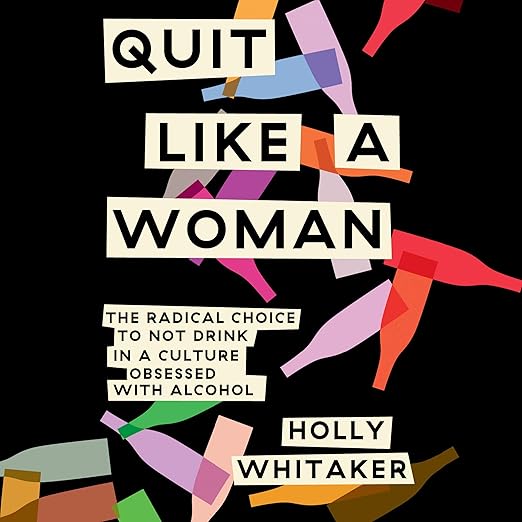
Holly Whitaker's voice in this audiobook carries something specific from the first minutes: the particular quality of someone who has worked through something genuinely difficult and is now, with enormous care, trying to pass the map back. Quit Like a Woman is a New York Times bestseller and, in Whitaker's own narration, it becomes something more than a recovery memoir. It becomes a real-time argument with the culture that made the problem as widespread as it is. I finished this one over two evenings, and I found myself pausing frequently, not because the material was hard to follow but because Whitaker's analysis of how alcohol functions in contemporary women's social lives kept landing harder than I expected.
Recovery Systems Weren't Built for Women
Whitaker founded the first female-focused recovery program after her own path to sobriety revealed something she could not ignore: the predominant systems of recovery in the United States were built on frameworks that did not fit the actual psychology and social circumstances of the women who needed them. Alcoholics Anonymous, she argues, asks people to surrender ego and yield to a male concept of God, a framework that simply does not map onto the experience of women and other historically marginalized people who need to cultivate a stronger sense of self rather than diminish it. That critique is not new, but Whitaker makes it with particular force because she grounds it in her own experience of trying to use those systems and finding them inadequate.
The book operates on two tracks simultaneously: personal memoir and cultural analysis. The memoir sections are sharp and often funny, with a self-awareness about the particular absurdities of high-functioning alcohol dependence that will be immediately recognizable to readers who have been there or watched someone they love navigate it. The cultural analysis sections are where the book becomes more ambitious and more demanding: Whitaker draws a direct parallel between the alcohol industry's targeting of women in recent decades and the tobacco industry's earlier success at marketing cigarettes to women, and the argument is both historically grounded and genuinely disturbing.
Whitaker Narrates Both Honesty and Wit
Whitaker self-narrates, and the choice is essential to the book's effect. The personal sections, which require a voice capable of holding both raw honesty and wry distance at once, are delivered with precisely that combination. She reads her own more difficult material with a lightness that communicates survival without minimizing what it cost. The cultural critique sections benefit from her evident conviction: this is not a narrator reciting analysis but a person arguing for something she believes has real consequences for real lives.
Reviewer LittleRedReading described the book as surpassing expectations, noting both the 'hilarious and incredibly engaging' tone and the way Whitaker puts together a feminist argument regarding alcohol. Reviewer TS described it as 'raw, honest, and insightful' and noted that it changed the way they approach life in general, well beyond the specific question of alcohol. A third reviewer stumbled onto Whitaker's blog after deciding to drink less and found the book resonated without requiring identification with the alcoholic label or with AA's framework. That breadth of audience is real and deliberate: Whitaker explicitly positions the book for anyone questioning their relationship with drinking, not only people in crisis.
Redefining Alcoholic as a Protective Myth
The book's feminist framework is central rather than incidental. Whitaker is not simply describing her personal recovery journey with some cultural context attached; she is arguing that alcohol dependence in women must be understood as shaped by systemic forces, including the deliberate marketing strategies of alcohol companies and the failure of existing recovery systems to address women's specific needs. Listeners who want a personal memoir without the political analysis will find the two are inseparable here.
At ten hours and eight minutes, this is a substantial audiobook that covers a lot of conceptual ground alongside the personal narrative. Some listeners may find the balance between memoir and cultural critique shifts in ways that feel uneven: the most personal sections are among the book's most affecting moments, and the transition into more extended policy or institutional analysis occasionally requires a recalibration of reading energy. That unevenness is worth knowing about, though the self-narration generally keeps the energy consistent even through denser analytical passages.
The book is not a twelve-step guide and does not provide a structured sobriety program, though it does describe the program Whitaker built. Readers looking for a step-by-step system will need to explore her organization's resources separately; the book is more about the argument for why a different approach is necessary than about the operational details of that approach.
One aspect of the audiobook that rewards attention is Whitaker's treatment of the word alcoholic itself and the cultural work it does. She argues that the binary between alcoholic and normal drinker functions to protect drinking culture rather than to identify and help people who are struggling. By defining problem drinking as something that happens only to other people, the category prevents many people who would benefit from changing their relationship with alcohol from recognizing themselves in it. That argument runs through the book and gives the memoir sections a political subtext that Whitaker's narration makes feel urgent rather than abstract.
Women Whose Frameworks for Drinking Don't Fit
This audiobook is most directly useful for women who are questioning their relationship with alcohol and find that existing frameworks for thinking about that relationship, including the alcoholic/not-alcoholic binary and the AA model, do not fit their experience. It is also valuable for people who care about someone in that situation and want to understand it better. The cultural analysis sections will resonate with listeners interested in the history of addiction treatment and in how the alcohol industry has shaped cultural norms around drinking. Readers looking for a purely personal recovery narrative may find the book's ambition larger than they expected, but Whitaker's wit and self-narration make even the more analytical sections highly listenable.
A Few Questions About Quit Like a Woman
Is this audiobook only for people who identify as alcoholics or who are in recovery?
No. Whitaker explicitly positions the book for anyone questioning their relationship with drinking, including people who drink more than they want to, people who are curious about sobriety without feeling in crisis, and people who have found the existing recovery frameworks do not speak to their experience.
How does Holly Whitaker's self-narration affect the audiobook experience?
It is essential to the book's effect. The personal sections require a voice that can hold raw honesty and wry distance simultaneously, and Whitaker achieves that balance consistently. The cultural critique sections benefit from her evident conviction, making the argument feel urgent rather than academic.
Does this audiobook offer a specific sobriety program or is it more of a conceptual argument?
More of a conceptual argument. The book makes the case for why existing recovery frameworks are inadequate for women and describes the approach Whitaker developed, but it is not a step-by-step program. Listeners looking for a structured system will need to explore additional resources.
Is the feminist framing central to this audiobook, or can it be read as a straightforward recovery memoir?
The feminist framework is inseparable from the book's argument. Whitaker treats alcohol dependence in women as shaped by deliberate industry marketing and by the failures of patriarchal recovery systems, making the cultural analysis as central as the personal narrative. The two tracks cannot be separated.