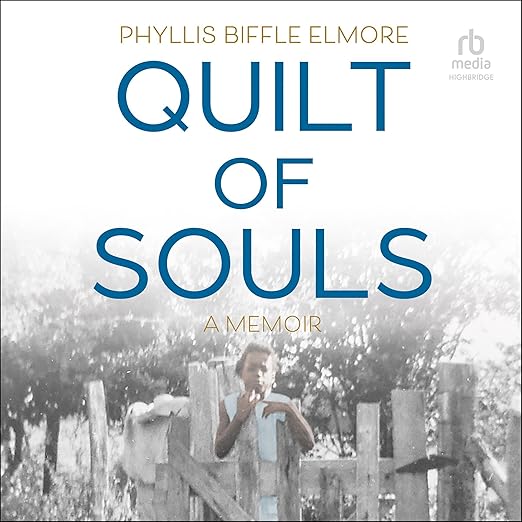
I started listening to Quilt of Souls on a Sunday evening without knowing much about it beyond the description, and I did not stop until it was finished. That sounds like promotion but it is just what happened. Phyllis Biffle Elmore's memoir does something that relatively few books accomplish: it makes the past feel genuinely present, not through the usual mechanisms of historical fiction or dramatized reconstruction, but through the direct line of oral testimony. The quilts at the center of this book are not metaphors. They are made from the actual clothing of the dead, and the stories Elmore's grandmother Lula Horn attached to each piece of fabric are recovered lives.
Elmore narrates her own memoir, which is the only possible choice for a book about oral tradition. The stories she tells are ones that came to her through her grandmother's voice, and hearing them delivered in Elmore's own voice closes that transmission loop. One reviewer who had quilted for forty years described encountering the concept of soul quilts for the first time in this book. Another found herself crying by the end. These responses are not manufactured. The book earns them.
Grandma Lula's Quilts Speak for the Unrecorded
The memoir's structure follows Elmore from her unexpected arrival at her grandmother's rural Alabama home at age four, dropped there by her mother in a moment that felt like abandonment, through the relationship that transformed her understanding of herself and her family's history. Grandma Lula is the book's animating force. She is an extraordinary character in the literary sense, meaning she is a real person rendered with the kind of specificity that makes her feel three-dimensional on the page. Her generosity of spirit, her strong will, her creative soul are Elmore's words, but the stories that follow make those qualities concrete rather than abstract.
The quilts themselves are a remarkable narrative device. Lula Horn quilted from the clothing of people who had died, making them for the families of the deceased. As she sewed, she told stories about whose clothing this was, what their lives had been, what they had endured and survived and built. This is oral history embedded in textile, and Elmore's memoir is an attempt to preserve that oral history before it disappears entirely. The people she describes, enslaved women, laundresses, healers, storytellers, women whose lives went undocumented in any official record, exist now because Lula Horn remembered them and Elmore wrote them down.
Elmore's Own Voice Carries Her Grandmother's Oral History
A reviewer describes it as American history, an important book, purchased on a friend's recommendation and impossible to set down despite needing to keep tissues close. Another calls it oral tradition written and preserved for posterity. Both of these responses point to what the audiobook format does specifically for this material: oral tradition belongs in oral form. Hearing these stories told, rather than reading them, feels appropriate in a way that goes beyond preference.
The historical scope of the memoir is considerable. Elmore's grandmother's stories reach back before and after the Civil War, through the stories preserved in the quilts. The women she describes are not famous. They are not in history books. Their preservation exists entirely through the memory that Lula Horn carried and transmitted through fabric and story. That act of transmission, and this audiobook's role in extending it, is genuinely moving.
A Nonlinear Memoir That Faces Colorism Head-On
This is a memoir in the truest sense, meaning it does not proceed in a straight chronological line. Elmore moves back and forth through time, piecing together her own story alongside the stories her grandmother told her. Some listeners may find this structure initially disorienting. It rewards patient attention rather than linear absorption.
The book does not soften its historical content. Stories of racism, sexism, and colorism are present throughout, rooted in the real experiences of real women whose lives intersected with some of the most brutal periods of American history. Readers who want difficult history treated honestly will find it here. Readers who prefer their historical content filtered through narrative distance may find some sections difficult to hear.
Recovered History for Listeners Who Embrace Nonlinear Memory
Readers interested in Black women's history, oral tradition, and the ways that craft and community serve as preservation mechanisms will find this essential. Anyone drawn to memoir that reaches beyond individual experience into historical recovery will connect deeply with what Elmore is doing here. Quilters who want to understand the deeper cultural and historical significance of the craft may find this book changes how they think about what they make.
Listeners who prefer tightly plotted narratives with clear structural arcs may find the memoir's associative, nonlinear movement difficult. But for readers who can settle into a different kind of storytelling, one that moves by memory and association rather than chronology, Quilt of Souls offers something uncommon: recovered history, told in the voice of someone who received it firsthand.
- Narrator: Phyllis Biffle Elmore narrates her own memoir, and the effect is irreplaceable, her grandmother's stories feel transmitted rather than performed.
- Subjects: Oral tradition and ancestral memory, racism and resilience, intergenerational Black womanhood
- Tone: Deeply moving and historically weighty, with warmth at its core
- Bottom line: A memoir that functions as recovered history, the oral tradition of Grandma Lula's quilt stories carries weight that no fictional narrative could replicate.
Does Elmore's self-narration work for an audiobook format?
Reviewers and listeners consistently find it essential rather than merely acceptable. The book is about oral tradition, stories passed from grandmother to granddaughter through the act of telling. Hearing Elmore deliver those stories herself restores the quality of transmission that the written page partially flattens. A third-party narrator would be a meaningful loss for this particular book.
What time period does Quilt of Souls cover?
The memoir moves between Elmore's own childhood in Detroit and her grandmother Lula Horn's rural Alabama home, and the historical stories reach back through the Civil War and into the lives of enslaved women and their descendants. The temporal scope is multigenerational, held together by the quilts Lula Horn made from the clothing of the dead.