Key Details
- Narrator: Patrick Kelly Shannon handles the lyrical, fragmented prose with quiet authority, maintaining atmosphere without overselling the philosophical weight.
- Subjects: Quantum mechanics as lens, observer effect, simulation theory
- Tone: Contemplative and atmospheric, more like a long essay than a science text
- Bottom line: A short philosophical meditation on quantum mechanics and simulation theory that is rich in atmosphere but light on evidence; suited to the intellectually curious rather than those seeking scientific rigor.
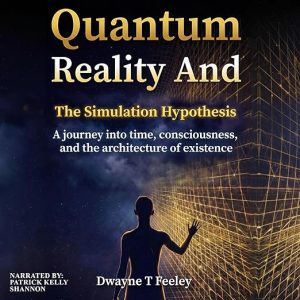
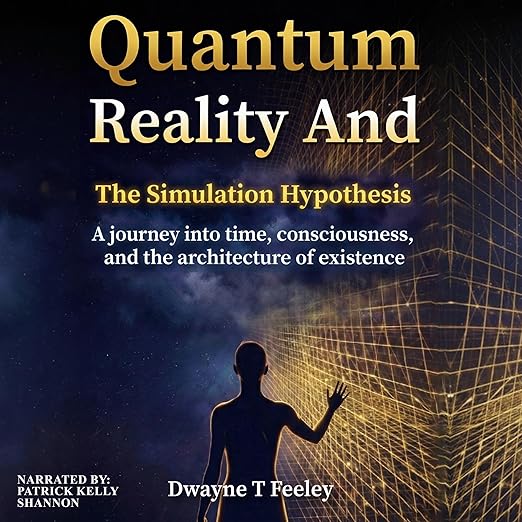
Dwayne T. Feeley's Quantum Reality and the Simulation Hypothesis, narrated by Patrick Kelly Shannon, announces its intentions clearly: this audiobook is not a textbook, and it is not making truth claims it can fully defend. At 1 hour and 9 minutes, it is a philosophical meditation on quantum phenomena that uses the double-slit experiment, quantum entanglement, and the observer effect as doorways into larger questions about consciousness, observation, and whether reality is the kind of thing that can exist independently of the mind that perceives it. Shannon reads this material with measured quiet, giving the fragmented prose the space it needs to accumulate meaning rather than rushing it toward conclusions it cannot reach.
The simulation hypothesis, associated most prominently with philosopher Nick Bostrom and physicist John Wheeler, is invoked throughout as the destination Feeley is building toward. But the approach is poetic and elliptical rather than analytical. Each chapter introduces a quantum concept, surrounds it with philosophical implication, and moves on. The text does not claim to offer answers, a promise it keeps consistently. Whether that restraint reads as intellectual honesty or evasiveness depends entirely on what you came looking for when you pressed play on this one-hour listen.
The writing style is the defining characteristic of this production, and your response to it will determine your response to the audiobook entirely. Feeley writes in short, declarative fragments that accumulate into an argument by implication rather than evidence. The structure is deliberately elliptical, which suits the subject matter in the sense that quantum mechanics genuinely resists the kind of clean linear explanation that popular science usually attempts. No one has fully explained how observation collapses a wave function, and Feeley at least does not pretend to have solved what physicists have not.
Shannon reads this material with restraint. He does not dramatize the more provocative claims or lean into the mystical undertone that less careful narration might. The result is an audiobook that serves the text without amplifying its weaknesses, which is the right call given how easily this material could tip into New Age territory if performed with uncritical enthusiasm. The two reviewers available at time of writing both gave five stars and cited the book as offering a key to deeper understanding, which suggests it is finding its intended audience: listeners open to philosophical speculation about the nature of reality who find the conventional popular science format too dry or too conclusive.
What Dwayne T. Feeley Gets Right
The strongest case for this audiobook is its brevity and its unusual formal approach. At just over an hour, it is not asking for a major time commitment, and the poetic prose style is genuinely well-suited to audio. Reading fragmented philosophical writing can feel halting on the page; hearing it read aloud with Shannon's measured cadence gives the fragments space to breathe and accumulate meaning in a way that silent reading might not produce. If you have read the standard popular treatments of quantum mechanics, Carlo Rovelli on the relational interpretation or Julian Barbour on timelessness, and found them stimulating but wanted something less lecture-like, this sits in a different and more impressionistic register.
The book functions more as a prompt for reflection than an argument to evaluate, and on those terms the audio format is close to ideal. The simulation hypothesis angle connects to broader cultural conversations about virtual reality, consciousness, and the limits of materialist science that have accelerated considerably since Bostrom's original formulation. Feeley does not engage with these debates in depth, but he frames questions in ways that open productive thinking for listeners already familiar with the terrain.
Where Dwayne T. Feeley Loses Some Ground
The scientific claims here need to be treated with care. Feeley invokes quantum phenomena accurately enough at the surface level but uses them to support metaphysical conclusions that most physicists would not endorse. The leap from observer effect in quantum mechanics to consciousness shaping reality, or from quantum nonlocality to a simulated universe, is a philosophical jump that the book does not fully defend. Listeners with strong science backgrounds may find the treatment superficial. Those without that background should supplement this audiobook with more rigorous sources before drawing conclusions about what quantum physics actually implies for the nature of reality.
The very short runtime also means that any specific topic is handled briefly. Entanglement, superposition, the simulation hypothesis, the nature of time: each receives a few minutes of poetic treatment rather than sustained examination. This is a deliberate feature for some listeners and an honest limitation for others, and the book's own framing acknowledges it by positioning itself as a key rather than a map of the territory it opens.
Who Should Pick Up Quantum Reality and the Simulation Hypothesis
This audiobook is for listeners who approach science and philosophy as adjacent territories and are comfortable sitting with open questions rather than resolved answers. It works as a short, atmospheric companion to more rigorous treatments of quantum mechanics or simulation theory rather than as a standalone education in either field. Those who need their science books to be empirically grounded and systematically argued should look elsewhere. Fans of meditative, idea-forward audio content who want something brief and stimulating will find it satisfying, and at just over an hour the time cost of trying it is negligible even if it does not land the way you hoped.
Good to Know
Is Quantum Reality and the Simulation Hypothesis audiobook suitable for someone with no background in physics?
Yes, the book does not assume any prior knowledge of physics. It uses quantum concepts as philosophical prompts rather than technical subjects, so the language remains accessible throughout. Listeners with a physics background may find the treatment too impressionistic, as the science is used poetically rather than rigorously.
How long is this audiobook, and is it a complete treatment of the simulation hypothesis?
The audiobook runs just 1 hour and 9 minutes, which means it functions as a philosophical meditation rather than a comprehensive examination. The simulation hypothesis is introduced as a frame but not rigorously analyzed. For deeper treatment of simulation theory, Bostrom's original paper or longer popular science treatments would be a better fit alongside this listen.
Is this audiobook making scientific claims or philosophical ones?
Philosophical ones, primarily. The book uses genuine quantum phenomena as a starting point but the conclusions drawn are speculative and metaphysical rather than scientific. It explicitly states it is offering a key rather than answers, which accurately characterizes the approach throughout.