![Quantum Physics for beginners Bible [2 Books in 1]](https://audiobookdaily.com/wp-content/uploads/2026/03/quantum-physics-for-beginners-bible-2-books-in-1.jpg)
Quick Take
- Performance: Virtual Voice narration delivers the text accurately but without the pedagogical instinct a skilled human narrator brings to complex science material. Functional but flat.
- What it covers: Wave-particle duality, quantum superposition, the uncertainty principle
- Feel: Structured and systematic, aimed at accessibility over depth
- Our call: A workable audio introduction to quantum fundamentals for absolute beginners, with the understanding that the Virtual Voice narration and the under-three-hour runtime define its ceiling.
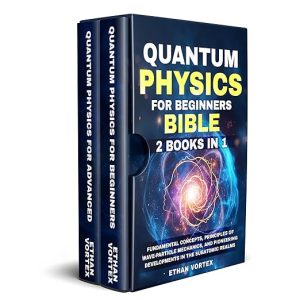
Ethan Vortex's Quantum Physics for beginners Bible [2 Books in 1] arrives as an audiobook with Virtual Voice narration at two hours and forty-four minutes. The package combines two volumes: one covering foundational quantum concepts for beginners, including wave-particle duality, the uncertainty principle, and quantum superposition, and one advancing into more complex territory including perturbation theory, group theory, and computational methods. That two-book structure is the collection's most significant design decision. It attempts to take a listener from zero familiarity with quantum mechanics all the way through vocabulary associated with graduate-level physics in under three hours. Whether that ambition matches what is actually delivered depends significantly on what the listener needs from a science audiobook and what they bring to it.
Is Quantum Physics for beginners Bible [2 Books in 1] Worth Your Time?
The core question for any introductory physics audiobook is whether the audio format can serve the content. For Vortex's collection, the answer is: adequately, for the purely conceptual material. Reviewers who came in as genuine beginners found the explanations accessible and helpful. One described it as "surprisingly helpful and informative," noting that it "breaks down the concepts of quantum physics into easy to follow lessons so that anyone with any education level can comprehend." That is a real accomplishment. Quantum superposition, the uncertainty principle, and wave-particle duality are among the most counterintuitive concepts in modern physics, and presenting them in audio without supporting diagrams or equations is a genuine pedagogical challenge. The collection handles this challenge adequately for the opening material.
Where the audiobook is less successful is in the "advanced" volume, which references perturbation theory, approximation methods, and group theory. These are mathematical frameworks that require working engagement with actual mathematics to learn rather than conceptual orientation. You cannot absorb perturbation theory from audio. What the collection can do, and does, is introduce the vocabulary, gesture at what these tools are used for, and give listeners a conceptual sketch of where the advanced territory lies. That has value as orientation rather than instruction. Reviewers who were already somewhat familiar with the subject found the material "easy to grasp" and appreciated learning things even in familiar territory, which points to the appropriate use case: this is a primer, not a textbook.
The Best Parts of Quantum Physics for beginners Bible [2 Books in 1]
For the right listener, someone with genuine curiosity about quantum physics and no prior exposure to the field, this collection offers a compressed, accessible entry point that costs under three hours. The Virtual Voice narration delivers the text accurately if without expressive sophistication. For factual science content where the information is carried in the words themselves rather than in tonal interpretation, AI narration is less problematic than it would be for narrative or emotionally textured material. The lack of equations in the audio, which is necessarily the case since mathematical notation does not survive audio format, means the conceptual explanations have to carry more weight than they would in a print text, and for the beginner volume at least, they largely succeed.
The two-volume structure gives the collection organizational logic. Listeners can stop after the beginner volume and have a coherent experience covering wave-particle duality, superposition, and the uncertainty principle, the three concepts that most popular physics writing returns to. The advanced volume is available for those who want to push further, with the understanding that the word "advanced" describes the territory rather than the depth of treatment. At under three hours total, the investment is low enough that listeners uncertain about the content can sample without meaningful risk.
Before You Commit to Quantum Physics for beginners Bible [2 Books in 1]
The ambition mismatch between the "advanced" framing and the actual runtime deserves honest acknowledgment. Perturbation theory and group theory are subjects that physicists spend semesters studying at the graduate level. A brief segment of a combined two-hour-forty-four-minute audiobook can introduce the vocabulary and sketch the context, including what these tools do and when physicists reach for them, but cannot deliver working understanding. Listeners who arrive expecting to understand advanced quantum mechanics will be disappointed. Those who arrive wanting orientation, a sense of what the landscape looks like and what terminology they will encounter if they pursue formal study, will find it useful. This is an important distinction to make before purchasing.
The Virtual Voice narration is the other factor worth noting plainly. AI-generated audio delivers the text accurately. What it lacks is the pedagogical instinct a skilled human narrator brings to complex material: the ability to adjust pace for a concept that requires more processing time, to emphasize the word in a sentence that carries the key distinction, to make the structure of a complex argument audible through vocal emphasis rather than purely through the words themselves. For listeners who find synthetic speech distracting, this will limit the experience significantly. For listeners who can engage with Virtual Voice narration without difficulty, the informational content is the same.
Should You Listen to Quantum Physics for beginners Bible [2 Books in 1]?
The best listener for this audiobook is someone with genuine curiosity about quantum physics and no prior background in the field, who wants a first pass at the conceptual landscape before investing in longer and more rigorous resources. Science communicators like Carlo Rovelli, Sean Carroll, or Brian Greene have written accessible accounts of quantum mechanics at book length and with considerably more depth. Those resources serve listeners who want genuine understanding rather than orientation. This collection is a starting point, not a destination, and it is most useful for listeners who know they are at the beginning and want to get their bearings before committing to something more demanding. The Virtual Voice narration and sub-three-hour runtime are the correct format for that specific purpose.
Questions Listeners Ask
Is this audiobook genuinely accessible to someone with no science background?
The beginner volume is designed for accessibility and achieves it reasonably well for the conceptual material. Reviewers with no prior physics background found the wave-particle duality and uncertainty principle explanations clear. The advanced volume introduces complex vocabulary without requiring the mathematics behind it, which is both its value and its limitation.
Does the Virtual Voice narration in this audiobook significantly affect the experience?
For factual science content, Virtual Voice narration is functional and delivers the text accurately. What it lacks is the pedagogical instinct a skilled human narrator brings: adjusting pace for difficult concepts, emphasizing key terms, and making an argument's structure audible through tone. Listeners sensitive to AI narration will notice the difference.
How does this audiobook handle the mathematical content of quantum physics?
It describes mathematical concepts including linear algebra, probability, and wave functions at a conceptual level rather than a working level. There are no equations read aloud, and the treatment is orienting rather than instructional. This is appropriate for a beginner audio format but means listeners seeking mathematical grounding will need supplementary resources.
Is this audiobook better as an introduction or as a review of material already studied?
Better as an introduction. Listeners with prior exposure to quantum concepts will likely find the beginner volume elementary and the advanced volume too brief to add significant value. The collection's design targets genuine newcomers. For review purposes, longer and more rigorous audio resources would be more appropriate.