Key Details
- Performance: Virtual Voice handles Ajit Singh's dense technical prose adequately, though listeners should expect the AI narration to flatten the nuanced emphasis that a human engineer narrator would bring to equations and implementation walkthroughs.
- What it covers: Quantum computing meets physical infrastructure, implementation-first engineering, capstone project design
- Feel: Dense and systematic, like sitting in on an advanced graduate lecture
- Our call: Engineering students and early-career developers looking for a structured audiobook introduction to quantum-linked cyber-physical systems will find Singh's implementation-first approach more accessible than most academic texts on the subject.
Seventy Percent of This Book Is Implementation
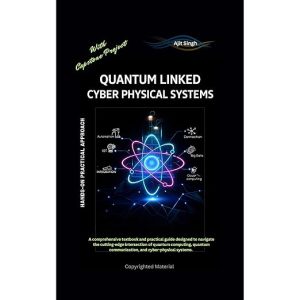
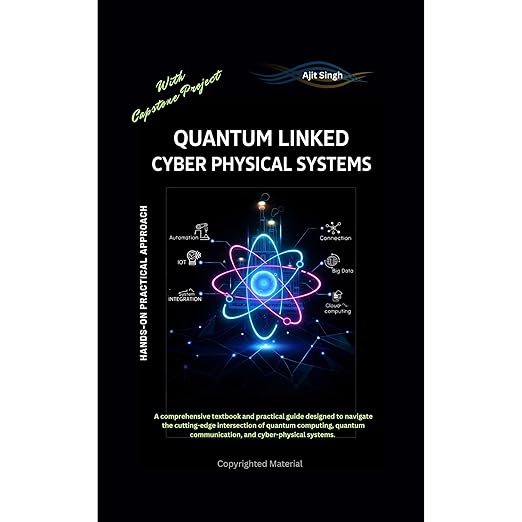
Ajit Singh's Quantum Linked Cyber Physical Systems arrives as one of the more ambitious engineering audiobooks in the AI-and-infrastructure category, covering a technical territory that most practitioners have barely begun to map. The audiobook, narrated by Virtual Voice across nearly nine hours, promises something genuinely unusual for a textbook: that over seventy percent of its content is dedicated to practical implementation rather than theoretical foundations. Whether that promise holds determines whether this will be worth nearly nine hours of focused listening.
Singh's core argument is that quantum mechanics becomes accessible not through mathematical density but through the active process of building. The guiding question throughout the text is not "What is it?" but "How do we build it?" That pedagogical shift, from theoretical derivation to engineering application, is what distinguishes this volume from the majority of quantum computing texts currently available in audio format, which tend to drown students in formalism before reaching anything that resembles a deployable system. This framing is not merely rhetorical: Singh structures each chapter so that a concept is introduced and immediately connected to a practical application, a simplified algorithm, or a concrete implementation detail.
Every Chapter Builds Toward a Smart Grid Capstone
The book is structured to serve B.Tech and M.Tech students in computer science and allied engineering disciplines, though its implementation-first philosophy makes it approachable for any developer with a working understanding of programming fundamentals who wants to understand where quantum technologies are heading in the cyber-physical space. Singh walks through quantum communication protocols, including QKD, quantum key distribution, which he frames as a practical security layer for cyber-physical networks rather than an abstract cryptographic novelty, and extends through quantum machine learning applications for anomaly detection in data streams.
The capstone project in the final chapter, a Quantum-Enhanced Secure Smart Grid Monitoring System, is the most instructive structural choice in the book. Building the entire arc around a concrete deliverable gives every preceding chapter a functional purpose. Students working through the audio will find that the intermediate chapters on quantum sensors, actuators, and simplified algorithms make more intuitive sense when they understand where those pieces are heading in the final build. The tools Singh references, including Qiskit and Cirq for quantum circuit simulation, are current and widely adopted, which means the skills translate directly to real-world environments rather than to academic abstractions.
For audio listeners specifically, the content's structure, each concept linked immediately to a practical application, is better suited to the medium than most academic engineering texts. Dense mathematical treatments, however rigorous, are nearly impossible to follow in audio without visual reference. Singh's decision to prioritize functional understanding over mathematical proof is the correct one for an audiobook format, and it shows in how the argument builds. The progression is clear enough that listeners can follow the arc without constant recourse to diagrams or equations.
Singh notes in the book's disclaimer that the Kindle edition is useful for a glance at visual reference materials. That note is honest and practical: certain implementation guides and code examples are better engaged with on the page. Treating this audiobook as a conceptual and architectural overview, with the Kindle edition as a companion for technical specifics, is the most effective listening strategy for serious students.
Singh also addresses the ethical and future-scope dimensions of deploying quantum technologies in critical infrastructure, a consideration that is increasingly relevant as quantum computing moves from research labs toward real-world deployment. The final chapter's treatment of security implications, regulatory challenges, and the societal impact of integrating quantum systems into power grids, healthcare infrastructure, and financial networks rounds out the curriculum in ways that make the audiobook useful for policy-adjacent roles as well as pure engineering.
Virtual Voice Cannot Inflect Load-Bearing Concepts
Virtual Voice narration presents a meaningful tradeoff for a text this technical. Singh's prose is precise and methodical, and the AI voice renders it reliably, but it cannot inflect in the ways that signal which concepts are load-bearing and which are supplementary. A skilled human narrator with engineering background would know when to slow down for a protocol definition, when to pause before an algorithm step, and when to carry through a conceptual explanation without interruption. Virtual Voice delivers the text at a uniform pace that works for explanatory passages but flattens the pedagogical rhythm that makes technical instruction effective.
Listeners should also be realistic about the scope of what nine hours can cover in a field this broad. QL-CPS sits at the intersection of quantum computing, communication protocols, and embedded physical systems, three disciplines that each take years to master individually. Singh's implementation-first approach necessarily simplifies the mathematical underpinnings, which is exactly the right call for an engineering-practice book but means that physicists or theoreticians looking for formal rigor will find this a starting point rather than a definitive reference.
Engineering Students Skip the Physics PhD Requirement
This audiobook is targeted squarely at senior undergraduate and postgraduate engineering students who want a structured, practical introduction to quantum-linked cyber-physical systems without needing a physics PhD to follow along. It will also serve software developers who are tracking the quantum computing space professionally and want a coherent framework for understanding how quantum technologies will integrate with the physical infrastructure they already build on. Researchers seeking formal mathematical treatment or physicists looking for theoretical depth should approach with adjusted expectations. The Virtual Voice narration is functional but not optimal for extended technical listening, so treating this as a supplementary study tool alongside the written edition is likely the best approach for anyone engaging with the material seriously.
A Few Questions About Quantum Linked Cyber Physical Systems
How does the Virtual Voice narration handle the technical terminology in this audiobook?
Virtual Voice renders the terminology accurately but without the inflection a human narrator would bring to complex technical passages. It is functional for following the argument but less effective at signaling which concepts are most critical. Pairing the audiobook with the Kindle edition is advisable for serious study.
What quantum tools and frameworks does the audiobook cover?
The book focuses on currently adopted simulation tools including Qiskit and Cirq for quantum circuit work, alongside quantum key distribution protocols and quantum machine learning concepts applied to cyber-physical data streams. The emphasis throughout is on tools that translate directly to real engineering environments.