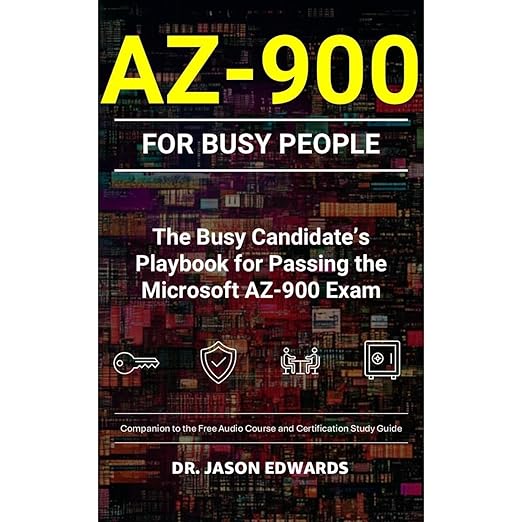
Busy people, says the title, and fourteen hours and forty-four minutes, says the runtime. That tension is the first thing to reckon with. AZ-900 is Microsoft's entry-level cloud certification, the one candidates sit before anything harder, and this audiobook spends longer on it than many people spend preparing for the paper altogether. Jason Edwards has written something thorough. Whether thorough was what a busy buyer wanted, or whether they wanted short, is a question the packaging and the product answer in different ways.
Fast Recall Beats Documentation Written to Be Scanned
Microsoft's fundamentals exam rewards recognition more than reasoning. You are asked to identify which service does what, which responsibilities sit with the provider, and which pricing lever applies, and the questions arrive in a house style that becomes predictable once you have seen enough of them. Edwards builds directly on that observation. The stated goal is fast recall during the exam, which is the right target, because almost nobody derives an answer about shared responsibility under time pressure; they either recognize the phrasing or they do not. A guide organized around recognition suits this particular test better than one organized around understanding.
Plain language is the promise, and it is the correct promise for the format, because the alternative in this subject is a wall of product names. The copy commits to explaining what Microsoft tests in words that support recall, not in the vendor's own documentation voice. That distinction matters enormously in audio. Documentation prose is written to be scanned, with meaning carried by headings, tables and bullet indentation, none of which survives being read out loud. A guide rewritten into sentences is a guide that can actually be listened to, and this one states outright that it has been.
Acronyms Are Where Synthetic Reading Mangles Phrases
Cloud service models and the split of responsibility between you and Microsoft head the list of what the book covers, followed by core Azure services and their uses, then identity, security, governance and compliance, then pricing, subscriptions and cost awareness. One further item is the interesting one: how to read a Microsoft-style question and eliminate distractors quickly. That is exam craft rather than cloud knowledge, and it is the part most candidates are missing. Six areas across nearly fifteen hours works out at something over two hours each, which is generous coverage for a fundamentals paper.
Text-to-speech handles this record. The reader field carries Virtual Voice, and on technical material that cuts in two directions at once. In its favor: the register stays flat and consistent, which suits a definition-heavy text, and a machine will not tire in hour eleven the way a person might. Against it: acronyms and product names are where synthetic reading most often mangles a phrase, and this subject consists of very little else. Anyone who has heard a system spell an acronym out in one sentence and pronounce it as a word in the next knows what to sample for.
Exam preparation in audio has one structural limitation that no amount of good writing repairs: you cannot practice on it. Recognizing question phrasing is a skill built by answering questions and seeing which distractor caught you, and that loop needs a screen. Nothing on this record mentions a companion document, a question bank or a downloadable summary. What a recording can do is the first pass, the stage where unfamiliar vocabulary turns familiar, and it can do that during hours you could not otherwise use. Paired with a practice engine, it earns its place easily.
Cloud Pricing Comparisons Need Columns to Compare
Series fields on this record are half filled. Bare Metal Cyber Study Guides is named and the position within it is blank, so a buyer cannot tell whether this is the first guide in the run, the tenth, or one of several covering unrelated certifications. For a study series that is not cosmetic: candidates want to know what else the same author has covered and in what order, and the listing hides it. The genre tagging is loose in the same way, filing a certification cram guide under computer science.
Tables, portal screens and architecture diagrams are how this subject is normally taught, and not one of them exists inside a recording. Cloud pricing in particular is a comparison problem, and comparisons live in columns. The copy never addresses how it handles that, and no supplementary document is mentioned anywhere. More significant still, nothing states which version of the exam objectives the material follows. Microsoft revises its fundamentals blueprints periodically, and a study guide carrying no date stamp on its content is asking the candidate to verify currency before trusting a single definition.
No grade of any kind sits on this listing. Not an average, not a count, and not one written sentence, on a title released at the end of January 2026. For a study guide that absence carries a particular cost, because the only review that really matters for exam prep is somebody reporting whether they passed. That is the single data point a candidate is shopping for, and this page cannot supply it. You are buying on the table of contents and on the author's stated approach, and on nothing else whatsoever.
Fourteen and Three Quarter Hours of Thorough Prep
Candidates who already hold a practice-question subscription and want something to run during a drive or a gym hour are the clear fit, along with anyone coming to Azure cold who wants vocabulary before opening a portal for the first time. Nearly fifteen hours suits a first pass across two or three weeks, which is roughly the preparation window this exam usually gets. A second run at increased speed works well too, since a definition-led text tolerates acceleration far better than narrative does, and most of the value on a repeat is reminder rather than explanation.
The wrong buyer here is the one who reads the title as a shortcut. Fourteen and three quarter hours is a thorough course, not a crib sheet, and anyone genuinely short of time will move faster through a written summary they can scan. Candidates who need to see the Azure portal, or who learn by clicking, will get very little from a voice describing an interface. And anyone who cannot tolerate synthetic reading across a long technical text should sample first, because at this length that decision is not a small one.
Before You Press Play
- What it covers: Azure fundamentals, shared responsibility, identity and governance, cloud pricing, exam question craft
- Feel: Even, methodical and vocabulary-first
- Our call: A generous first pass at a fundamentals exam, best paired with a practice engine and a screen.
Good to Know
Can this audiobook alone get me through the AZ-900?
For the knowledge, plausibly. For the exam technique, no. The copy promises coverage of every domain the paper tests plus advice on reading Microsoft's question style, but spotting a distractor is a skill you build by answering questions and getting them wrong. Use this for concepts and something interactive for drilling.
Is nearly fifteen hours too much audiobook for a fundamentals paper?
It is generous rather than excessive, provided you treat it as a first pass. Two or three weeks of daily travel covers the whole thing comfortably. A second run at higher speed a few days before the test works well too, since the material is definition-led and holds up under acceleration far better than a story would.
Does the recording come with any written material?
Nothing on the record mentions a supplement of any kind: no summary, no diagram set and no question bank. That matters for cost comparisons and service tables, which are normally taught in columns. Expect to build your own notes, or to keep the official learning path open on a screen beside it.
Is the content current for the exam as it stands today?
Impossible to confirm from this page. No objective version, revision date or blueprint reference appears on the listing, and Microsoft refreshes its fundamentals syllabus periodically. Check the published skills outline against the contents before relying on the coverage, particularly around pricing and the names of individual services.