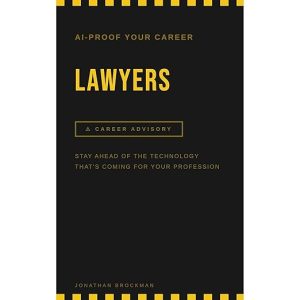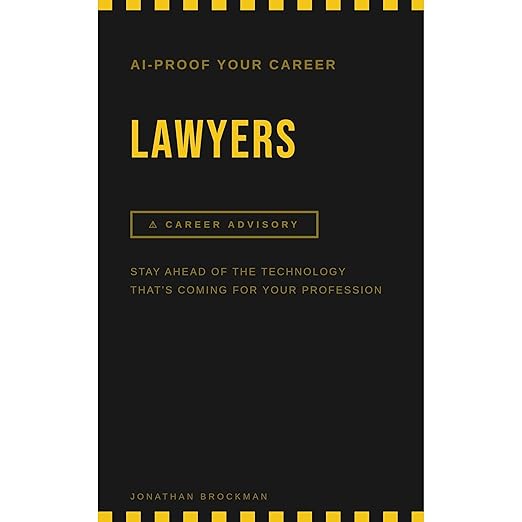
Billable hours are the unit of account inside a law firm and the unit of exposure inside this audiobook, which is why it opens with figures instead of an argument. A tool drafting memoranda at 94.8 percent accuracy. Case law searched in seconds for $110 a month. AI Proof Your Career: Lawyers is the fourth entry in its series, it runs two hours and forty-nine minutes, and every structural decision in it serves one purpose, which is to make a specific listener uncomfortable enough to move before somebody else moves on their behalf.
Brockman's central device is the Automation Line, and it is a better organizing idea than most career books manage. Instead of asking whether artificial intelligence will affect legal practice, the book sorts an actual billable day into work sitting above the line and work sitting below it, then runs the arithmetic. A fifth-year associate billing 2,000 hours is told that roughly 1,300 of those hours are contested territory, which the copy converts into $455,000 of annual revenue attributable to work a tool now performs in a fraction of the time. Precision at that resolution is either clarifying or destabilizing, and the book is not neutral about which reaction it is going for.
Where the approach gets genuinely useful is the sub-role breakdown. Exposure is mapped separately for the junior associate, the mid-level, the senior associate, the equity partner, in-house counsel, the government lawyer and the solo practitioner, each with its own set of next moves. That granularity is rare in this category. Most treatments of the subject address a generic professional and leave you to work out whether the advice applies to somebody four years into document review or somebody with an equity stake and a book of business to defend. Those two positions face almost nothing in common, and the book knows it.
Numbers do most of the persuading here. Goldman Sachs is cited for the estimate that 44 percent of legal tasks and 74 percent of billable hours spent on research and analysis are automatable right now. Baker McKenzie is cited for cutting between 700 and 1,000 positions in early 2026 with AI named as the primary driver. A 2,000-document review drops from $14,000 to $1,400. A five-hour research assignment drops to one hour. Whether every figure survives scrutiny is not something a listener can check in the middle of a chapter, which is worth saying plainly about a book leaning this hard on its citations.
No Credential Exists Yet for AI Law Governance
Copy-paste prompts are advertised as the headline deliverable, tested against real legal workflows and supplied for case law research, contract risk review, deposition preparation, client communications and brief drafting. In audio you cannot copy or paste anything at all. That is the structural problem this particular format has with this particular book, and it is less fatal than expensive: you will be pausing, rewinding and typing, or you will be treating the prompts as a demonstration of what good legal prompting looks like instead of as templates ready for the next assignment that lands on your desk.
Beyond the defensive material, the second half is the more interesting half. Seven niches are named where lawyers command premium rates, among them data privacy and cybersecurity at $950,000 to $2.2 million at partner level, and AI law and governance, which produces the sharpest observation in the whole run: no credential exists yet, so the early movers become the credential. Compensation gets the same flat treatment. Corporate M&A partners averaging $1.92 million against employment and labor partners at $929,000 in the same firm tier is a fact with career consequences attached, and the book states it without cushioning.
AI Cannot Be Admitted to the Bar
Nobody has said a word about this one in public. The listing carries no rating, no grade count and no written response, five months after a March 2026 release, which means every observation above comes from publisher copy and from what the structure of the book implies. That is a thin evidence base for a title asking you to make consequential decisions about your own career, and it is the first thing a buyer should know. The silence is not a verdict against the book. It does mean you are the test case rather than the beneficiary of somebody else's.
Legal technology dates faster than almost any other subject, and this book is pinned hard to one moment. Tool pricing, accuracy percentages, headcount decisions at a named firm, a count of lawyers sanctioned for filing AI-generated briefs without verifying the citations: all of it reads as accurate for early 2026 and all of it will drift. The underlying argument is more durable than its evidence, because the accountability floor the book identifies does not move. AI cannot be admitted to the bar, and somebody licensed still signs the filing and stakes a career on its contents.
Forty-Nine Minutes of Dollar Figures by Ear
Associates in the exposed years are the obvious buyers, particularly anyone whose week is document review and who has not yet been handed a reason to treat that as a problem. Solo practitioners get real value as well, since the pitch aimed at them is competing on research quality with firms ten times their size. In-house counsel dealing with a CFO who has begun asking what the legal department does that a $300-a-month tool cannot will find the exposure map and the adjacent-career section both pointed squarely in their direction.
Partners with an established book of business will find less that is new, though the compensation spread and the niche analysis earn their place. Anybody hoping for a technical education in how these systems actually work should look elsewhere, since this is legal-market economics with no interest in explaining a model architecture. The synthetic reading is the real format cost: two hours and forty-nine minutes of dollar figures, percentages and firm names is a lot of specific data to absorb by ear whatever the voice, so treat the audio as reconnaissance and buy the text if you intend to run the plays.
Key Details
- Big ideas: automation exposure inside the billable hour, repositioning before the firm decides for you, the accountability floor a law license still provides
- Atmosphere: Cold, numerate and deliberately unsettling
- Worth it?: The most legally specific entry in this series and genuinely useful to exposed associates, though the prompts it sells are the one deliverable audio handles worst.
A Few Questions About AI Proof Your Career: Lawyers
Do you need the earlier AI Proof Your Career audiobooks before this one?
No. This is the fourth entry and the listing gives it a volume number, but the analysis is self-contained and built entirely around legal practice: the sub-roles, the billing math and the niche list all assume a law firm. Nothing in the copy asks you to recall an argument from a previous volume.
Is this audiobook written for practicing attorneys or for law students choosing a path?
Practicing attorneys, unmistakably. The framing assumes you already bill hours and already have a position worth defending, and the exposure map runs from junior associate up to equity partner. A student can still take the market picture from it, but the urgency is written for people already inside a firm and already carrying a target.
Does the audiobook tell you what to say at work, or only what to worry about?
It supplies language. One advertised deliverable is a word-for-word script for pitching a managing partner on a new practice direction, timed for your next performance review, and the closing instruction is to run a time audit on your own billable day first. The book cares more about that conversation than about your anxiety.