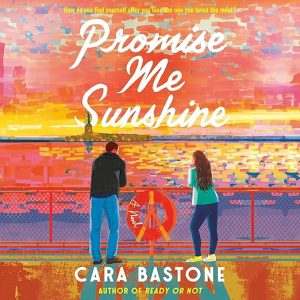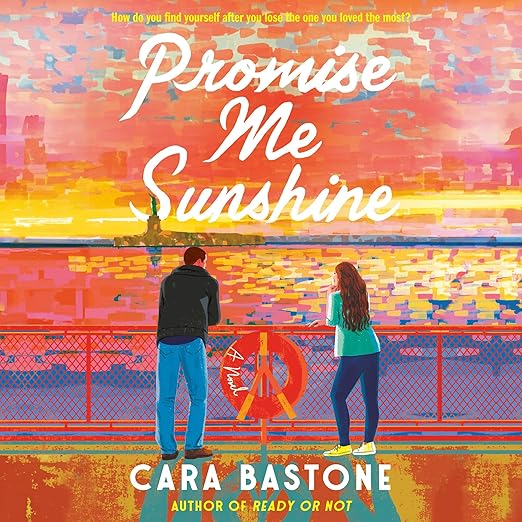
- Read by: Alex Finke handles Lenny's grieving narration with a restraint that serves the slow-burn pacing well, keeping the emotional temperature calibrated rather than letting the loss dominate every scene.
- At its heart: grief and the specific loneliness of losing a best friend, the 'live again' list as structure for healing, unexpected connection as intervention
- Vibe: Tender and unhurried, with stretches of gentle humor that keep the grief from becoming oppressive
- Short version: Cara Bastone's NPR and Elle best-of-year romance earns its accolades through the precision of Lenny and Miles as characters, not just their emotional arc.
Lenny is avoiding three things: her concerned parents, the apartment she shared with her best friend who died of cancer, and a laminated list of things she promised to do to survive her grief. Cara Bastone's Promise Me Sunshine, narrated by Alex Finke across 11 hours and 11 minutes, opens in that specific emotional territory, not the acute early phase of loss but the weeks-into-months phase where functioning is possible but meaning is not, where the mechanisms of daily life run but the motivation to run them has gone quiet. Finke establishes this register from the first pages and holds it with enough precision that the runtime never feels like a long wait for something to happen. This audiobook is, among other things, a romance about what happens inside a person before anyone else shows up, and that inside space is where it does its best work.
The central structural device, the laminated 'live again' list that Lenny has been avoiding, is the kind of narrative mechanism that collapses under scrutiny if the character who carries it is not specific enough to make it feel necessary rather than convenient. Bastone makes Lenny specific enough. Her avoidance of the list is not passive; she is actively constructing an alternative self that looks fine from the outside, landing temporary babysitting gigs, maintaining enough surface-level function to deflect her parents' concern. The list is not a to-do registry of personal-growth tasks; it is evidence of a promise she made to her friend before she died, which means completing it is simultaneously an act of love and an act of grief that Lenny is not ready for. That distinction is everything, and Bastone never lets it soften into something more comfortable.
Miles, the uncle of Lenny's babysitting charge Ainsley, is introduced as difficult before he is introduced as perceptive, which is the right order. He is grumpy in the specific way of someone who has himself learned something about loss rather than in the generic romance-hero way of someone who simply needs softening. His offer, he will help Lenny complete the list if she will help him connect with Ainsley and navigate his complicated relationship with Ainsley's mother Reese, gives the slow burn a transactional quality that keeps it from becoming purely atmospheric. Reviewer Devin's description of Lenny and Miles as 'funny and relatable and genuine' identifies the key quality: both characters have their own specific register rather than generic romance-protagonist voice, and Finke renders both with the clarity that distinction requires.
Why Promise Me Sunshine Works as an Audiobook
This audiobook holds two things simultaneously that romance fiction often struggles to keep in balance: genuine romantic investment and genuine grief work. The best friend who died is not a plot device; she is a presence throughout the audiobook, remembered through specific objects, specific habits, specific jokes that Lenny can no longer share with anyone because no one else was in the room for them. Bastone does not resolve the grief by the time the romance concludes; she shows Lenny finding a way to carry it differently, which is a more honest treatment of long-term bereavement than the healing-through-love arc that genre default would suggest. That honesty is the reason the audiobook appeared on NPR, Elle, Library Journal, and the New York Public Library's best-of-year lists simultaneously.
Alex Finke's narration serves this quality directly. She plays Lenny's surface competence as genuine rather than as a mask, which means the moments when the competence cracks feel like revelations rather than breakdowns on cue. Her handling of the comedy in the early relationship with Miles, the late-night ferry rides and midnight ramen sessions that are also somehow standoffs, is equally well-calibrated. She commits to Lenny's exasperation before she commits to her attraction, and the slow transition between those states is where the audiobook's emotional intelligence lives. The Ainsley character, Reese's precocious daughter who links Lenny and Miles, is given her own perspective and her own needs by Bastone, and Finke handles the Lenny-Ainsley scenes with warmth that matches but does not overpower the adult relationships around them.
Weak Spots in Promise Me Sunshine
The slow burn is genuinely slow. Multiple reviews note the pacing, and it is worth flagging for listeners who expect romantic tension to build steadily toward a midpoint escalation: this audiobook defers that escalation consistently, letting emotional intimacy develop well ahead of romantic acknowledgment. That patience is the book's formal commitment and not a flaw, but listeners who prefer tighter romantic pacing should know the timeline before they commit 11 hours to it.
The domestic structure of the story, Lenny's babysitting arrangement creating the daily rhythm within which the romance develops, is more carefully constructed than it initially appears. The repetition of ordinary caretaking tasks is not padding; it is the mechanism through which Lenny slowly re-inhabits her own life rather than performing it. Bastone understands that grief recovery is not a series of dramatic breakthroughs but an accumulation of ordinary moments that eventually add up to something different from where you started, and Finke's narration gives every one of those ordinary moments its proper weight without letting the accumulation become monotonous.
The Right Listener for Promise Me Sunshine
Readers of contemporary romance who want genuine emotional substance rather than trope execution will find this audiobook worth the commitment. The grief content is handled with enough specificity that listeners who have lost a close friend will recognize it rather than find it approximate. The slow burn pacing rewards patience and makes the payoff land with the weight it has been building toward across eleven hours. Skip it if you need faster romantic acceleration or if you are not in the right emotional space for grief-adjacent fiction; this one earns its tenderness honestly, which means it asks something in return. The Dial Delights label suggests a connected series, but Promise Me Sunshine is fully standalone and requires no prior reading.
Questions Listeners Ask
Is Promise Me Sunshine a sad audiobook or does it lean toward the romantic comedy end of the spectrum?
Both, in proportions that shift as the story progresses. The grief content is genuine and specific, but Bastone builds in enough comic warmth, particularly in Lenny and Miles's early antagonism, that the overall tone is tender rather than heavy.
How slow is the slow burn in this audiobook?
Very slow by genre standards. Romantic acknowledgment is consistently deferred in favor of emotional intimacy and grief work. Listeners who prefer tighter romantic pacing should know this upfront; listeners who love slow burns will find it deeply satisfying.
Does Alex Finke's narration serve the grief-focused first-person perspective well in this audiobook?
Yes. Finke plays Lenny's surface competence as genuine rather than as a mask, which means the cracks in that competence register as revelations. Her handling of the comedy in the relationship with Miles is equally well-calibrated throughout.
Is this audiobook part of a series and do you need background reading to follow it?
Promise Me Sunshine is listed under the Dial Delights imprint, but it functions as a fully standalone story. All characters, relationships, and emotional backstory are established within the audiobook itself.