Quick Take
- Narration: Andrea Jean delivers a clean, professional reading that suits the primer format, though the short runtime means there is little room to establish distinctive character.
- Themes: AI integration in project workflows, prompt engineering for PM tasks, lifecycle management
- Mood: Brisk and practical, designed to be absorbed in a single commute
- Verdict: A useful orientation for project managers curious about ChatGPT, though its brevity leaves most scenarios at the surface rather than the solution level.
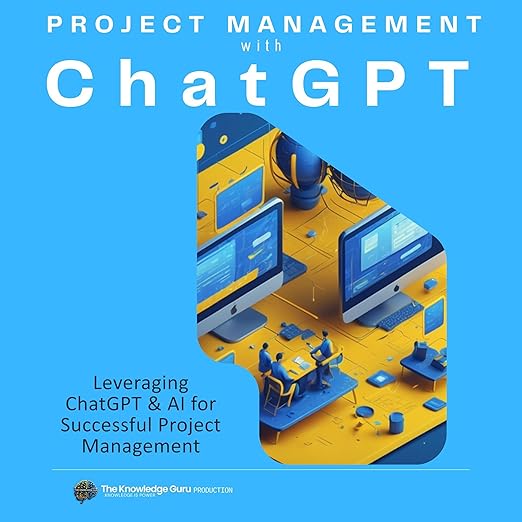
I finished this one on a Tuesday morning commute, which is exactly the right context for it. At just under two hours, Project Management with ChatGPT by Clement Pereira is not asking for a significant investment of your time. It arrives with a defined promise: show project managers, at a practical level, how ChatGPT can integrate into the parts of their job that feel most repetitive. That is a fair and potentially useful promise. Whether the execution delivers on it depends a great deal on what you already know about both project management and AI.
Andrea Jean narrates with a professional composure that suits the material. There is no warmth or personality layered in, but the content does not call for it. This is a dense primer, not a narrative. Jean moves through the chapters at a consistent pace that makes the runtime feel appropriate rather than truncated, which is a real skill given that two hours is not a lot of space for the scope being attempted.
What the Book Actually Covers
The structure follows the project management lifecycle: planning, risk management, team communication, task prioritization, monitoring, and execution. For each phase, Pereira introduces how ChatGPT can be used, typically with example prompts or output scenarios. The approach is sensible, and the framing throughout is clear. Reviewer Catherine called it “very practical” and pointed specifically to the step-by-step demonstration of how ChatGPT can improve planning and risk assessment. That is an accurate characterization. The book is organized and readable, and Pereira writes with someone who clearly uses these tools in mind.
The limitation, which reviewer Peter Jackson identified with precision, is that the examples stay in the safe zone. A ChatGPT prompt that helps you draft a status report is genuinely useful. A ChatGPT scenario involving a project that has gone off the rails, where the real judgment calls happen, is absent. This is not a fatal flaw in a book this short, but it means the listener walks away with a foundation rather than a toolkit. The theoretical concepts are introduced solidly; the difficult situations are not explored.
The Shelf-Life Question
Any book that anchors its practical value to a specific AI tool version faces an inherent problem, and Project Management with ChatGPT is no exception. The ChatGPT landscape has shifted significantly since many of these guides were written. Prompt examples that demonstrate what was novel in one version may now be baseline behavior, and the specific interfaces Pereira describes may have changed. Listeners should treat the prompt strategies as illustrative rather than literal, and expect to adapt them to whatever version or equivalent tool they are actually using. This is not a criticism of the book’s research so much as a structural condition of the genre.
What ages better is the underlying framework: the idea that AI tools can slot into the communication overhead of project management, specifically the drafting, summarizing, and status-reporting tasks that consume attention without generating insight. That argument holds regardless of which specific tool you use, and Pereira makes it coherently within the runtime he has.
Who This Is For and Who It Is Not
The audience for this book is a project manager who has been wondering how colleagues are using ChatGPT but has not yet experimented systematically. For that person, the two-hour investment maps comfortably onto a commute or a lunch break, and the payoff is a clearer mental model of where to start. Reviewer Greg Wonk captured this dynamic: the book identified specific use cases he had not previously considered, which changed how he approached his daily work. That is a real outcome.
For experienced AI practitioners or project managers who have already integrated tools into their workflows, the material will feel introductory. For those specifically looking for guidance on crisis scenarios, stakeholder conflict, or the edge cases where human judgment is hardest to replicate, the book does not go there. And for anyone who needs a tool that will still be directly applicable in two years, the specificity of ChatGPT references may create more revision work than the book saves. At under two hours, it earns its listen as an orientation. As a definitive reference, it asks more patience than it delivers depth.
Frequently Asked Questions
Is this book suitable for project managers with no prior AI or ChatGPT experience?
Yes, that is clearly its target audience. Pereira does not assume familiarity with prompt engineering or AI terminology, and the lifecycle structure means someone coming in with only project management knowledge can follow along without prior AI context.
At under two hours, does the audiobook feel rushed or incomplete?
It feels deliberately scoped rather than rushed. The chapters are short but organized, and Andrea Jean’s pacing prevents the runtime from feeling compressed. That said, the brevity means most scenarios are introduced but not developed to a problem-solving level.
Do the ChatGPT-specific examples risk becoming outdated quickly?
Yes, this is a real concern. Prompt strategies and interface descriptions tied to a specific version of ChatGPT can feel dated within months of publication. The underlying PM framework ages better, but listeners should treat the AI-specific content as illustrative rather than a current how-to guide.
How does this compare to Paul Clapis’s Project Management in the Age of AI, also in this space?
Clapis’s book is longer (over six hours) and positions itself as a broader strategic and ethical guide to AI in project management, including failure modes and organizational change. Pereira’s is narrower, faster, and more tool-specific. They address the same audience from different angles and can complement each other.