Quick Take
- Narration: Virtual Voice handles the six-plus hours adequately for a text-heavy, bullet-organized guide, though the ethical challenge sections feel tonally flattened by synthetic delivery.
- Themes: AI literacy for project managers, failure modes of AI projects, ethical governance
- Mood: Strategically optimistic with a realistic edge, like a good pre-mortem session
- Verdict: The most substantive project management and AI crossover audiobook in this space, with enough ethical and organizational depth to outlast the tool-specific sections.
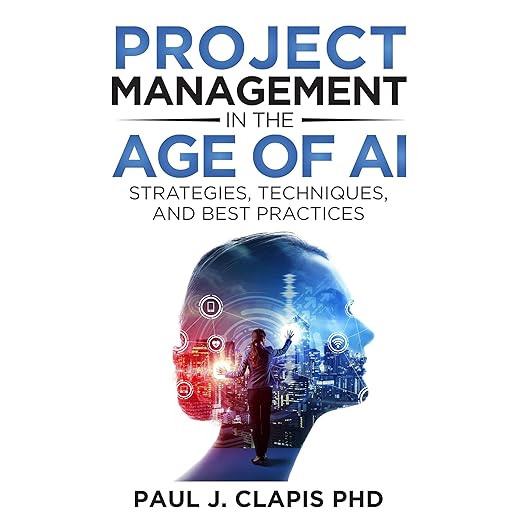
The statistic Paul Clapis opens with has stayed with me: more than half of all AI projects never get past the prototype stage. I was driving on a gray Wednesday morning when I heard it, and I spent the next several miles thinking about why that number exists, which is, of course, exactly what Clapis wants you to do. The framing is smart. Rather than starting with the promise of what AI can do, he starts with the problem that most organizations have already encountered, and then positions the project manager as the professional most structurally equipped to fix it.
Virtual Voice narrates, which is the unavoidable caveat for a six-hour-plus listen. Over that runtime, the limitations of synthetic narration accumulate differently than they do in shorter texts. The informational chapters, the numbered lists of best practices, the structured step-by-step frameworks, hold up reasonably well. The sections on ethical challenges and on what Clapis calls the “three pivotal future trends” are where the tonal flatness of Virtual Voice creates the most friction. These are sections that benefit from the weight a human voice would give them. Listening to a discussion of algorithmic bias with the measured neutrality of a synthesized voice is an odd aesthetic experience.
The 90 Percent Argument and Why It Works
Clapis’s central argument is that project managers already possess 90 percent of the skills needed to manage an AI initiative. This is both reassuring and analytically defensible. Risk assessment, stakeholder management, lifecycle planning, scope control, and communication are all as relevant to an AI project as to any infrastructure migration or product launch. What the remaining 10 percent requires is AI literacy, not technical depth. Clapis makes this distinction carefully. He is not arguing that project managers should become data scientists. He is arguing that they need enough conceptual fluency with AI systems to ask the right questions, recognize the failure signals, and communicate meaningfully with technical team members.
That positioning resonates with what reviewer Jack J. Santos described as moving from a “superficial understanding of AI” to something actionable. The book is not designed to replace an AI fundamentals course. It is designed to give a working project manager enough context to operate confidently in AI environments without needing to understand the underlying mathematics. That is a genuinely useful gap to fill, and Clapis fills it without condescension.
The Ten Best Practices Worth Your Attention
The ten best practices for managing AI projects that Clapis includes are the section of this book most likely to generate direct value in a listener’s next project review. They are concrete, ordered by project phase, and accompanied by the kind of real-world failure analysis that keeps abstract principles from feeling academic. The prototype-to-production gap, which is where those fifty-plus percent of AI projects die, is examined with specific attention to why organizations consistently underestimate the difference between a demo that works and a system that works under load with real users and incomplete data. That specificity is what separates this from the optimistic AI business books that skip over the hard parts.
The ChatGPT best practices section, which promises ten techniques directly applicable to project management tasks, is the most time-sensitive part of the book. Clapis uses ChatGPT as the primary illustrative tool, and the interface and capability descriptions will age as the tool evolves. The underlying prompt strategy principles transfer; the specific examples will require updating by any listener working with current-generation tools.
Ethical Governance and the Questions Nobody Asks First
The sections on ethical challenges that “sabotage AI initiatives” are both the most important and the most underserved part of this book. Clapis identifies a genuine pattern: AI projects fail not only for technical and project management reasons but because organizations fail to ask the bias, accountability, and transparency questions before deployment rather than after the controversy. The coverage of this is real but surface-level, and listeners looking for a rigorous treatment of AI ethics will need to supplement with dedicated texts. What Clapis delivers is a project manager’s checklist of the questions that should be on every project kickoff agenda. That is a starting point, not a framework, but starting points matter.
Who Should Listen and Who Should Skip
Listen if you are a project manager, program manager, or organizational leader who regularly interacts with AI initiatives and wants a structured way to think about the risks, failure modes, and governance requirements specific to that kind of work. The book earns its runtime by covering scope that shorter alternatives skip. Skip if you need deep technical grounding in AI systems, or if you want a pure strategic vision document rather than a practitioner guide. Skip also if you are highly averse to Virtual Voice narration across six hours of structured content, since the longer runtime makes the limitations more noticeable than in shorter titles.
Frequently Asked Questions
The book is part of the AI Leadership Mastery series. Is it necessary to read other books in the series first?
No, it reads as a standalone guide. The series designation seems to reflect thematic grouping rather than sequential dependency. Project Management in the Age of AI develops its own argument from first principles without requiring prior knowledge of other titles.
Clapis warns readers not to buy this book if they think AI is a fad. Is it appropriately skeptical, or mostly enthusiastic about AI adoption?
It leans toward adoption advocacy, but with more substantive acknowledgment of failure modes than most books in this space. The opening statistic about AI projects failing before production is not decoration. Clapis spends real time on why organizations get this wrong, which gives the optimistic sections more credibility than they would have without that grounding.
Does the six-hour runtime feel padded, or does the book earn that length?
It earns it, mostly. The ethical governance sections, the organizational change guidance, and the ten best practices are all substantive enough to justify the length. The ChatGPT-specific sections, which are the most time-sensitive content, could have been compressed without losing the book’s core value.
How does Virtual Voice perform across six-plus hours of this content?
Adequately for the structured, list-organized sections, which represent most of the runtime. The ethical and reflective sections feel flatter than they should. Listeners with high sensitivity to synthetic narration will find the length challenging. Listeners accustomed to Virtual Voice for instructional content will adjust within the first chapter.