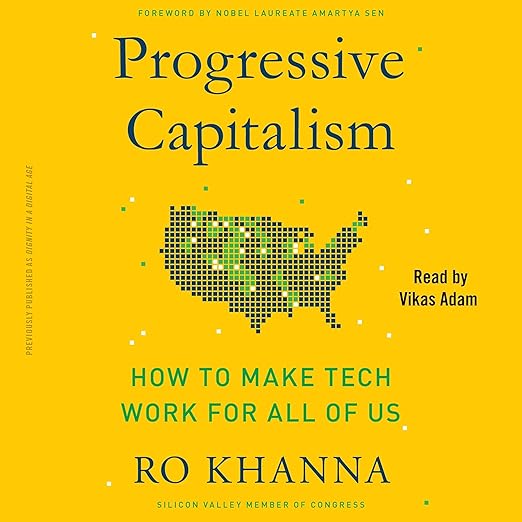
Quick Take
- Narration: Vikas Adam delivers Khanna’s policy arguments with consistent authority, the narration is professional and clear, though the material’s occasional oratorical register suits a Congressman’s voice more naturally.
- Themes: Digital economic inequality, technology access as civil right, decentralization of tech opportunity
- Mood: Constructive and policy-minded, with the carefully optimistic register of someone trying to persuade across partisan lines
- Verdict: Khanna’s case for democratizing tech opportunity beyond coastal hubs is well-researched and argues for a vision most listeners will find appealing, even if the policy specifics occasionally slide into advocacy-speak.
I have been thinking about the geography of tech opportunity for years, watching the gravitational pull of San Francisco and Seattle and New York draw talent and capital away from places that have their own considerable capacities. Ro Khanna’s Progressive Capitalism is the most sustained political argument I have heard for why that concentration is a policy choice rather than an economic inevitability, and what a different set of choices might look like.
Khanna represents Silicon Valley’s congressional district and has carved out a specific political identity: a Democrat who understands the tech industry from inside its geographic center while arguing for distributing its benefits far beyond that center. That positioning creates both his credibility and his limitations as an author here. He knows the world he is describing with unusual specificity. He also has an institutional interest in proposing solutions that require the industry’s participation.
The Diagnosis: Two Americas in the Digital Economy
Khanna’s opening argument is clear and well-evidenced. An economic gulf exists between those who have participated in the tech boom and those displaced by automation, a geographic divide between coastal tech corridors and the heartland, and structural inequalities in who has access to the infrastructure, computers, broadband, training, and professional networks, that make tech participation possible. He moves between policy data and human storytelling with the practiced ease of someone who has spent years explaining economic abstractions to constituents facing concrete job losses.
The book draws endorsements from economists across the ideological spectrum: James Heckman at Chicago calls the approach progressive, Amartya Sen contributes a foreword, Arlie Russell Hochschild praises the vision. That breadth of support is itself an argument. Khanna is trying to occupy a political space between left economic nationalism and center-left tech optimism, and he is doing so by engaging seriously with evidence from multiple disciplinary traditions.
The Vision: Technology Moving to People
The book’s central proposition, captured in Sen’s foreword framing that just as people can move to technology, technology can move to people, is more radical than it initially sounds. Khanna is arguing for a deliberate policy project to establish technology jobs and research infrastructure in regions currently excluded from the digital economy, through public-private partnerships, targeted federal investment, university expansion, and corporate incentive structures. The examples he cites, tech companies that have established engineering centers in non-coastal cities, apprenticeship programs that do not require four-year degrees, broadband investment programs, are real and documented.
Vikas Adam’s narration handles the policy passages with appropriate seriousness. Where the book shifts into more directly oratorical mode, passages designed to inspire as much as inform, Adam’s more neutral professional delivery creates a slight tonal mismatch. Khanna is a politician and speaks naturally in a register that assumes a live audience; the audiobook format mutes some of that energy.
Where the Policy Prescription Gets Thinner
Progressive Capitalism is at its strongest in diagnosis and vision. It is somewhat thinner on the specific mechanisms by which the transformation it describes would be achieved against the structural incentives that currently produce geographic concentration. Tech companies cluster in coastal cities because of agglomeration effects: talent pools, venture networks, legal infrastructure, specialized suppliers, and proximity to other tech companies all reinforce each other. Khanna acknowledges this but the policy tools he proposes to overcome these effects are presented with more confidence than the evidence for their efficacy quite supports.
Reviewer Philip Montag praised the book’s thoughtfulness while reviewer Kyle noted its occasional advocacy register. Both assessments are accurate. This is a book that wants to be both analytical and persuasive, and the tension between those goals is occasionally visible.
Who Should Listen, Who Should Skip
This audiobook is for listeners interested in the politics and policy of technology’s geographic concentration, particularly those who want a constructive vision rather than a purely critical account. It is also valuable for listeners outside the US who are tracking debates about technology policy and economic geography. Skip it if you want primarily technical economic analysis: Khanna’s training is political and his mode is policy advocacy rather than academic economics. Also be aware that some specific programmatic recommendations will date faster than the broader argument, which remains relevant.
Frequently Asked Questions
Is Progressive Capitalism a left-wing or a centrist book politically?
Khanna positions himself as a progressive Democrat who is also enthusiastic about technology and private enterprise. The book draws endorsements from economists across the ideological spectrum and explicitly attempts to appeal beyond partisan lines, though its underlying values are center-left.
Does Vikas Adam’s narration suit Congressman Khanna’s material?
Generally yes, with a qualification: Khanna writes in a register that occasionally assumes an audience in a room, and Adam’s more neutral professional narration mutes some of that oratorical energy. The policy analysis sections work particularly well with this approach.
Is this book primarily about the technology industry, or is it a broader economic policy argument?
Both. The technology industry is the vehicle for a broader argument about geographic economic inequality and what deliberate policy could do to redistribute opportunity. Readers interested in regional economic development will find as much to engage with as readers primarily interested in tech.
How does Progressive Capitalism relate to debates about remote work and whether tech opportunity has already been distributed by pandemic-era changes?
The book was published before remote work became widespread, and some of its arguments about the necessity of deliberate policy intervention have been complicated by the fact that geography became somewhat less determinative after 2020. Treat those sections as a baseline rather than a current assessment.