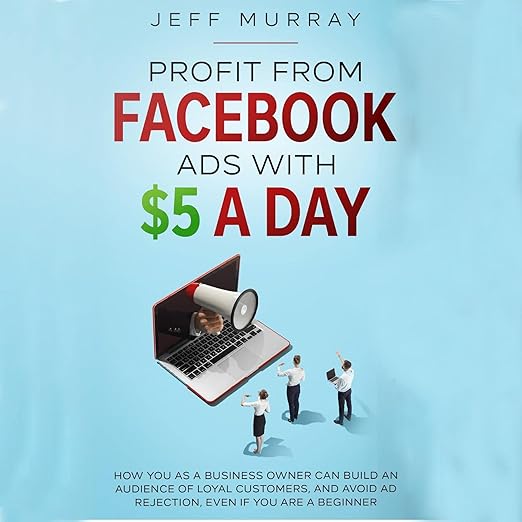
Under three and a half hours, which for a business how-to is either a virtue or a warning depending on what you wanted from it. Jeff Murray's guide sets out to move a complete beginner from having no business page at all to running a working sales funnel, and the audiobook is short enough to finish in a single day of commuting. Benjamin Koschella narrates. The question worth settling before you buy is not whether the advice is sound, but whether a subject this visual and this fast-moving survives being delivered by voice alone.
Five Dollars Frames This as Testing Rather Than Spend
The five dollars in the title is the framing device and it is a good one. This is small-budget testing rather than agency spend, which changes what advertising means for the person listening. The contents follow a sensible beginner's sequence: why a business page matters and how to create one, how to keep and grow followers so you reach more potential customers, how to craft a clear call to action, why ads get rejected and how to avoid it, and how to build a funnel that carries someone from first sighting to purchase.
The reviews confirm both the level and the ceiling, and they do it without contradicting each other. Booklvr writes that the book "provides a detailed description of how to use Facebook to reach your marketing goals, while along the way integrating lots of helpful general marketing guidance". Darla says it "Clearly explains what to do as you try and build your business." Ronald D. B. Smith, giving four stars, puts a finger on the limit: "I would have liked a bit more detail and a few more examples. An excellent book to build a foundation." Foundation is the accurate word for what this is.
Koschella's Businesslike Register Suits a Numbered List
Koschella reads it in a businesslike, consistent register, which is the right decision for instructional nonfiction. This kind of material does not want a performance, it wants somebody who will not get in the way of a numbered sequence, and that is what the recording supplies. Marketing how-to is a genre where a reader who tries to inject drama into a list of ad-rejection reasons actively damages the content, so restraint is a virtue rather than a shortfall.
The brevity is a genuine feature and not a compromise. A beginner gets the entire map before losing interest, which matters more in this subject than in almost any other, because the standard failure mode is buying a four-hundred-page marketing book and abandoning it at chapter three. The general marketing guidance Booklvr singles out is also the part that holds its value longest. Understanding why a call to action converts transfers to email, to a shopfront, to any channel you ever use. Knowing which button sits in which menu does not.
The economic framing is the quietly useful part. Most advertising books assume a budget already exists. Starting from a five-dollar daily test reframes the whole exercise as learning rather than spending, which is psychologically important for a small business owner who has already put money into boosted posts and seen nothing come back. The copy addresses that person directly, promising to explain why ads are not converting rather than simply asserting that they will.
2.91 Billion Users Pins This to One Moment
Datedness is the first real caution. The copy cites Hootsuite for a figure of 2.91 billion monthly active users, which pins the book to a specific moment in the platform's history. Interfaces, targeting rules, review policies and pricing all move considerably faster than publishing schedules. Treat the strategy as durable and the tactics as perishable, and check any named menu path against what is actually on your screen before following it.
Then the visual problem, which is structural rather than fixable. Ad managers are dashboards. Campaign structures, audience builders, rejection notices and performance charts are things you look at, and this listing mentions no companion PDF, so anything a print edition would have shown as a screenshot has to be described in words instead. That works acceptably for concepts and awkwardly for step-by-step setup, which is why the recording is better used as an orientation than as a manual you follow with your other hand on the mouse.
The register tells you where this sits in the publishing landscape. The description closes by instructing you to click the add-to-cart button, which places it at the independent direct-response end rather than at a trade house. That is not disqualifying at all, but it does set expectations: confident, energetic instruction rather than case studies with audited numbers attached. Ronald D. B. Smith's wish for more detail and more examples is the predictable consequence of that house style, and an average of 4.3 across twenty-five ratings is a modest rather than a resounding endorsement.
Experienced Marketers Meet the Ceiling Within an Hour
The natural audience is a small business owner, a freelancer or a side-project founder who has never run a paid campaign and wants the vocabulary and the sequence in place before spending anything. It also fits anyone who has boosted posts on instinct, watched the money disappear and never understood which part of the setup was wrong. For that reader, a short and orderly explanation is worth considerably more than a comprehensive one.
Complete beginners get the most from this and they get it fast, which is the entire argument for a book this brief. Anyone already running campaigns, managing a real monthly budget or working in-house on paid social will meet the ceiling inside the first hour and find little above it. And if what you need is current screen-by-screen instruction, no book in any format will serve you as well as the platform's own documentation, whoever is reading it aloud.
At a Glance
- Narration: Benjamin Koschella reads in a businesslike, consistent register that suits marketing instruction and stays out of the material's way.
- Themes: Paid social advertising, small-budget testing, sales funnels, small business marketing
- Mood: Brisk, practical and encouraging
- Verdict: A decent short foundation for absolute beginners, with a low ceiling and tactics that will date.