Quick Take
- Narration: Virtual Voice AI narrator. Serviceable for framework delivery but lacks the inflection that makes dense professional content stick.
- Themes: product strategy formulation, roadmap construction, cross-functional leadership
- Mood: Practical and methodical, classroom-adjacent
- Verdict: A useful condensed framework for product managers who need structured templates fast, but the AI narration and slim runtime mean it works better as a reference than an immersive listening experience.
I have a complicated relationship with short professional audiobooks narrated by AI voices. On one hand, they lower the barrier to distributing useful ideas. On the other, the narration strips out the inflection that makes professional development content land, and a two-hour-and-thirty-seven-minute book already needs every advantage it can get to justify the format.
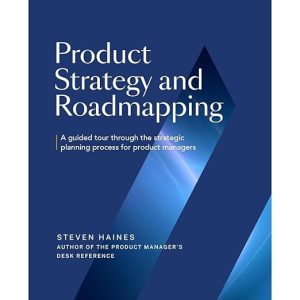
Product Strategy and Roadmapping sits in that ambiguous space. Steven Haines is a product management educator associated with Sequent Learning Networks, and this book functions as a companion to his workshops and applied learning programs. He says so directly: the book can stand alone or pair with formal training. That transparency is actually reassuring, because it positions the work correctly rather than overclaiming what a sub-three-hour listen can deliver.
Our Take on Product Strategy and Roadmapping
Haines frames the book as a narrated template with subtemplates, and that description is accurate. The content covers the terrain that any working product manager encounters: gathering customer and market insights, assessing business performance, calibrating resources, setting goals and strategies, and building roadmaps that extend beyond the next release cycle. He describes the challenge clearly, that strategic planning is overwhelming and most product teams default to short-term feature lists rather than genuine strategy, and organizes the material as a practical framework for addressing that gap.
The book is part of the Product Management Professionals series, which signals that the content is positioned at practitioners rather than executives or general business readers. That focus is appropriate. The templates and frameworks Haines offers are designed to be used at the work level, not as high-level philosophy.
Why Listen to Product Strategy and Roadmapping
The strongest case for this audiobook is efficiency. At under three hours, a working product manager can consume the entire framework during a single commute or afternoon walk. One reviewer describes it simply as a valuable boost to their career, which suggests the content delivered practical value quickly. For someone preparing for a roadmapping exercise or entering a new product role, that concentrated framework is genuinely useful.
Haines also deserves credit for being honest about scope. He is not promising a complete product management education in two and a half hours. He is offering a structured approach to a specific problem, the gap between day-to-day feature delivery and actual strategic thinking, and the constraint of format forces him to be precise rather than expansive.
What to Watch For in Product Strategy and Roadmapping
The Virtual Voice narration is the significant caveat here. AI narration has improved considerably, but it still lacks the emphasis patterns that human narrators use to signal which elements of a framework are load-bearing versus supplementary. In professional development content, that distinction matters: a human reader knows to slow down and let a key principle land. The AI voice processes it at the same pace as the surrounding sentences. Listeners who learn best through audio may find the format works against retention of the specific templates Haines offers.
The minimal review base makes broader assessment difficult. One review calls it valuable. Without more listener feedback, the honest answer is that this book’s utility will vary significantly depending on where the listener is in their product management career. Someone new to product roles will likely extract more value than a senior PM who has spent years building roadmaps.
Who Should Listen to Product Strategy and Roadmapping
This is best suited for product managers who are early to mid-career and need a structured framework for strategic thinking that they have not yet built through experience. It also has value as a quick refresher before a major planning cycle or as preparation for leading a roadmapping session with stakeholders. The book is explicitly designed to accompany Sequent Learning’s workshop program, so listeners who have attended or plan to attend that training will get more from it than those encountering Haines’s framework cold. Listeners who prefer their professional development content with strong narrative voice and extensive case studies will find this too spare.
Frequently Asked Questions
Is this book useful without attending the Sequent Learning workshop?
Haines says it can stand alone, and the frameworks are self-contained enough to apply independently. However, the book is explicitly designed as a companion, so listeners who engage with the workshop will get more from the content.
What level of product management experience does this book assume?
It is aimed at practicing product managers and team leaders rather than complete beginners. Some familiarity with product concepts like roadmaps, feature prioritization, and stakeholder management will help the frameworks land.
Does the AI narration affect how useful the book is?
It is a real limitation for content that relies on emphasis to signal which frameworks are most important. The material can still be absorbed, but listeners may want to take notes to compensate for the flat delivery.
How does this compare to longer product strategy books like Marty Cagan’s Inspired?
This is a much shorter, more template-focused resource. Cagan’s work offers deeper philosophy and more extensive case studies. Haines is offering a compressed practical framework, not a comprehensive treatment of product thinking.