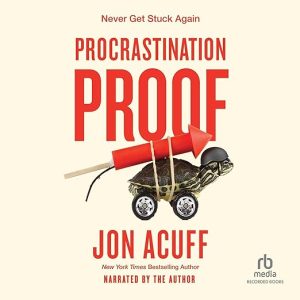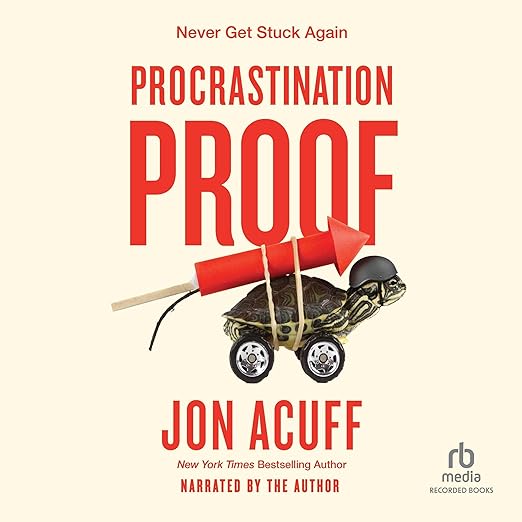
Before You Press Play
- Voice: Jon Acuff reading his own work is as polished as you'd expect from someone who has done this across multiple bestselling books. He has the pace and energy of a practiced public speaker, which suits the motivational material.
- Big ideas: Permission as the antidote to delay, closing the gap between intention and action, dream-to-execution frameworks
- Atmosphere: Energetic and encouraging, with Acuff's characteristic humor keeping the material from feeling like a scolding
- Worth it?: If Acuff's earlier books have resonated with you, the four-step permission system here is his most structured delivery yet of ideas he's been building toward across his career.
Jon Acuff has built a career on a specific kind of self-help book, one that acknowledges the messy internal experience of trying to change without making you feel worse about having the mess in the first place. His books tend to be funny in a way that doesn't undercut the substance, and they are structured around insights that feel obvious in retrospect but aren't the kind of thing most people work out independently. Procrastination Proof, his new audiobook released in April 2026, is Acuff taking his most direct run at what he identifies as the central problem in most people's lives: the gap between what they intend to do and what they actually do.
His argument is built on a reframe that is either obvious or genuinely useful depending on where you're starting from: the solution to procrastination is not willpower but permission. The specific formulation, that everything you're waiting for has been waiting for you, is the kind of motivational language Acuff is fluent in, and the surrounding structure gives it operational teeth: a four-step system built around permission to dream, plan, do, and review. At just over six hours, the audiobook has enough space to develop the framework without padding it into territory it doesn't need.
Acuff's Job-Hopping Years Ground This Framework
Acuff occupies a specific position in the self-help genre that is easier to describe than it is to replicate: he is a practitioner writing from the experience of having actually changed his own life, with enough self-awareness about the difficulty of that to avoid the preachiness that undermines so much of the genre. The autobiography woven through Procrastination Proof, his own years of moving from job to unsatisfying job before finding work that matched his intentions, gives the abstract framework a specific grounding. He is not writing about procrastination as an external phenomenon he has studied. He is writing about it as something he lived with and worked through.
The four-step permission system is designed to work across the full range of what people put off, from mundane daily tasks to the larger questions of what kind of life they want to build. That ambition carries risk: frameworks that claim to apply everywhere sometimes apply with less precision everywhere. But Acuff's track record of connecting abstract productivity ideas to specific behavioral changes across his earlier work suggests the system has been through enough iteration to hold up under practical application.
The Price Tag Is Your Life, Acuff Says
Acuff narrating his own work is one of those authorial pairings where the voice is genuinely part of the experience. He is a practiced public speaker, and the energy level and pacing in his audiobook narrations tend to be calibrated for the material in a way that a professional narrator working from the text alone might not find as naturally. The humor lands because his timing is intact; the motivational moments land because they don't sound performed. If you've listened to any of his prior audiobooks, you know what you're getting into and the consistency will be a feature.
The audience for this book has been clearly thinking about the gap Acuff describes, between the remarkable life they imagine and the daily reality they keep postponing. His framing of procrastination as expensive not because it costs money but because "the price tag is your life" is designed to recontextualize delay in a way that produces urgency without shame. That balance between urgency and non-judgment is one of Acuff's consistent strengths as a writer.
New Framework, Familiar Permission Philosophy Underneath
No reviews are available for this title at time of writing, as it released April 2026. That means this assessment is based on the synopsis, Acuff's established track record, and the structural promises the book makes about its own content. Listeners who've found his previous books effective, Finish, Soundtracks, Start, will have reasonable grounds for confidence here. Those who've found his approach too anecdotal or his humor too light for serious productivity work should note that the stylistic fingerprints appear consistent across the synopsis and framing.
The four-step framework is new, but the underlying philosophy isn't entirely so for Acuff readers. The permission concept builds on themes he has been developing for years, and if you've read him extensively, some of the territory may feel familiar rather than revelatory. The synthesis and the structured system may be the genuine addition here rather than an entirely new argument.
Listen If Acuff's Earlier Books Clicked
Listen if: You've connected with Acuff's earlier books and want his most structured framework for converting intentions into action; you respond well to self-help that combines humor with real operational guidance; or you are specifically stuck on a large goal you keep postponing and want a permission-based reset rather than another willpower prescription.
Consider skipping if: You prefer evidence-based behavioral science with academic grounding over narrative self-help; you've found Acuff's previous books too light on depth; or you are already familiar with his body of work and are unsure whether a new framework or a synthesis of existing themes is what you need next.
A Few Questions About Procrastination Proof
Jon Acuff narrates his own audiobook, is the production quality professional, or does it have the roughness of author-narrated titles?
Acuff has narrated multiple audiobooks across his career and is a professional speaker with significant experience performing his own material for audiences. His narration consistently receives positive responses for energy and pacing. This is not a first-time author reading awkwardly into a microphone; it is a polished production from someone who understands how his own voice serves his material.
At six hours, is Procrastination Proof detailed enough to actually teach a usable system, or does the length feel thin for the scope of what it promises?
Six hours is on the shorter end for a self-help framework book but within the typical range for Acuff's work. His books tend to be concise by design, he prioritizes accessibility and momentum over exhaustive coverage. Whether that's appropriate for the scope of a four-step life system depends on how much development each step receives within the runtime. Based on his prior work, expect the treatment to be thorough enough to be actionable without being encyclopedic.