Quick Take
- Narrator: Elizabeth Lamont captures Maya Killgore's younger, often chaotic emotional register convincingly, and her rendering of the Sicilian setting scenes adds atmosphere that the text alone doesn't always deliver on its own.
- Subjects: age-gap romance, forbidden desire, trauma backstory shaping behavior
- Tone: Sun-drenched and tension-filled, with banter that occasionally tips into frustration before it resolves
- Bottom line: Ali Hazelwood fans already invested in the Not in Love world will find enough here to satisfy, though listeners coming in cold may find Maya's characterization tests their patience before it earns their sympathy.
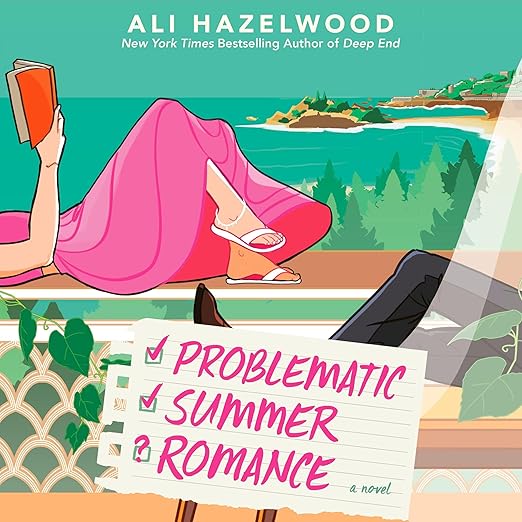
Ali Hazelwood's Problematic Summer Romance arrives trailing the weight of its own premise. Maya Killgore is twenty-three, still figuring out her life, and entirely unable to stop thinking about Conor Harkness, who is thirty-eight, her brother's best friend, and categorically unavailable to her in ways that extend well beyond age. The setup is genre shorthand for a story that knows exactly what it is doing and commits to every trope on the label: older man and younger woman, forbidden proximity, enemies circling each other at a destination wedding in Taormina, Sicily. This audiobook is the second installment in the Not in Love series, narrated by Elizabeth Lamont, and it runs nearly twelve hours. Its status as an Instant Number One New York Times Bestseller signals an audience that was already primed for this story.
Hazelwood earned her readership through books like Deep End and her earlier STEM-romance titles, and her prose has a distinctive quality: it is fully self-aware about the clichés it employs while taking the emotional stakes underneath them entirely seriously. That combination is harder to execute than it sounds. When Maya thinks the situation "almost makes her heart implode," the line acknowledges its own romantic excess while the feeling it names is real. Lamont's narration understands this double register and leans into the wry, observational quality of Maya's first-person voice without letting the irony flatten the genuine longing underneath it.
Taormina Turns a Wedding Into a Pressure Cooker
The novel's Sicilian setting is more than backdrop. Hazelwood uses Taormina, with its ancient ruins, Ionian coast caves, and the particular texture of a destination wedding pulling every character into enforced proximity, to create a pressure cooker that justifies the story's emotional acceleration. In a Sicilian villa for over a week with no practical exit option, the tension between Maya and Conor is not manufactured but structural. Lamont's narration gives the setting real atmospheric weight in the listening experience, particularly in scenes involving the coast and the ruins, where she allows a slightly more spacious pace than the internal-monologue sections typically permit.
Reviewer Fharen noted patience-testing early sections before ultimately enjoying the book, and that trajectory is honest. Maya's characterization in the first third leans heavily on a sassy, self-undermining quality that reviewer midwestgirl described as "too much and not enough." The seriousness of Maya's backstory, involving trauma that shaped her coping behaviors and social presentation, arrives relatively late relative to the retroactive work it is asked to do on the reader's sympathy. Listeners who commit past the initial friction will find that the backstory does reframe Maya's earlier behavior in satisfying ways, but the audiobook makes a real demand on patience before delivering that payoff.
Lamont Holds Two Registers for Twelve Hours
The core appeal of this audiobook is Hazelwood's control of the slow-burn enemies-to-lovers structure in a genuinely beautiful international setting. Conor's insistence that the power dynamic is "too imbalanced" is not a smokescreen for simple disinterest but a position the novel forces him to hold even as it becomes increasingly untenable under the pressure of Sicilian proximity. The architecture of forced togetherness at a wedding, where social performance is mandatory and private moments keep happening anyway, is well deployed across the second and third acts. Lamont communicates both the social performance layer and the undercurrent of what neither character will say, which requires a kind of simultaneous double-register vocal work that she manages effectively over nearly twelve hours.
For listeners who have already read or listened to the first Not in Love book, the series investment pays dividends here. Maya's context within that world adds dimension that cold-entry listeners will not have access to, and reviewer theladysparks speaks for a committed Hazelwood fan base in saying nothing but bangers. That enthusiasm is genre-informed in the best way: Hazelwood's readers know what they are signing up for, and the audiobook delivers it with real craft and intentionality.
Conor's Hidden Secret Reframes the Early Antagonism
The heat level here is explicitly noted in the publisher's content warning. This is adult romance with intimate scenes, and Lamont's narration handles those sections with the matter-of-fact directness that suits Hazelwood's prose. Listeners who prefer their romance without explicit content should know that upfront and attend to the content warning at the beginning of the audiobook rather than skipping past it.
The novel's structure relies on a plot mechanism that the synopsis hints at without naming: Conor is hiding something from Maya, and that concealment functions as the book's central turn, reframing much of the early antagonism when it is finally revealed. Some listeners will find the pivot satisfying as a structural payoff; others may feel it arrives somewhat neatly given the setup. The audiobook's length gives Hazelwood room to develop both sides of that reveal without rushing, which is one place where the nearly twelve-hour runtime genuinely earns its keep rather than simply consuming it.
New Readers Should Start With Deep End
This audiobook is the right fit for established Hazelwood readers following the Not in Love series, and for romance listeners who enjoy the specific pleasure of an age-gap setup executed with self-aware craft in a vivid international setting. It is not the ideal entry point into Hazelwood's work; something like The Love Hypothesis or Deep End would be a more accessible and less patience-demanding starting place. Listeners who require protagonists they can warm to immediately, rather than characters who earn sympathy retroactively through delayed backstory, may find the first third of this audiobook more work than they want to do. For everyone else: a Sicilian villa, ancient ruins, a wedding spiraling out of control, and Conor Harkness hiding something. Hazelwood delivers what she promises.
How explicit is the audiobook, and does Elizabeth Lamont's narration handle the intimate scenes tastefully?
The novel contains explicit adult content, and the publisher includes a content warning at the beginning of the audiobook. Lamont's narration approaches those sections with directness consistent with Hazelwood's prose style. Listeners uncomfortable with explicit content should note this before committing to the full twelve-hour runtime.
Is Maya Killgore the kind of protagonist this audiobook format makes easier or harder to spend time with?
Multiple reviews flagged Maya as challenging early on, describing her sassiness as occasionally grating before her backstory provides necessary context. Audio narration can amplify this effect because you are in a first-person voice for extended periods. Lamont manages the register well, but the patience requirement in the first third is genuine and worth knowing about.