
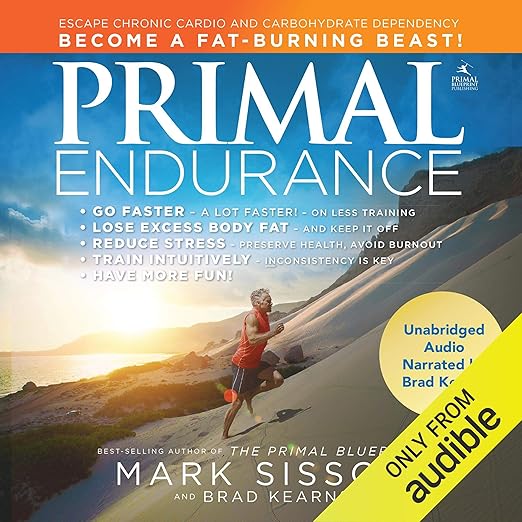
- Performance: Brad Kearns co-authored the book and narrates it himself, which gives the performance an insider authority that no third-party voice actor could replicate; he delivers Sisson's arguments with the conviction of someone who lived the experiment.
- What it covers: Fat adaptation and aerobic base building, rejecting chronic cardio culture, periodization and recovery as performance tools
- Feel: Evangelical and energetic, like talking to a coach who genuinely believes you have been training wrong your whole life
- Our call: A persuasive, occasionally repetitive case for rethinking endurance training that will resonate most strongly with athletes already frustrated by the carb-heavy, always-tired status quo.
I started listening to Primal Endurance on a Tuesday morning run, which felt appropriate and slightly ironic, since the entire argument of the book is that the kind of steady-state cardio I was doing was making me slower, fatter, and more exhausted than necessary. By the time I finished the first section, I had slowed to what Mark Sisson calls a Maffetone-style aerobic pace, and I was genuinely reconsidering everything I thought I knew about training.
That early jolt of recognition is where Primal Endurance is most effective. Sisson, who brings a 2:18 marathon and a fourth-place Hawaii Ironman finish to his credentials, opens with a diagnosis that will feel uncomfortably familiar to a lot of endurance athletes: you train relentlessly, you eat enormous amounts of carbohydrates to fuel that training, and yet you carry more body fat than you think you should, you get sick every winter, and you feel perpetually ground down. The framing is direct and bracingly confident, and it establishes the book's tone from the first chapter.
First, the Big Picture
The core of Primal Endurance is an argument for fat adaptation over carbohydrate dependency. Sisson contends that the conventional endurance model, which he memorably labels chronic cardio, keeps athletes locked in a physiological state where they can never efficiently access fat stores as fuel. The result is that they bonk without constant glucose replenishment, burn muscle in lieu of fat, and suppress hormonal recovery. The solution he proposes is a multi-pronged approach: build a genuine aerobic base by training at lower heart rates than most athletes are comfortable with, eliminate processed grains and sugars, add targeted high-intensity sprint work rather than endless medium-effort miles, and treat rest and sleep as non-negotiable training variables rather than optional recovery tools.
The science here is real, though Sisson presents it with a missionary certainty that occasionally outruns the evidence. The research on low-carbohydrate performance in endurance sports is genuinely mixed, and one of the book's weaker points is that competing studies are rarely acknowledged. Reviewer A. King put it well when they noted the book contains about one chapter of essential ideas stretched across a full-length text, and that is not entirely unfair. The same themes do cycle back repeatedly. But for listeners new to the primal or paleo application to endurance sports, the repetition may function as reinforcement rather than padding, and many listeners report the repetition actually helped them internalize the protocols more durably.
What Makes Primal Endurance Worth Hearing
The decision to have Brad Kearns narrate is one that pays off in ways not immediately obvious from the setup. Kearns is Sisson's co-author and business partner, and a former world-ranked triathlete in his own right. He is not a professional narrator, and this is occasionally audible in how he handles certain passages, which lack the polish of a studio performer. But what he brings instead is something more valuable for this particular content: he narrates the training philosophy as someone who abandoned a conventional endurance career to test these ideas, rose to a world number-three triathlon ranking under Sisson's guidance, and has spent decades refining the approach. When he describes the discomfort of slowing your pace to build an aerobic base, there is nothing hypothetical about it. The performance is authoritative in a way that is genuinely hard to manufacture.
The 12-hour runtime is on the longer side for a book that reviewer feedback consistently describes as containing a concentrated set of big ideas. The PDF supplement included in the Audible purchase is useful for the training schedules and heart-rate zone tables that are harder to absorb purely through audio. Listeners who plan to actually implement the program should plan to reference that material separately rather than trying to retain the numbers from a single listen.
A Few Reservations
Primal Endurance works best for a specific kind of listener: someone already engaged in marathon, triathlon, or cycling training who has noticed a persistent gap between effort and results. Sisson is not really writing for beginners, despite the book's accessible tone. He assumes familiarity with training load concepts, with the basic mechanics of Ironman racing, and with at least a passing knowledge of paleo nutritional frameworks. Listeners who come in cold on both the endurance and the primal-eating sides may find the argument harder to evaluate without that context.
For athletes already frustrated by the chronic-cardio trap, the book's vision of training that emphasizes quality over volume, that builds a real fat-burning engine, and that treats recovery as part of the program rather than weakness, lands with genuine force. The anecdotes about Simon Whitfield and Dave Zabriskie give the approach real-world credibility beyond Sisson's own race history. And the periodization framework, which structures the training year with a genuine off-season and a deliberate escalation toward peak events, is one of the most practically useful sections of the book. Listen if you are an endurance athlete who regularly trains hard and still feels depleted. Skip if you need a nuanced engagement with conflicting research traditions in sports nutrition science, because this book argues a position rather than surveying a field.
Should You Listen to Primal Endurance?
Primal Endurance works best for a specific kind of listener: someone already engaged in marathon, triathlon, or cycling training who has noticed a persistent gap between effort and results. Sisson is not really writing for beginners, despite the book's accessible tone. He assumes familiarity with training load concepts, with the basic mechanics of Ironman racing, and with at least a passing knowledge of paleo nutritional frameworks.
For athletes already frustrated by the chronic-cardio trap, the book's vision of training that emphasizes quality over volume, that builds a real fat-burning engine, and that treats recovery as part of the program rather than weakness, lands with genuine force. The anecdotes about Simon Whitfield and Dave Zabriskie give the approach real-world credibility beyond Sisson's own race history. Listen if you are an endurance athlete who regularly trains hard and still feels depleted. Skip if you need a nuanced engagement with conflicting research traditions in sports nutrition science, because this book argues a position rather than surveying a field, and that commitment to advocacy over balance is both the book's strength and its limit.







