At a Glance
- Narration: Ray Chase delivers Schreier's investigative prose with clarity and controlled urgency, keeping a measured register that serves reported nonfiction far better than theatrical performance would.
- Themes: studio closure and the human cost of creative labor, industry volatility versus record profits, resilience after institutional collapse
- Mood: Sobering and eye-opening, with genuine admiration for the people who kept making games under impossible conditions
- Verdict: A clear-eyed, humanizing account of what happens when beloved game studios shut their doors and the people inside them have to start over from nothing.
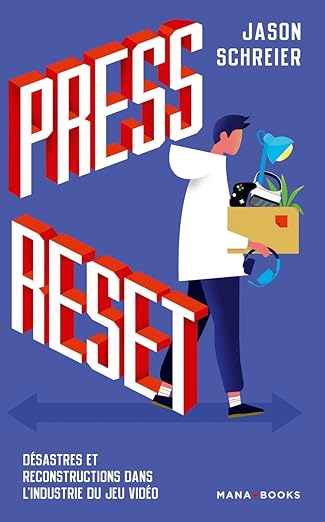
Jason Schreier built his reputation covering the video game industry from the inside, and this audiobook does not waste that access. Where his earlier work Blood, Sweat, and Pixels traced the making of games under impossible conditions, Press Reset turns to the moment everything ends: the studio shutdowns, the layoffs, the careers derailed overnight. It is a harder, quieter story, and Ray Chase narrates it with exactly the kind of restrained authority that investigative nonfiction like this demands. For listeners who assumed the games they loved came from stable, well-run companies, what this audiobook presents will be genuinely uncomfortable and, ultimately, clarifying.
The Verdict, Briefly
Schreier spent years conducting firsthand interviews with developers who lived through some of the most significant studio closures of the past two decades. The roll call alone should resonate with anyone who has followed gaming: BioShock Infinite came out of Irrational Games, which then folded. Epic Mickey was the product of Junction Point, gone shortly after. Dead Space launched from a studio that no longer exists. These are not trivia points. Schreier uses each shutdown as a case study in what actually happens when a hit game ships and a publisher decides the numbers do not justify keeping the team together.
What makes the audiobook work is that Schreier never loses sight of the human dimension. Bounced checks, hostile acquisitions, abusive management, and the particular psychological weight of building something beloved only to watch the institution collapse around you. These are stories about careers, relationships, and in some cases entire communities built around studios that turned out to be far less permanent than the people inside them believed. Ray Chase renders all of it with discipline, never letting the material become sensationalized. He understands that restraint is the right tool when the facts are damning enough on their own.
The Best Parts of Press Reset
The central argument Schreier builds over the course of the eight-plus hours is uncomfortable and well-supported: the video game industry is more profitable than it has ever been, and yet working in it has become less stable, less humane, and less sustainable for the people actually making the games. That tension gives the audiobook its moral weight. This is not a nostalgia piece about beloved titles. It is a labor story that happens to be set in a creative industry many listeners grew up loving, and Schreier never lets the reader forget that behind every celebrated release is a group of people whose jobs evaporate the moment the critical reception turns uncertain or the publisher recalculates the return on investment.
The pacing is deliberate and built around accumulation. Schreier writes like a journalist who trusts his sources and his structure, and Chase serves that prose without calling attention to himself. Listeners who came to this title hoping for something as tightly chapter-organized as Blood, Sweat, and Pixels should note that one early review flagged the book's structure as looser, without a formal table of contents. That observation is worth noting going in. The book earns its runtime through accumulated detail and the weight of repeated pattern rather than architectural precision, but the pattern itself eventually becomes the argument.
Points to Consider
The coverage of crunch culture, hostile buyouts, and executives who treated studios as disposable creative resources adds up across the eight hours into something genuinely troubling. Schreier's account of the cycle, acquisition followed by creative constraint followed by market disappointment followed by closure, recurs across the studios he profiles with enough regularity to function as structural critique rather than isolated incident. He is asking a pointed question: in an industry generating billions of dollars in revenue, why are so many of the people responsible for that revenue unable to build sustainable careers? The audiobook does not offer easy answers or moral editorializing. Schreier lets the pattern speak for itself and trusts the listener to draw the appropriate conclusions.
Listeners with no prior knowledge of the industry will come away with a real understanding of how game development actually functions as a business. Listeners who already follow the industry will find confirmation and texture they may not have encountered before, drawn from sources who were actually in the room. Chase carries these reported testimonies with appropriate gravity, rendering the voices of developers who went through layoffs and bankruptcy proceedings without overdramatizing the human stakes of each story. The accumulated effect is significant.
Who Should Listen to Press Reset
Listeners who want an informed, reported perspective on the real conditions behind the games they play will find this audiobook compelling and well-sourced. Schreier is a journalist first, and the audiobook reflects that: it is built on evidence and testimony, not editorial grandstanding. If you finished Blood, Sweat, and Pixels and wanted to know what comes after the credits roll, this is the follow-up that earns that curiosity with the same methodical rigor applied to a harder subject.
Listeners who prefer narrative nonfiction with tight structural architecture should know that this book is organized thematically around studio closures rather than as a single driving arc. It reads more like a series of connected investigations than a unified story. That is a feature for some listeners and a friction point for others. Anyone looking for an uncritical celebration of game development culture will not find it here. Schreier's admiration for the people who keep making games despite the instability is real and present throughout. His indictment of the systems they work inside is equally clear and equally sustained across every story he tells.