Quick Take
- Narration: Ivan Busenius delivers a clear, workmanlike read suited to instructional content – functional rather than expressive, which is appropriate for a how-to audiobook.
- Themes: Self-sufficiency and food security, traditional preservation techniques, gut health and fermentation
- Mood: Practical and comprehensive, with the feel of a reliable reference guide rather than an engaging narrative
- Verdict: A solid four-in-one compilation for anyone starting out with food preservation who wants breadth over depth.
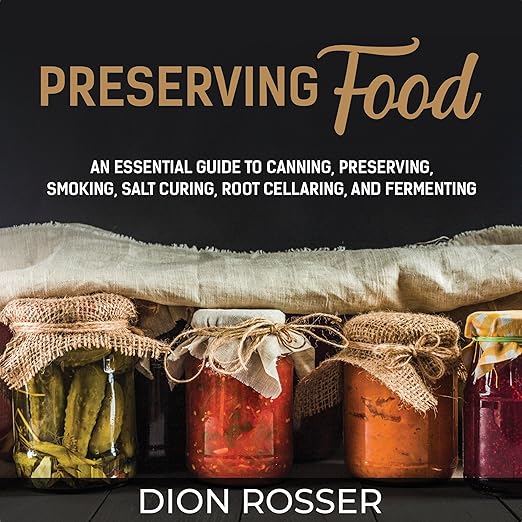
There is a specific kind of weekend that calls for this audiobook: the one where you have come back from the farmers market with more tomatoes than you can possibly eat fresh, the dehydrator you bought eighteen months ago is still in its box, and you have been meaning to look into fermentation since the sourdough phase of 2020 but never quite got there. That was, more or less, the afternoon I put on Dion Rosser’s Preserving Food, and I worked my way through a considerable portion of it while doing something finally useful with those tomatoes.
This is a four-manuscript compilation packaged as a single audiobook: canning and preserving, smoking and salt curing, root cellaring, and fermentation. The scope is ambitious. At thirteen-plus hours, it is substantive enough to function as a genuine reference rather than a surface-level overview, which puts it in a different category from the many short-format food preservation guides that have proliferated as interest in self-sufficiency has grown.
Our Take on Preserving Food
The compilation format has genuine advantages. Each of the four manuscripts covers its domain methodically – the canning section walks through the difference between water bath and pressure canning, explains what each method is appropriate for, and covers vegetables, fruit, meat, poultry, fish, jellies, and jams. The fermentation section, the longest of the four, includes more than seventy-five recipes covering kombucha, sourdough, kimchi, sauerkraut, yogurt, and more. Rosser treats fermentation not just as a preservation technique but as a gut health practice, connecting the traditional methods to the modern understanding of probiotics in a way that feels current without being breathless about it.
Reviewers at various experience levels found it useful. One self-described novice used it as a textbook. Another with decades of canning, smoking, curing, and fermenting experience found it a useful refresher that brought back some techniques they had let lapse. That range of applicability is a real accomplishment for a single compilation.
Why Listen to Preserving Food
The practical argument for audiobook format with instructional content is not always straightforward – you often want to be able to flip back to a specific technique, which audio makes harder than print. What the audio format gives you is a way to absorb the material during tasks that do not require screen attention: driving, preparing ingredients, doing other kitchen work. Ivan Busenius reads clearly and at a pace that suits the instructional register. He does not editorialize or try to perform enthusiasm he does not need to perform – this is technical content, and it benefits from a narrator who treats it as such.
The root cellaring section, which covers building a simple root cellar from scratch including DIY shelving and cleaning protocols, is particularly well suited to audio introduction. It is the kind of project where you want to understand the concept and scale before you look at diagrams, and the verbal walkthrough prepares you for that.
What to Watch For in Preserving Food
The audiobook format does impose real limitations on how useful this can be at the recipe execution stage. The fermentation section’s seventy-five-plus recipes are described in detail, but listeners will almost certainly want a print or digital version at hand when they are actually making the food. This is less a criticism of this specific title than a structural truth about instructional audiobooks, but it means the audio version is probably best used as an orientation and overview layer rather than a step-by-step kitchen companion.
The compilation nature also means that the four sections vary slightly in depth and approach, since they originated as separate manuscripts. Listeners who dive deep into one area – professional smokers, dedicated fermenters – may find that individual sections feel incomplete compared to a dedicated single-subject guide. The breadth is the value proposition; depth within any one area requires supplemental reading.
Who Should Listen to Preserving Food
The ideal listener is someone approaching food preservation with genuine interest but limited prior experience, who wants a broad foundation across multiple methods before committing to a specialty. It is also a reasonable choice for existing practitioners who want a consolidated refresher rather than new material. Those who already have dedicated expertise in any of the four areas will likely find that section underwhelming. The four-in-one format is a strength for beginners and a potential limitation for specialists.
Frequently Asked Questions
Does the audiobook format work for an instructional food preservation guide?
For learning and orientation, yes. For actual recipe execution, you will want a print or digital version at hand – the fermentation section alone includes over 75 recipes that are difficult to reference in pure audio. Think of the audiobook as the conceptual layer and keep the text accessible for the kitchen.
Which of the four manuscripts is the most substantial in the compilation?
The fermentation section is the largest, covering kombucha, sourdough, kimchi, sauerkraut, yogurt, and more with over 75 recipes and background on gut health and probiotics. The canning section is the most comprehensive for beginners covering the widest range of food types.
Is this suitable for someone with no prior food preservation experience?
Yes – multiple reviewers described themselves as complete beginners who found it accessible and thorough. The writing assumes no prior knowledge and builds from foundational concepts in each section.
Does the root cellaring section cover building a root cellar from scratch?
Yes, including a step-by-step guide to building a simple root cellar, DIY shelving, and cleaning and sanitization protocols. Reviewers who were actively researching root cellar construction found this section directly useful.