Quick Take
- Narration: Ivan Busenius reads with a functional clarity that suits the practical guide format, though the delivery is neutral rather than engaging; it gets the information across without inspiring the material.
- Themes: Self-sufficiency and resilience, off-grid living, disaster preparedness psychology
- Mood: Practical and earnest, with the slightly anxious urgency of someone who genuinely believes the storm is coming
- Verdict: A broad survey that works best as an orientation for complete newcomers to the homesteading and prepping world, experienced practitioners will find it thin, but beginners will have a useful map.
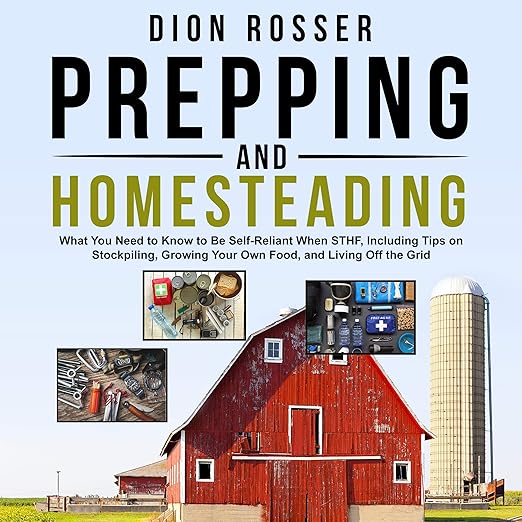
I had been looking for something to listen to during a stretch of weekend gardening, the kind of task that occupies your hands but leaves your mind free. Prepping and Homesteading by Dion Rosser seemed like a logical choice: a practical guide to self-sufficiency, broad enough in scope to cover both disaster preparation and everyday homesteading skills. I made it through the full six hours and forty-nine minutes before the beds were done. That gives you some idea of the pace and density of what is here.
Rosser positions this book as a two-part introduction to two overlapping disciplines. Part one covers prepping: the philosophy of being prepared for disruption, the practical skills involved, how to build a bug-out bag, what to stockpile, how to think about off-grid living. Part two turns to homesteading specifically: how to acquire land without financial ruin, the essential skills of producing your own food, the psychology of becoming a producer rather than a consumer. That framing, producer versus consumer, is one of the more interesting ideas in the book, and Rosser returns to it several times with genuine conviction.
Our Take on Prepping and Homesteading
The honest answer is that this book sits in an awkward middle zone. It covers significant ground, the chapter on rookie prepper mistakes and how to avoid them is genuinely useful, as is the section on the eleven essential homesteading skills, but it does so at a level of generality that will frustrate anyone who comes with prior knowledge. One reviewer put it directly: the prepping half is a “horribly basic overview” compared to what the dedicated prepping literature offers. That is fair. If you have already read anything substantial in either the prepping or homesteading genres, you will find Rosser re-covering ground you know.
Where the book is more successful is as a unified introduction, a single volume that gives someone new to both concepts a starting map before they decide which direction to go deeper. The argument for why prepping and homesteading belong together is genuinely made rather than assumed, and Rosser has real affection for the homesteading life that comes through in the second half. The sections on the psychology of expanding a homestead too quickly, and the often-overlooked importance of starting small and consolidating skills, contain practical wisdom that goes beyond the checklist format.
Why Listen to Prepping and Homesteading
Ivan Busenius provides a clear, straightforward narration that treats the material as functional content rather than entertainment. That approach fits the guide-book format, though it means the listen has the atmosphere of a well-organized training manual rather than a conversation. At just under seven hours, the runtime is accessible, this is not a dense investment of time, and the chapter structure makes it easy to navigate back to specific sections after the fact.
The book works best listened to as background while doing something hands-on. Rosser’s prose is not designed to reward close analytical attention; it is designed to deliver information in digestible increments. That is a legitimate design choice for the audience this is targeting, and Busenius’s pacing honors it.
What to Watch For in Prepping and Homesteading
The most consistent critique from reader reviews is the gap between what the book promises and what it delivers on the practical “how-to” front. Rosser is good at identifying what needs to be done, what skills to acquire, what supplies to accumulate, what land characteristics to prioritize, but the detailed instruction on how to actually execute those things is often absent. One reviewer called this the book’s central failure: it tells you what, but not how. That is an honest assessment. If you are looking for step-by-step instruction, this is not that book. If you want a conceptual framework and a prioritized list of what to learn next, it serves that purpose more adequately.
The GMO section in the homesteading chapters takes a firm anti-GMO stance that some readers will find credibly grounded and others will find ideologically overreaching. It is worth knowing that perspective is present so you can contextualize the framing accordingly.
Who Should Listen to Prepping and Homesteading
This audiobook suits people who are genuinely new to both prepping and homesteading and want a single-volume orientation before committing to deeper research in either direction. It also works for people whose interest is philosophical rather than operational, readers who want to understand the worldview and motivation of the self-sufficiency movement more than acquire specific technical skills. Experienced preppers or working homesteaders will find little new here. The book is honest about its level and delivers on it for the right audience; the mistake is expecting something more advanced than it presents itself to be.
Frequently Asked Questions
Does the book cover both prepping and homesteading equally, or does one half outperform the other?
The homesteading half is generally considered the stronger section. The prepping portion is broad but thin compared to dedicated prepping guides; the homesteading chapters have more texture and practical detail, particularly around land acquisition strategy and the pitfalls of expanding too quickly.
Is this suitable for someone who already has experience with either prepping or homesteading, or is it strictly for beginners?
Strictly for beginners. Multiple reviewers with existing knowledge in either field found it too surface-level to add value. If you have read one or two books on either topic, you have likely covered most of what Rosser covers here.
How does the bug-out bag and stockpiling advice compare to dedicated prepping guides?
It is an introduction rather than a thorough treatment. Rosser covers the categories of what to include and why, but the depth of guidance falls short of what you would find in a dedicated prepping manual. The value here is orientation, not operational detail.
Does Prepping and Homesteading take a particular ideological stance on self-sufficiency that listeners should know about upfront?
Yes. The book takes a skeptical position on GMO crops in the homesteading section, and the overall framing is consistent with a broadly preparationist worldview that assumes social and financial instability as a likely backdrop. That perspective is present but not overwhelming.