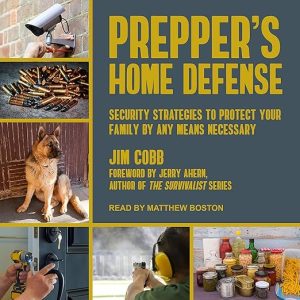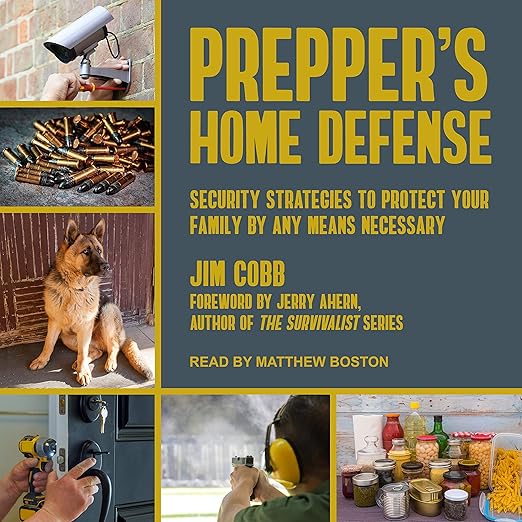
Jim Cobb's Prepper's Home Defense belongs to a genre that too often oscillates between paralytic anxiety and action-movie fantasy. This audiobook, narrated by Matthew Boston across five hours, does neither. Cobb is a survival consultant and writer with a background in social work, and that combination shows in how the book is organized: not around fear, but around the gap between current household vulnerability and a more defensible position, and the concrete steps that close that gap. The framework is Deter, Delay, Defend - a sequence that reflects a realistic understanding of how home security actually works rather than a romanticized vision of last-stand heroics. The 4.4 rating across nearly a thousand listener reviews reflects a book that delivers what its title promises without inflation or alarm.
Five Layers Where Community Outranks Fortifications
Cobb structures the audiobook through five interlocking layers: perimeter security systems and traps, house fortifications and safe rooms, secured and hidden storage for supplies, firearms and defensive combat techniques, and finally the intelligence-gathering and alliance-forming that go beyond the individual property. That final category is what separates this from books that treat self-reliance as a purely solo project. Cobb's consistent argument is that community relationships and shared security planning are more effective than any single household's fortifications, regardless of how thoroughly that household has prepared. A well-defended house surrounded by unprepared neighbors is not a well-defended position. That nuance is what lifts the book above the survivalist genre's typical individualism.
The five-star reviewer who identified herself as a suburban prepper with martial arts and amateur radio backgrounds noted that the book held up against her existing knowledge while still adding specific practical detail. The four-star reviewer who found value as a newcomer to the subject praised the clarity of Cobb's writing and its accessibility to beginners. That range speaks to a book that knows what it is and executes it well: a serious primer for people who want to think systematically about household security without requiring either military training or a rural property as prerequisites. Cobb writes as though he is sitting across from you and has an hour to tell you what you actually need to know, rather than everything he knows.
The safe room and fortification sections are the most technically specific part of the book, and Cobb addresses both structural modifications and lower-cost interim measures that apply to renters or people with limited budgets. He does not pretend that a hardened safe room is within reach of every listener, but he does explain the principles behind what one should accomplish, which allows readers to apply those principles to their own situations at whatever level of investment is realistic.
Boston Keeps a Five-Hour Manual Restrained
Matthew Boston's narration keeps the audiobook in its intended register throughout. Cobb's prose is direct and instructional, and Boston does not try to add drama or urgency that the writing declines to perform. For a subject that attracts both sensationalism and grim fantasy from lesser presenters, this tonal restraint is exactly right. At five hours, the audiobook is short enough to complete in a single long session, which suits its function: this is reference material as much as a narrative, and listeners will want to process each section with deliberation before moving to the next.
The accompanying PDF mentioned in the book's notes comes with the audio purchase on the platform and extends the value of the listening experience. Charts, checklists, and diagrams supplement Cobb's verbal descriptions of fortification and security systems, and listeners who are actively planning a household security upgrade will want to work through those materials alongside the audio chapters. Cobb's verbal descriptions of physical security systems are clear, but some of the spatial concepts benefit from the visual reference the PDF provides.
Firearms Chapters Depend on Your Jurisdiction
The firearms sections are practical and specific in a way that will be useful to readers who have decided to incorporate personal defense weapons into their security plan and less useful to those who have not. Cobb does not proselytize about firearms ownership, but he assumes a readership that views it as a legitimate option. Listeners in jurisdictions with strict firearms regulations will need to filter those chapters through their local legal context rather than applying his advice directly. The core security framework is fully applicable regardless of whether the listener chooses to add a firearms component.
One reviewer noted that the sidebar boxes from the print edition do not translate perfectly to audio, which is a fair observation about a book designed with a visual reference component in mind. Boston reads the core text cleanly, but the slightly fragmented feel of passages that were clearly designed for a different format is occasionally audible. This is a minor issue and does not significantly affect the listening experience, but listeners who find themselves wanting visual reference material should access the accompanying PDF as they go.
Suburban Homeowners Get the Clearest Entry Point
Suburban homeowners who are starting to think seriously about household security in the context of broader emergency preparedness will find this audiobook the clearest available introduction to the subject. Existing preppers who have focused primarily on food and water storage but have not yet addressed the security dimension of their planning will find Cobb's systematic approach fills a genuine gap in their preparation. Renters and apartment dwellers will find some sections, particularly those dealing with perimeter and structural fortification, less applicable to their situation, but the community alliance and secured storage material applies regardless of property type. Readers looking for tactical combat training or weapons specifications should look elsewhere; this is planning and preparedness at the household level, not operator doctrine.
Before You Listen
Does this audiobook assume the listener already owns firearms?
No. Cobb addresses firearms as one component of a broader security plan and provides context for those considering them, but the book's core framework around perimeter security, fortification, and community planning does not require firearms ownership to be fully actionable.
Is this audiobook useful for renters or people in apartments?
Partially. The perimeter and structural fortification chapters assume property ownership and are less applicable in rental situations. However, the sections on secured storage, intelligence gathering, and community alliance building apply to any living situation, and the overall security-thinking framework is universally useful.
Does the audiobook cover natural disaster scenarios or only civil unrest?
Cobb's framework is designed around the scenario where civil infrastructure has failed and social order has broken down. The principles apply across a range of disaster scenarios rather than only civil conflict, but the primary framing is the extended grid-down situation rather than short-term emergency response.
How does the PDF companion material work with this audiobook?
The accompanying PDF is available in your library alongside the audio file on the platform where you purchase. It contains charts, checklists, and diagrams referenced in the text. The visual reference is particularly useful for the security systems and fortification sections, where spatial concepts are harder to convey through audio alone.