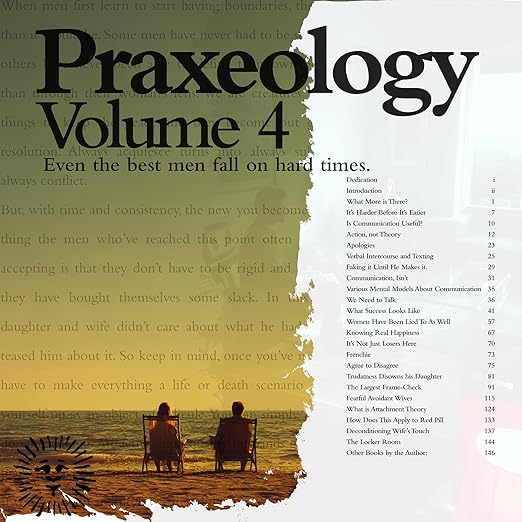
Before You Press Play
- Voice: Jack Napier reads rather than the author, and that credit is one of only four production facts this listing bothers to state.
- Big ideas: Achievement without satisfaction, relationship strategy, subculture vocabulary, accounts in place of instruction.
- Atmosphere: Blunt and insider-facing, with no on-ramp offered.
- Worth it?: Fine for anyone already three volumes deep, and close to unbuyable for everybody else on the evidence provided.
Ninety-nine characters is the entire description on this record, and I counted them twice to be certain. One sentence, about guys who had it all and still ended up at the low point the Red Pill guys are here to work on, is everything the page offers about a fourth volume. The audiobook runs five hours and fifty-two minutes. Whether those are five hours you want depends almost entirely on information this listing has declined to supply.
Ninety-Nine Characters and an Undefined Central Term
Volume four of a series arriving with a one-line description represents a specific publishing decision. It assumes you already own the first three, know what the title means in this context, and need no persuading. That is defensible for a returning reader and useless to anybody else. Nothing here states the scope of the book, the questions it takes up, whether it collects new material or revisits old ground, or what separates it from the three volumes behind it.
Praxeology is never defined anywhere on this page. The word appears in the title and in the series field and nowhere else, so a buyer who does not already know what Rian Stone means by it receives no help whatsoever. The one sentence available does establish a subject: men who by conventional measures were doing well and reached a low point regardless. That is a genuinely interesting starting problem, and the record says nothing about how the book proposes to work on it.
Jack Napier's Six Hours for 4R Books
Jack Napier holds the reading credit, 4R Books issued it in March 2026, and the running time sits just under six hours. Those facts, plus a series number, make up the complete evidence a buyer can gather without leaving the page. On a title where the entire question is whether the material suits you, that is a thin basis for a decision, and the sample ends up doing work a description ought to have done.
The Gap Between Achievement and Satisfaction
Familiarity is the strongest argument for this one. Anybody who has worked through the first three volumes already knows the framework, the vocabulary and the author's method, and a fourth installment hands them more of it with no overhead. A series reaching volume four inside a niche this narrow does so because a readership keeps coming back, which counts as a form of evidence in itself when the description supplies none of the usual sort.
Six hours is a sensible length for material of this type. Long enough to develop several cases at a pace that lets each one register, short enough to finish across a couple of long walks, and far less demanding than the doorstop treatises this corner of publishing tends to produce. If the book really is assembled from accounts rather than from argument, the running time suggests a handful of them treated properly rather than a survey.
Specificity is the promise hiding inside that single sentence, and it deserves taking seriously. Most books in the self-improvement register address a man who is failing at something obvious. This one names a different and much less discussed situation: the person who did everything the scoreboard asked, achieved it, and arrived at a low point anyway. The gap between achievement and satisfaction is a real subject, and very little of the surrounding literature separates the two cases at all.
Jargon the Lone Review Never Bothers to Explain
Vocabulary is the first barrier and the record does nothing to lower it. The lone written response calls the contents field reports, credits somebody named Couch with having covered everything valuable in the RP space, and reports having read all four Praxeology books. Not one of those terms appears anywhere in the listing. Couch is not the byline, RP is never expanded, and field reports is not a phrase the description uses, so the only person describing this book speaks a language the page has not taught you.
Shelving spreads across three categories at once: health and wellness, politics and social sciences, and relationships, parenting and personal development, with a psychology and mental health tag laid over the top. A browser arriving from any one of those will find something other than what the shelf implied. The health and wellness placement in particular sets up an expectation this book will not meet, and anybody looking for evidence-based material should read the title and the description together first.
Timing deserves a note too. The written column predates the recording entirely, filed in early February, weeks before 4R Books released this in the middle of March. What sits above the responses is therefore a badge earned by a text rather than by a reading, awarded from inside the audience the book was written for, which is the least demanding position from which to judge anything at all. A buyer standing outside that audience gets no independent check, and the page offers nothing to supply one.
Existing Series Readers Are the Only Real Audience
Existing readers of the series are the only audience this page addresses, and they will already know whether they want it. If the first three volumes proved useful, a fourth built the same way almost certainly will be, and nothing in the description hints at a change of method or a shift of subject. That is what a one-sentence description says implicitly: you know what this is, and I am not going to explain it to anybody else.
First-time buyers should start at volume one instead, and the record gives no reason to do otherwise. A series that has reached its fourth installment inside a defined framework was never designed to be entered halfway through, and this page does nothing to make an exception workable. Reconstructing a vocabulary nobody defines, from a description one sentence long, is a poor use of six hours and a worse use of the money.
Skeptics of the subculture will not be persuaded here and should not spend the time trying. The framework carries its own premises, and this volume assumes them rather than arguing them, which is the normal shape of a fourth book. What the record leaves open is the middle case: somebody who recognizes the problem that one sentence describes, achievement without satisfaction, and has no interest in the movement around it. That listener deserves a description, and this page does not provide one.
Frequently Asked Questions
Do you need the earlier Praxeology audiobooks first?
Almost certainly. The series field puts this at volume four, the description runs to a single sentence, and no recap or scope statement appears anywhere on the record. Starting here means picking up a framework in the middle, with nothing on the page to define the terms it uses or to say what this installment adds.
What does the audiobook actually contain?
The page will not tell you. Its description covers one sentence, about men who had it all and reached a low point anyway, and then stops. No chapter list, no scope statement, no summary of what separates this volume from the previous three. Five hours and fifty-two minutes of material sit behind that single line.