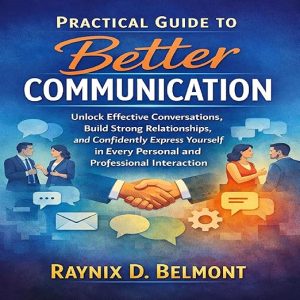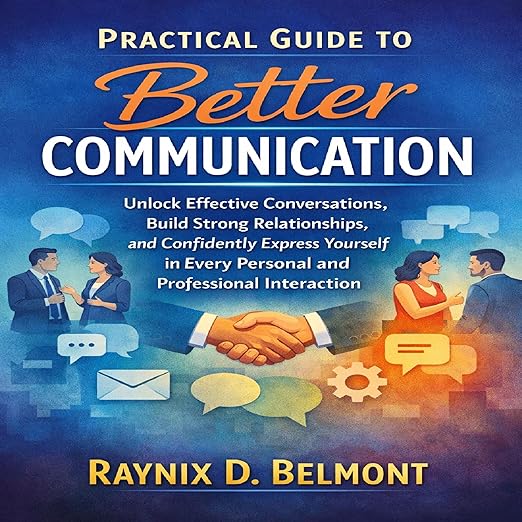
Communication skills guides occupy a peculiar corner of the self-help audiobook market: they are sold primarily to people who already communicate reasonably well and want to communicate better, rather than to people with significant deficits that require remediation. RaynixD Belmont's Practical Guide to Better Communication positions itself directly at that audience, and Eddie Leonard Jr.'s narration carries the material with the kind of engaged clarity that communication guides especially need, a narrator who models good delivery while explaining it.
Hearing Is Passive, Listening Is a Deliberate Act
Belmont's stated goal is to offer practical tools rather than abstract theory, and the book largely delivers on that commitment. The chapter structure follows the core competencies of effective communication in sequence: active listening, clear speaking, nonverbal cues, emotional intelligence, and adaptability. That sequence is logical and pedagogically sound, active listening comes first because it is the foundation on which everything else rests, and the book treats it as such rather than burying it after sections about presentation technique and assertive speaking.
The active listening section is the most developed. Belmont distinguishes between hearing, the passive reception of sound, and listening as a deliberate act of attention that includes noticing what is not said, tracking emotional subtext, and managing your own response impulses while the speaker is still speaking. For professional listeners, those distinctions are familiar. For people who have never formally examined their listening behavior, the section provides genuinely useful categories. The book's promise of 'real-world examples that make the concepts easy to understand and implement' is most fully kept here, where the scenarios are recognizable enough to produce the kind of self-recognition that communication training requires.
Leonard Makes the Voice-Register Shifts Legible
The emotional intelligence chapter earns its inclusion in a communication guide by treating emotional regulation as a communication skill rather than a separate psychological topic. Belmont's argument that your emotional state is continuously communicating regardless of your words, and that managing that background signal is part of communicating effectively, is well grounded and practically framed. He avoids the trap of making emotional intelligence sound like emotional suppression; the chapter distinguishes clearly between the ability to recognize and name emotional states and the ability to choose whether and how to express them in a given context.
Adaptability receives specific treatment in its own chapter, which reflects how seriously Belmont takes audience-awareness as a core competency. The book's framework for reading a communication partner's style and adjusting your approach accordingly is the kind of material that consultants and coaches charge considerably more than this book costs to teach. The audio format works particularly well for this section because Belmont's examples are scenario-based and verbal, and Leonard's delivery makes the voice-register shifts in each scenario legible in ways that print cannot replicate as efficiently.
Eddie Leonard Jr.'s narration is one of the strengths that elevates this particular audiobook. He reads communication content with appropriate warmth, not artificial enthusiasm, but the kind of engaged attention that the subject matter calls for. He sounds like someone who has thought about the way he speaks to people, which is exactly the register a communication guide needs. For a book that depends on the listener connecting the advice with the performance, Leonard's narration is a casting success.
Guidance About Body Language for Someone Listening
The guide's primary limitation is its scope. At three hours and forty-two minutes, Belmont covers significant territory efficiently, but that efficiency comes at the cost of depth. Listeners who have already read Nonviolent Communication by Marshall Rosenberg, or spent time with Susan Scott's Fierce Conversations, will find that much of Belmont's framework overlaps with those more extensively developed accounts. The Practical Guide is best understood as a structured overview rather than a comprehensive training system.
The book is strongest on the interpersonal and workplace communication scenarios; it is less developed on the high-stakes versions of the same skills, conflict resolution in significant relationship ruptures, communication under organizational crisis, navigating conversations where power differentials are extreme. Those scenarios require the kind of contextual nuance that the book's efficient structure cannot fully accommodate.
The nonverbal communication chapter addresses one of the genuinely interesting challenges of applying communication advice in audio format: how do you convey guidance about body language, eye contact, and physical presence to someone who is listening rather than watching? Belmont handles this well by focusing on the communicative intent behind nonverbal signals rather than on their physical mechanics. The principle that nonverbal communication functions primarily to signal emotional authenticity or its absence, rather than to perform specific gestures, translates cleanly to audio and gives listeners a framework that works in video call environments as well as in-person settings. That adaptability is practically important given how much professional communication now happens in hybrid contexts where visual cues are partial or intermittent.
Listeners who find themselves regularly navigating cross-cultural professional communication will find the adaptability section particularly worth attention. Belmont's framework for reading communication style preferences across cultural registers is necessarily high-level for a book of this scope, but the orientation it provides, toward curiosity and adjustment rather than assuming universal norms, is useful as a default stance. Eddie Leonard Jr.'s narration stays appropriately measured through these sections, which benefits the content: a guide about adjusting to your audience should not itself be one-register delivery, and Leonard's performance demonstrates range without calling attention to it.
Listening to Guidance About Listening Has Its Own Logic
Listeners who want a structured audio introduction to communication fundamentals, particularly those new to the personal development genre who have not yet encountered the key frameworks, will find this an accessible and well-organized starting point. The audiobook format suits the material particularly well because communication is a verbal and auditory domain, and listening to practical guidance about listening has an intrinsic logic that print does not replicate.
Listeners who have already developed significant communication awareness through therapy, coaching, or extensive reading in the space will find the content familiar rather than revelatory. This guide is best positioned as an entry point or a refresher, not as advanced training for people who already operate at a high level of communicative sophistication.
- Performance: Eddie Leonard Jr. brings engaged warmth to the material, modeling the communication quality the book advocates; he sounds like someone who has thought carefully about how he speaks, which is the correct register for this content.
- What it covers: active listening as foundation, emotional intelligence as communication skill, adaptability to communication styles
- Feel: Clear and practical, structured without being clinical
- Our call: A solid communication fundamentals audiobook narrated with appropriate care; best positioned as an accessible introduction for listeners new to the personal development space rather than advanced training for experienced communicators.
Common Questions
How does Eddie Leonard Jr.'s narration serve the Practical Guide to Better Communication audiobook?
Leonard's narration models the engaged warmth the book advocates, which creates a productive alignment between the instruction and its delivery. He reads the scenario examples with register shifts that make the practical distinctions legible in audio, which print cannot replicate as efficiently.
Does the audiobook cover workplace communication specifically, or is it general?
Both. Belmont draws on workplace and interpersonal scenarios roughly equally. The adaptability chapter is particularly applicable to professional contexts, and the emotional intelligence framing has direct workplace relevance. The book does not exclude personal relationship communication.
How does this audiobook compare to other communication guides like Nonviolent Communication or Fierce Conversations?
Belmont's book is shorter and more broadly accessible than either of those titles. It covers similar core concepts at overview level rather than developing any single framework in depth. Listeners who have read those books may find the Practical Guide covers familiar territory; listeners encountering communication frameworks for the first time will find it a useful and efficient starting point.