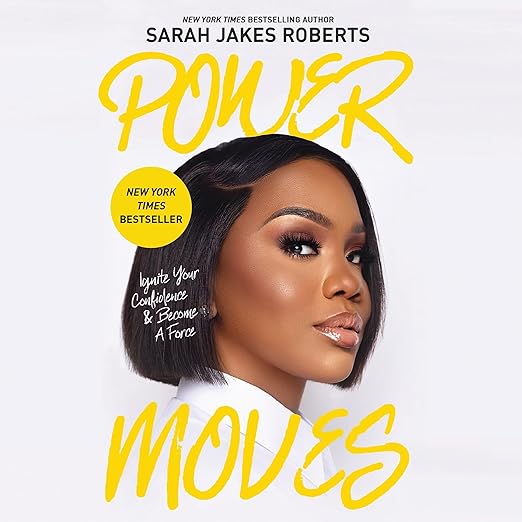
An exclamation point in the publisher copy is doing more work than it looks like it should. Read by the Author! sits at the very top of the description, ahead of the pitch, ahead of the credentials, ahead of everything else. On most books that would be a nice-to-have. On this audiobook it is close to the whole proposition, because Sarah Jakes Roberts is a working pastor, the material is built almost entirely out of direct address, and the distance between reading an exhortation and being handed one by the person who wrote it is not a small distance. The credits get her name slightly wrong on the way through, listing the narrator as Sarah Roberts against a byline reading Sarah Jakes Roberts, which is a filing slip rather than a mystery.
Power Moves is a book about subtraction wearing the jacket of a book about power. Roberts spends most of it stripping things away: other people's projections, the expectations that arrive with a single scroll through a phone, the maintenance work of appearing to have it together. What remains, in her framing, is the raw material that God's love can actually meet. Power does not live in success, achievement or performance, the description says flatly, which is an odd argument for a book with this title to make. It lives instead in humility, honesty and a commitment to continuous growth. That is a harder sell than the cover implies, and it is also why the thing holds together. The promise is not that you will become more powerful. The promise is that you will stop spending yourself on upkeep.
A note on this page praises the way Roberts formatted the book, singling out the tools built into it as the reason for not being able to set it down. That deserves a pause, because formatting is the single thing an audio edition cannot show you. Whatever visual scaffolding exists in print flattens here into one continuous voice. The four commitments the description sets out, giving language to changing needs, applauding your own growth, refusing to carry everything at once or alone, and releasing your power, arrive as spoken sentences rather than as a structure you can see on a page. The material mostly survives the change, because it was written as speech to begin with. Listeners who work by capturing frameworks will still feel the loss.
The Strengths
Buried in a note filed in December 2025 is the best argument for this edition, which says the lessons are actionable and feel personal, as if the author were speaking directly to you. In print that is a compliment about voice. Here it stops being a comparison. Roberts is reading her own text, so the as-if simply collapses. Books of spiritual instruction usually reach a listener through a hired third party who has to perform conviction rather than hold it, and that gap is audible more often than publishers would like to admit. This edition does not have the gap. Whatever you make of the theology, the delivery mechanism and the content are the same object, which is more than most titles in this category can claim.
Shape is the second reason. The description builds the book around a single diagnostic question, whether you are living authentically or quietly maintaining the status quo, and works outward from there. That is a question shape rather than a chapter shape, and it tolerates interruption unusually well. Seven hours and thirty minutes is too clean a number to be a stopwatch reading, but the practical consequence is that the material divides into sittings without losing its argument between them. Roberts wrote this as the newly appointed pastor of The Potter's House Church in Dallas and as the author of Woman Evolve, and the register throughout is instruction rather than testimony.
Before You Commit to Power Moves
Metadata on this listing does not survive a moment's arithmetic. The average displayed is 4.8 and the number of ratings recorded behind it is one. A single vote can only land on a whole star, so 4.8 cannot possibly have come from it. Meanwhile five responses sit visibly on the page, every one of them at five stars. Whatever the real tally is, the field reporting it is broken, and the average deserves to be read as unverified rather than as a settled verdict. Worth adding that one of those five responses runs to a single sentence saying the writer absolutely loves the book, which is warm and is not evidence you can act on.
Specificity is the second caution. A note filed in January 2026 credits the book with practical lessons you can actually apply, and that is the claim most likely to split listeners. Roberts works in the vocabulary of posture and interior orientation rather than procedure. Give language to your changing needs is a genuine instruction, but it is not a step, and it does not become one by being spoken aloud. If a workbook is what you came for, this is not one, and audio strips away even the illusion of one by removing anything you could underline or find again by page number. Anybody who has previously found Christian nonfiction frustratingly abstract will meet the same texture here, at a somewhat higher temperature.
Recommended For
Audience is named here without much ambiguity, and a note filed in September 2025 names it straight back: if you are a Christian, this one is for you. The framework is explicitly power in Christ, the diagnostic runs through God's view of you rather than your own, and nobody has sanded the theology down for a general reader. That directness is a virtue if you share the premises and an immediate barrier if you do not. Inside that audience, the listeners best served are people carrying more than they have admitted to carrying, since refusing to bear the weight all at once or all alone is one of the four commitments the book organizes itself around.
Pass on it if the vocabulary of authenticity grates on you, because it recurs constantly and without apology. Pass on it when you need theology argued against opposing positions rather than built from the inside, since Roberts assumes agreement and proceeds from there. The people who get the most out of this recording are the ones who already trust the voice and would rather have it in the room than on a shelf, which is exactly what an author-read edition supplies and what no third-party reading could stand in for. The commitment is manageable, the address is constant, and the format choice turns out to be the argument.
Common Questions
How long is the Power Moves audiobook and when was it released?
It runs seven hours and thirty minutes, issued by Thomas Nelson in the spring of 2024. That is a middling length for Christian instruction, dividing into six or seven comfortable sittings, though a runtime landing exactly on the half hour is usually an approximation.
Does the Power Moves audiobook assume you have read Woman Evolve?
No. The series data on this page is empty in both fields, and nothing formally connects the two titles. Woman Evolve turns up in the description purely to establish Roberts as a bestselling author, alongside her appointment as pastor of The Potter's House Church in Dallas.
What kind of Christian nonfiction is this?
It is filed under religion and spirituality with a Christianity tag, and it operates as instruction rather than devotional reading or verse-by-verse exegesis. The organizing frame is authentic power in Christ, aimed squarely at readers trying to shed other people's expectations of them.