Quick Take
- Narration: Virtual Voice delivers Mir’s dense theoretical prose at consistent flat register, which strips the epigrammatic style that endorsers specifically praise from its intended rhythm.
- Themes: The economics of media collapse, outrage as product, the transformation of journalism into political advocacy
- Mood: Cerebral and somewhat bleak, with the compressed energy of a book making a large argument in tight quarters
- Verdict: The theoretical framework Mir builds is genuinely valuable and has held up since 2020, but Virtual Voice narration is a poor match for prose described by endorsers as rich in quotable epigrams.
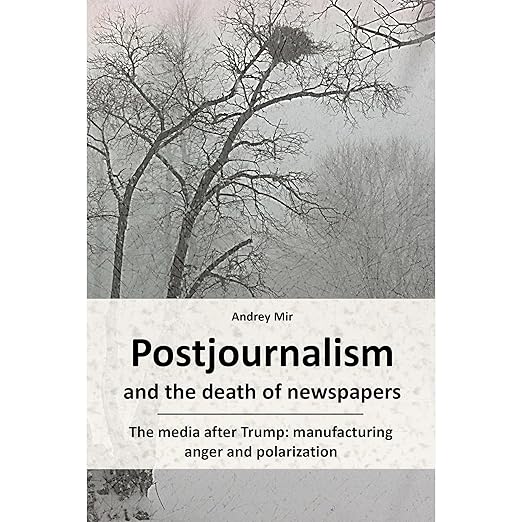
One of the endorsers of Postjournalism and the Death of Newspapers, the media theorist Paul Levinson, calls it the most important book in media theory written in the past 40 years. That is a significant claim, and it is not entirely disconnected from what the book actually delivers. Andrey Mir’s central argument, that the collapse of advertising revenue forced news organizations to switch from manufacturing consent to manufacturing anger, is one of those theoretical frameworks that, once you have encountered it, you cannot easily stop applying to what you see in front of you.
The economic argument is Mir’s primary contribution and his most durable one. Ad-supported journalism needed large, undifferentiated audiences, which created structural incentives for relative neutrality. Subscription-supported journalism needs motivated, emotionally invested subscribers, which creates structural incentives for confirmation and outrage. The shift from plentiful ad revenue to desperately seeking reader and viewer revenue is, in Mir’s account, not a story about ideology but about economic survival. Editors did not decide to become more partisan; the business model they were forced into selected for partisan content because partisan readers pay more reliably than neutral ones.
The Intellectual Lineage and the Epigrammatic Style
The comparison to Marshall McLuhan is not accidental. Mir writes in a compressed, aphoristic style that aims for the kind of formulations that can travel across contexts and disciplines. Martin Gurri, author of The Revolt of the Public, praises him for writing in a “wonderful epigrammatic style” and promises that readers will be “digging up quotes from it for years.” That style is real in print. In audio via Virtual Voice, it largely disappears. The compression that makes Mir’s best formulations memorable depends on rhythm and pacing, the slight pause before a reversal, the sentence structure that sets up a principle and then overturns it. Virtual Voice delivers all of this at uniform tempo, which is a meaningful aesthetic loss for a book whose medium-is-the-message credentials are unusually high.
The book also draws on a broad intellectual history of news media, tracing the evolution from oral to print to digital distribution and the business models each enabled. This historical depth prevents the argument from being simply reactive to the Trump moment, even as the Trump era serves as its primary contemporary case study. The 2025 revision referenced in the synopsis suggests Mir has updated the framework for subsequent developments, which matters for a theory that needs to engage with the proliferation of social media-native journalism and the partial recovery of some outlets through digital subscriptions.
Where the Argument Needs More Work
The book is stronger in diagnosis than prescription. Mir is, as one reviewer accurately noted, quite pessimistic, and his analysis of polarization as a structural media effect rather than a political choice does not leave much room for reform. The implicit conclusion is that as long as subscription revenue dominates, the incentive to manufacture anger will persist, and no amount of editorial courage or journalistic ethics training changes the underlying economics. Whether that pessimism is warranted or whether it underestimates the capacity of institutions to resist their own financial incentives is a genuine debate the book surfaces without fully resolving.
The reviewer who describes themselves as a longtime newspaper consumer offers the most poignant observation: the question is not just whether newspapers are dead but whether journalism has died alongside them. Mir’s framework suggests these are separate phenomena, and distinguishing them is one of the book’s useful contributions to the conversation.
The Virtual Voice Decision
At 10 hours and 48 minutes, Postjournalism is long enough that narration quality matters. Virtual Voice is particularly ill-suited to theoretical texts with distinctive prose styles because it cannot modulate for rhetorical effect. Sentences that are meant to arrive with weight arrive at the same volume as sentences that are meant to set up context. For a book whose endorsers specifically praise it for prose density and quotability, this is not a trivial limitation. Listeners who have access to the print or ebook edition would be better served by reading it rather than listening to this version.
Who Should Listen and Who Should Skip
Worthwhile for: media scholars, journalists, policy researchers, and engaged readers who want a theoretical framework for understanding why contemporary news behaves the way it does, and who can compensate for the narration’s limitations with active attention. Less ideal for: casual listeners who want the ideas without the density, or anyone expecting the epigrammatic wit that endorsers describe, which requires a human voice to land properly.
Frequently Asked Questions
What is the core difference between what Mir calls journalism and postjournalism?
Journalism, in Mir’s framework, was funded by advertising and served large undifferentiated audiences, which created incentives for relative neutrality and factual reporting. Postjournalism is funded primarily by subscribers who are emotionally invested in particular worldviews, which creates incentives to validate and amplify those worldviews. The shift is economic before it is ideological.
Was this book revised after its 2020 publication, and does the revision update the argument for more recent events?
Yes, the synopsis notes a 2025 revision. The original book introduced the concept of postjournalism in 2020, and the revision appears to update the framework for subsequent media developments. Listeners should be aware that the audio version may or may not reflect the 2025 revisions depending on when the recording was made.
Does the Virtual Voice narration significantly affect the listening experience for this book?
More than for some other titles. Mir’s prose is epigrammatic, meaning it relies on rhythm and compression to land its best formulations. Virtual Voice delivers all sentences at uniform tempo, which strips the rhetorical effect from the sentences that most need it. Endorsers specifically praise the quotability of Mir’s writing, a quality that depends on pacing a synthesized voice cannot replicate.
How does this book relate to other media criticism titles like The Revolt of the Public by Martin Gurri?
Gurri, who endorses Postjournalism, is analyzing related phenomena from a different angle. Gurri focuses on how the internet empowers distributed public voices to undermine institutional authority; Mir focuses on how those same dynamics transformed the economics of journalism. They are complementary frameworks, and readers who found Gurri’s book valuable will likely find Mir’s adds useful specificity to the media industry piece of that argument.