Quick Take
- Narration: Dolly Freed reads her own book, and the teenage voice she wrote it in comes through authentically; there is something both charming and slightly unnerving about hearing a teenager explain why you do not need doctors or lawyers.
- Themes: Radical self-sufficiency, the refusal of consumer culture, subsistence living as philosophical choice
- Mood: Bracingly practical and oddly liberating, like a manifesto written by someone who never learned to be politely vague
- Verdict: A 1978 survivalist classic that reads as more relevant now than it probably should, narrated by the teenager who lived it.
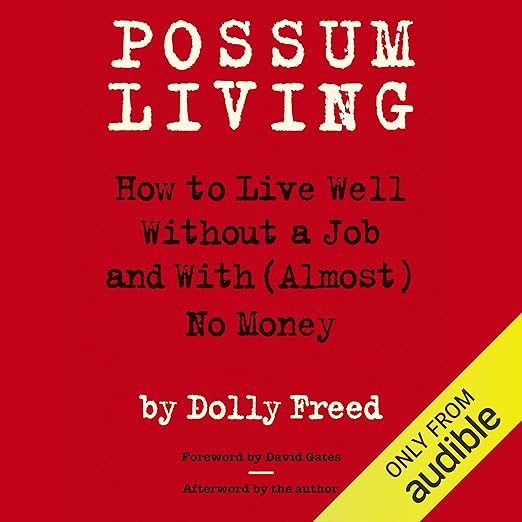
I first heard about Possum Living from a friend who described it as the most practical book she had ever read about opting out. She lent me her copy, a battered Tin House reissue, and I read it in an afternoon feeling alternately inspired and slightly alarmed. When I found out that Dolly Freed had narrated the Audible version herself, I immediately downloaded it. Hearing this book in its author’s voice adds a layer to the experience that print cannot replicate, because Freed was a teenager when she wrote it, and the voice she reads in carries the particular combination of certainty and innocence that makes the book’s most radical suggestions simultaneously more compelling and more believable than they would be from an adult expert.
The basic premise of Possum Living is straightforward: for nearly five years in the 1970s, Dolly Freed and her father lived on a half-acre lot outside Philadelphia, produced most of their own food and drink, and spent approximately $700 each per year. The book describes how they did it. It covers food production, home maintenance, dealing with the law, staying healthy without paying for it, and what Freed calls keeping up a middle-class facade when necessary. All of this is presented not as a political program or a romantic fantasy of self-sufficiency but as a set of practical techniques that worked and that Freed believes could work for others.
The Philosophy Dolly Denies Having
One of the book’s pleasures is that Freed explicitly refuses to describe herself as a philosopher. She insists she has no particular ideology, that she and her father simply chose the cheapest, most practical path and followed it. But one reviewer put it well: there is a beautiful philosophy running through the book whether Freed acknowledges it or not. The idea that most of what modern life treats as necessity, including doctors, lawyers, insurance, career, and the entire apparatus of consumer belonging, is actually optional if you are willing to think carefully about what you actually need rather than what you have been taught to want: that is a philosophical position, and it is argued here more effectively than in most books that announce themselves as philosophy.
The distinction between what you do need and what you do not is where the book is most useful and also most contested. Freed’s relationship with medical care, for example, reflects a nineteen-year-old’s confidence in her own health and a pre-internet era’s different relationship to both the costs and the accessibility of medicine. The afterword, written by Freed thirty years later as she had clearly matured into, as one reviewer put it, quite a nice person, acknowledges some of those shifts in perspective. The original text is a period document, and reading it as anything else would be a mistake. Reading it as a period document that still contains genuinely useful thinking about the optional nature of much of what we pay for is exactly right.
What the Book Actually Teaches About Living Cheap
The practical content divides into two categories: the immediately applicable and the obviously situated. Freed’s advice on food production, including raising rabbits and chickens, home brewing, and vegetable gardening on a small plot, is specific and actionable in ways that hold up in 2025. The chapter on maintaining a home cheaply, on making small repairs yourself, on understanding what legal protections you actually have, is similarly durable. One reviewer described reading this book, then Rich Dad Poor Dad, then actually buying a house with cash and heating it with wood, which is an extreme version of the book’s influence but an illustrative one.
The sections on medical care and legal advice are where the book shows its age most clearly, and where Freed’s teenage certainty tips into something worth questioning. She is not wrong that the medical and legal systems are expensive in ways that disproportionately affect people without resources. She is less reliable as a guide to navigating them safely. The book’s genius is in identifying the question of what is truly necessary. The answers it provides sometimes need updating.
Dolly Freed Reading Her Own Teenage Work
The self-narration is unusual and fascinating. Freed is reading material she wrote as a nineteen-year-old, and she does not attempt to add adult distance or retrospective wisdom to the voice. The result is that the text sounds exactly as young as it is, which matters. The confidence of a teenager who has worked out a system and is explaining it to you, without the qualifications and hedges that come with age, is part of what makes the book’s argument feel exciting rather than cautious. That same quality is also why the afterword is important: Freed adds the perspective that the original text intentionally does not have.
At five hours and forty-four minutes, the audiobook is a comfortable listen that fits naturally into a weekend afternoon or a series of commutes. The production from Audible Studios is clean, and Freed’s delivery is relaxed without being sloppy. For a book this specific in its advice, the audio format suits it well: you can listen while doing exactly the kind of domestic work the book advocates.
Who Should Spend Time With This Book
If you are curious about radical self-sufficiency but have found most contemporary homesteading content either too precious or too politically loaded, Possum Living offers something genuinely different: a practical manual written by someone who was actually doing it, without ideological framing or aspirational aesthetics. If you have already read the book in print, the audio version adds something real through Freed’s self-narration. If you are looking for a complete practical guide to off-grid living, this is a starting point rather than a destination, but it is an unusually honest one.
Frequently Asked Questions
Is Possum Living’s advice still applicable today, or is it too dated?
Mixed. The food production sections, including home brewing, small animal husbandry, and vegetable gardening, hold up well. The sections on avoiding doctors and lawyers reflect 1970s conditions and a teenager’s perspective, and should be read as period document rather than contemporary advice. Freed’s own afterword acknowledges this evolution.
Does Dolly Freed narrate the book differently from how a professional narrator would?
Yes, and the difference is meaningful. Freed reads the material she wrote as a nineteen-year-old without adding adult retrospective distance, so the voice carries the original book’s teenage certainty intact. That is both the appeal and the caveat of the self-narration.
Is this book politically oriented, like modern homesteading or prepper content?
Deliberately not. Freed explicitly refuses political framing and presents her choices as purely practical rather than ideological. The philosophy embedded in the book is real but never announced, which is part of what makes it readable across political contexts.
Is the 30-years-later afterword included in the Audible edition?
Yes. The Audible edition is based on the Tin House reissue, which includes both the original foreword by David Gates and Freed’s afterword written decades later. That afterword is worth staying for, as it adds perspective on what changed and what did not in Freed’s own assessment of her earlier arguments.