
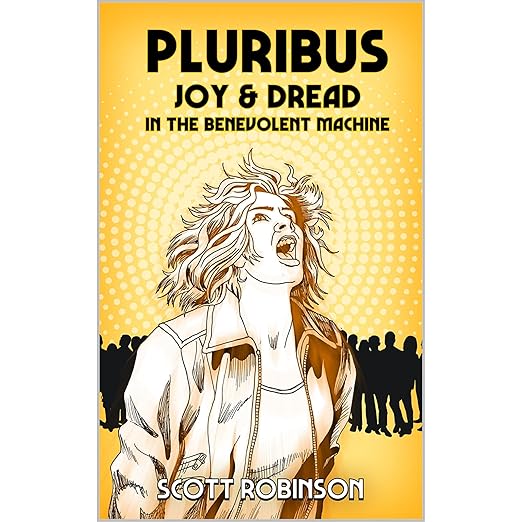
Pluribus: Joy and Dread in the Benevolent Machine is an audiobook companion to Vince Gilligan's Apple TV series of the same name, and it arrives with a premise calibrated to contemporary anxiety: an alien virus removes all of humanity's suffering, leaving only joy, cooperation, and total peace, while the one person unaffected by it decides this is a catastrophe worth fighting. Scott Robinson walks through each episode of the first season and then pivots to a collection of essays probing the philosophical territory the show maps. At four hours and fifty-one minutes, it is a compact listen for a genuinely dense subject.
The show's central figure, Carol Sturka (a romance writer described as chronically miserable who cannot enjoy her considerable success) is the human pivot on which the entire premise turns. Carol's immunity to the virus positions her not as a hero in any conventional sense but as someone who believes suffering is foundational to what makes humans worth saving. That argument, rendered through a genre lens by Gilligan (Breaking Bad, The X-Files), produces the kind of science fiction that operates as sustained philosophical provocation. Robinson's companion traces how each episode deploys that argument, connecting the series to predecessors including Invasion of the Body Snatchers and I Am Legend.
The Benevolent Machine's Double Meaning
Reviewer Becca Nushell's description of the book as a deep look at the philosophical questions in each episode is precise. Robinson is not writing television criticism in the conventional sense. He is not primarily interested in production decisions, casting, or narrative mechanics. He is interested in what the show is actually claiming about joy, dread, consciousness, and the relationship between suffering and meaning. That focus distinguishes this companion from the typical behind-the-scenes tie-in and makes it genuinely valuable for listeners who finished the season with the feeling that the ideas deserved more time than episodic television can provide.
Reviewer Craig Day's description of the book as a brilliantly unsettling exploration of our accelerating entanglement with artificial intelligence connects to one of the more interesting threads in Robinson's analysis. The benevolent machine of the subtitle is doing double work: it refers to whatever alien technology produces the virus, but it also maps onto contemporary anxieties about AI systems that might improve human welfare by removing human agency. Gilligan is clearly aware of both registers, and Robinson traces the connections with genuine intellectual precision.
AI Narration Depends on Your Tolerance
The audiobook format suits this companion well for a particular kind of listener: someone who is rewatching the series or who has recently completed it and wants to work through the ideas it raised in a structured way. Robinson's episode-by-episode section functions as a companion in the literal sense, something to bring alongside the viewing experience rather than replace it. The essays in the second section pull back to the larger questions, which rewards listeners who want to follow the show's ideas beyond their episodic deployment.
The Virtual Voice narration is worth acknowledging directly. AI narration in this category continues to improve, and its appropriateness here depends partly on the listener's tolerance for the format and partly on whether the clarity of Robinson's prose carries through the delivery. Reviewer D&S, noting the book reads like an episode-by-episode behind-the-scenes commentary with references to story events and inspirations, describes its value for engaged fans accurately. The companion does not try to be accessible to viewers who have not seen the show: it assumes you are in, and it rewards that assumption.
A Post-Viewing Companion, Not a Preview
The spoiler question is central to how this audiobook should be approached. Reviewer D&S explicitly flags that the book contains spoilers and should only be listened to by viewers who have completed the first season. That is not a caveat to bury: Robinson's analysis depends on knowing how the season resolves, and much of the essay section's impact is lost if the viewer has not yet seen the events being discussed. This is a post-viewing companion, not a preview or a supplement to an ongoing first watch.
Carol Sturka, Miserable Even in Her Cause
For listeners primarily interested in the philosophical territory rather than the series-specific analysis, Robinson's essay section functions more independently than the episode guide. The questions around voluntary suffering, the ethics of eliminating pain, and the distinction between peace and meaningful life are argued with enough rigor to engage readers who know the show only by reputation. But the companion's full value is unlocked by series familiarity, and the four-hour-fifty-one-minute runtime is best spent by someone who comes to it with that context already in place.
Robinson's framing of Carol Sturka as an unlikely protagonist for a story about the value of suffering is worth sitting with. She is not a sympathetic figure in the conventional sense: she is unpleasant, unsuccessful in the ways that matter to her despite her commercial success, and resistant to the happiness that the virus offers everyone else. Gilligan's choice to make the person who fights for suffering's preservation someone who has not found much joy in it is the most honest thing about the series, and Robinson spends real time on why that honesty matters philosophically as well as dramatically.
For Fans of Body-Horror Allegory Traditions
Viewers who have completed Pluribus Season 1 and want to understand its philosophical architecture rather than simply experience it will find Robinson's approach valuable. Science fiction readers interested in the tradition of body-horror allegory (Invasion of the Body Snatchers, I Am Legend, The Stepford Wives) will find the lineage Robinson traces genuinely illuminating. Those who have not yet seen the series or are still watching should set this aside until completion. Philosophy readers curious about the ethics of suffering and happiness will find the essay section accessible enough to engage independently, but the full companion is richer with series context in place.
Key Details
- What it covers: Voluntary suffering and free will, the ethics of engineered happiness, AI and consciousness
- Feel: Quiet and unsettling, philosophically dense in the best possible way
- Our call: Essential for fans of the Pluribus series who want to understand what Vince Gilligan is actually arguing, and for anyone seriously interested in the philosophy of suffering and joy.
Frequently Asked Questions
How does the Virtual Voice narration affect the listening experience for this audiobook?
The narration is functional for a companion book of this kind. The analytical prose is clear enough to carry through the delivery, but listeners who are sensitive to AI narration should know the format before committing to the listen.
Is the Pluribus audiobook companion more about the philosophy or the behind-the-scenes of the show?
Primarily philosophy. Robinson works through the ideas each episode raises (on suffering, joy, free will, and consciousness) rather than focusing on production decisions or casting. The second section's essays move fully into philosophical territory independent of episodic structure.







