Quick Take
- Narration: Joel Froomkin handles this community-guide material steadily, navigating a wide range of topics and tones without stumbling over specialized vocabulary.
- Themes: BDSM community navigation, ethical kink practice, social etiquette in leather and kink spaces
- Mood: Warm and community-minded, like a trusted insider giving you a tour
- Verdict: The only audiobook that explains how to actually enter and navigate kink communities, the social layer that no technical how-to guide covers, and it holds up well over time.
I had a conversation a few years ago with someone who had just come out to herself as kinky in her late thirties. She described the bewilderment of discovering that there were whole communities organized around the things she had privately imagined her whole life, and then the immediate paralysis of not knowing how to approach those communities without making embarrassing mistakes or putting herself in a vulnerable position. There were, she told me, plenty of books about technique, and none at all about the social world.
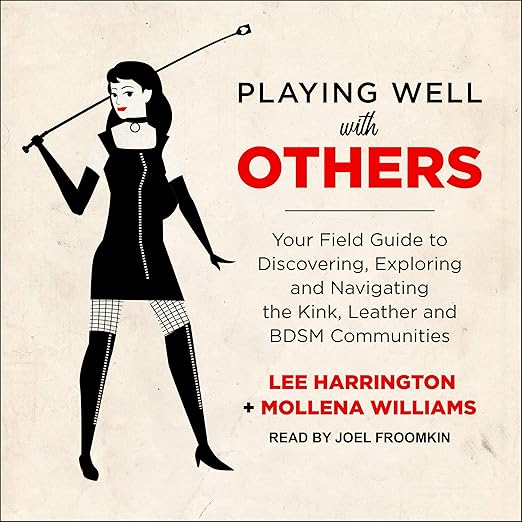
Playing Well with Others is the book she needed, and as far as I can tell from the available literature, it remains essentially the only one. Lee Harrington and Mollena Williams wrote it specifically to address the gap between knowing what BDSM is and knowing how to participate in BDSM communities, the munches and play parties, the leather bars and conferences, the fetish nights and exploratoriums that turn private desire into shared culture and, for many people, genuine community. At 12 hours of audio, it has room to actually do this properly.
The Community Layer No One Else Covers
Harrington is explicit in positioning this against the technical guides. Books like The New Topping Book or The Mistress Manual cover the physical and relational mechanics of BDSM practice. Playing Well with Others takes as its subject the social infrastructure that surrounds that practice. Who are the people in these spaces? What are the unwritten rules? How do you approach someone at a play party versus at a munch? How do you find communities in your area? What does etiquette look like in leather bars versus at educational conferences versus at public fetish events?
This is genuinely useful information that is difficult to find elsewhere, particularly for people entering these communities as adults without a mentor or established social network within the scene. The book functions partly as an orientation guide and partly as something like an anthropological account of a subculture from the inside, Harrington and Williams are themselves community members, not outside observers, which gives the whole enterprise a different quality than a journalist’s account would have.
Examining Your Own Motivations First
Before getting into community navigation, the book spends substantial time on introspection, the question of what you actually want, why you want it, what your needs and boundaries are. This sequencing is intentional. Harrington’s framework suggests you can’t engage effectively with community until you have some clarity about your own desires and limits, and that attempting to do so first exposes you to both practical risk and the more diffuse harm of not being able to recognize when something isn’t serving you.
This section is the one most likely to feel like genuine sex education in the broader sense, it asks questions about motivation, desire, and self-knowledge that are useful far beyond the context of BDSM. Reviewers note that even the “common sense” elements feel newly important when stated in the context of community participation: consent practices, communication about limits, the difference between what you fantasize and what you’d actually want in a real encounter. Chel’s review describes the combination of “common sense things” alongside genuinely helpful event explanations as characteristic of the book’s range.
Joel Froomkin and the Audio Experience
At twelve hours, this is a substantial commitment, and the narrator’s performance matters considerably. Froomkin is a reliable audiobook narrator who brings a calm, accessible quality to a text that covers a genuinely wide range of material, from the social history of leather communities to practical advice on how to introduce yourself at a munch. He handles the specialized vocabulary of the kink and BDSM world without the slight awkwardness that sometimes creeps into narrators encountering this territory for the first time. The pacing is measured and easy to follow.
One reviewer noted the kindle formatting was “wonky” but that the content stands up despite the book being a few years old. In audio, formatting is irrelevant, and the content question is the more important one. BDSM community culture does change over time, consent norms, in particular, have become more explicitly articulated in the years since this book’s publication, but the foundational community navigation guidance appears to have aged well based on reviewer responses.
Who Should Listen, Who Should Skip
This is for people who are curious about or beginning to explore BDSM communities and want to understand the social landscape before or alongside the physical practice. It’s also valuable for people who have been practicing privately and want to understand how community fits into that. It’s less useful as a technical how-to guide for specific practices, that’s not the book’s purpose, and it doesn’t pretend to be.
At 4.6 stars from 332 reviews, this has built a genuinely broad and satisfied readership. People outside the kink community who are curious about how these spaces actually operate will also find it educational, though the framing assumes the reader is at least potentially interested in participation rather than purely academic observation.
Frequently Asked Questions
Is Playing Well with Others suitable for someone who is curious about BDSM but not yet sure they want to participate in community events?
The book explicitly addresses people at the stage of self-examination and exploration, not only those ready to enter community spaces. The early sections on examining your own motivations and desires are specifically designed for readers at that threshold. Many people find it useful as a way of clarifying what they actually want before any community involvement.
Does the book address safety in community spaces, both physical safety and the risk of predatory individuals?
Community safety, vetting, and the recognition of problematic behavior in kink spaces is one of the book’s substantive topics. Harrington and Williams are both experienced community educators and address the reality that, like any community, BDSM spaces include both highly ethical participants and those who use community structures to circumvent consent.
Is this book inclusive of LGBTQ+ kinksters, or does it skew toward heterosexual practitioners?
Harrington and Williams both identify as queer and write from within queer and leather community traditions that are deeply rooted in LGBTQ+ history. The book is explicitly inclusive across orientations and gender identities, and the leather community’s historical connection to gay male culture is part of the context it provides.
How does this book compare to Stefani Goerlich’s The Leather Couch for understanding BDSM communities?
Goerlich’s The Leather Couch is written for mental health clinicians and provides a professional clinical framework. Playing Well with Others is written for community members and those considering participation, from the inside. They serve different audiences and complement rather than replace each other.