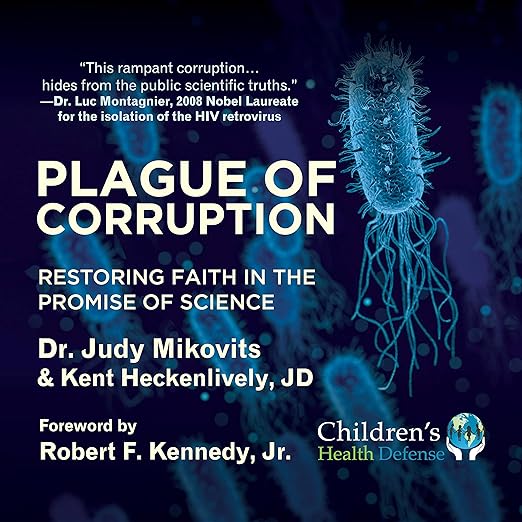
Science and whistleblowing make for uneasy companions, and Plague of Corruption, narrated by Mariel Hemingway, puts that unease front and center. This audiobook follows Dr. Judy Mikovits, who has had one of the most turbulent scientific careers of recent decades: celebrated for her contributions to HIV-AIDS research and then systematically discredited after she raised questions about animal tissue use in medical research and its potential links to chronic diseases like autism and chronic fatigue syndrome. Whether you encounter this audiobook as a believer in her findings or as a skeptic of her conclusions, the personal narrative is undeniable: this is a woman who paid an enormous price for what she believed science required of her.
I came to this audiobook in the context of reading widely about institutional science, including cases where lone dissidents were eventually vindicated and cases where they were not. Mikovits frames herself explicitly in the tradition of Rosalind Franklin, whose contributions were marginalized, and Erin Brockovich, whose grassroots persistence exposed industrial wrongdoing. Those are powerful comparisons, and the book does not fully adjudicate whether they hold. What it does offer, honestly and in detail, is one scientist's account of how the establishment reacts when it feels threatened.
Hemingway's narration is the unexpected asset of this production. She reads with calm conviction rather than alarm, which suits the material better than a more fevered delivery would. Mikovits's story is genuinely dramatic: discovery, institutional response, loss of funding, arrest, and the eventual marshaling of coauthors and allies to tell the full account. One reviewer accurately described the book as 'a thriller' while also calling it 'a reasoned and sometimes technically detailed account' of retrovirus research. Both things are true simultaneously, and Hemingway navigates both registers cleanly.
The science itself, when it appears, is handled with more specificity than most popular science audiobooks offer. The history of Mikovits's collaboration with Dr. Frank Ruscetti, spanning more than thirty-five years, grounds the narrative in real laboratory work rather than abstraction. The book is detailed enough that listeners with a science background will find points of genuine engagement, and accessible enough that non-specialists can follow the narrative thread without losing the plot.
What Stands Out
The audiobook's most valuable sections deal with the institutional dynamics of scientific research: how funding flows shape what questions get asked, how journals and peer review can become tools of suppression as easily as tools of quality control, and how a single powerful figure in a research community can redirect careers and reputations. These dynamics do not require agreement with Mikovits's specific conclusions to be worth understanding. Regardless of where you land on the science, the sociology described here is real.
The HIV-AIDS research history is worth the listen on its own terms. Mikovits's doctoral thesis work and its impact on treatment protocols is a story that has largely been erased from popular accounts. Whatever happened afterward, that contribution is documented and significant, and the book restores it to context. Listeners who have followed the long arc of AIDS activism and research will find details here that supplement the standard histories.
Things to Know Before Starting Plague of Corruption
This audiobook requires critical engagement rather than passive reception. Mikovits's claims about retroviruses, animal tissue, and links to chronic diseases remain contested in mainstream scientific literature. One reviewer found it 'incredibly important work you cannot get anywhere else.' Another called it 'a rehash of familiar narratives without critical rigor.' Those are genuinely different reading experiences of the same text, reflecting that this book functions differently depending on what the listener already believes going in.
The book was published in 2020 and became associated with certain pandemic-adjacent claims that gained traction at that time. Listeners should be aware of that context without letting it determine in advance what they take from the personal and scientific narrative that forms the book's core. Hemingway's measured narration actually helps here: she does not heighten the conspiratorial elements, which allows the substantive science history to come through more clearly than an alarm-register reading would permit.
A third reviewer found the writing 'highly accurate and detailed' even while noting the style. That range of reactions reflects the book's genuinely dual character: part scientific memoir, part institutional critique. Listeners who go in prepared for both registers will get considerably more from it than those expecting only one.
It is worth noting that the book arrived in a very specific cultural moment, one where institutions of all kinds were under heightened scrutiny. Mikovits's account of how she was removed from her position, how her research was suppressed and her reputation targeted, reads differently depending on how much credence you extend to the possibility that scientific institutions can behave in the ways she describes. The reviewer who called her story a thriller was not wrong: the pacing and structure of the narrative genuinely does have the rhythm of a personal conspiracy thriller, with discovery and betrayal and eventual persistence in the face of organized opposition. That formal quality is worth naming, because it shapes how the listener processes what they are hearing. Hemingway's steady narration keeps that identification available without exploiting it.
Best Suited For
This audiobook suits listeners who want to understand a dissenting scientific perspective from the inside, including its procedural and personal costs, and who are willing to bring their own critical thinking to disputed claims. Readers with interest in the sociology of science, the history of HIV-AIDS research, or the dynamics of whistleblowing within institutional settings will find it substantive. Listeners who want settled mainstream consensus science will find this book frustrating. Those already deeply committed to either full credence or full dismissal of Mikovits will likely not have their positions shifted, but the audiobook has real value for those willing to sit with ambiguity.
Is this audiobook presenting peer-reviewed consensus science?
No. Mikovits's claims about retroviruses and animal tissue links to chronic disease remain disputed in mainstream scientific literature. The book presents her personal experience and her interpretation of evidence, which diverges significantly from institutional consensus.
Why was Mariel Hemingway chosen to narrate this audiobook?
Hemingway brings name recognition and a measured, grounded reading style that suits Mikovits's account without sensationalizing it. Her calm delivery allows the substantive science history to come through more clearly than a more heightened reading would.
Is it necessary to have a science background to follow this audiobook?
No. The book is written for a general audience, and while some sections get technically detailed on retrovirus research, the personal narrative thread remains clear throughout. Listeners with no science background can follow the account.
How does this audiobook handle the association of Mikovits's work with pandemic-era controversies?
The book predates those associations for its core content, and Hemingway's measured narration does not amplify the conspiratorial framing. Listeners who engage critically with the text will find the science history and institutional critique stand on their own terms separate from later associations.