In Brief
- Voice: John Bedford Lloyd brings a controlled, dry authority to the swashbuckling material without tipping into camp.
- Big ideas: Greed and calculated risk in colonial trade, loyalty under pressure, the brutality beneath adventure-story glamour
- Atmosphere: Brisk and propulsive, unambiguous about what it is
- Worth it?: A posthumously published adventure novel that delivers exactly what it promises and nothing more, competent genre entertainment with Crichton’s imprint.
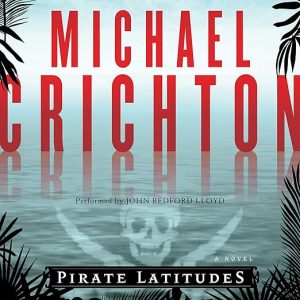
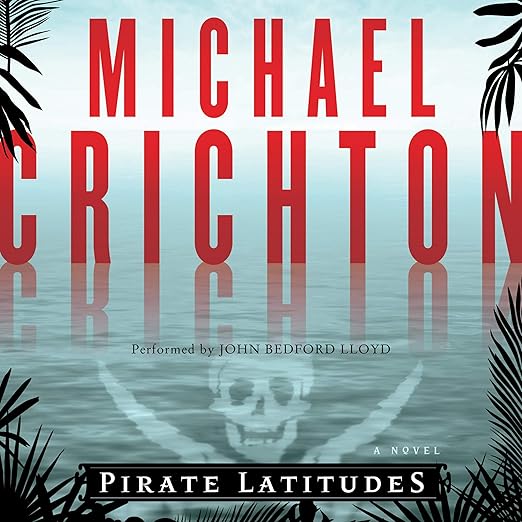
There is something clarifying about a book that knows exactly what it wants to be. I listened to Pirate Latitudes on a long flight, the kind where you cycle through three different things before finding something that holds, and once this started I did not change it. It is not a book that will rearrange your thinking about fiction or the seventeenth century. It is a pirate adventure, constructed with the efficiency of a writer who understood plot mechanics at a molecular level, and it moves with a consistency that most genre novels do not achieve.
Michael Crichton died in 2008, and this manuscript was found in his files afterward. Published in 2009, it is the work of a writer who had not polished the draft to his usual standard, and some of that roughness shows. But the core of it is Crichton doing what Crichton did: setting up a heist-adjacent scenario with a disparate team, a specific objective, and a series of escalating complications. The setting is seventeenth-century Port Royal, Jamaica, and the objective is a Spanish galleon anchored in a harbor that should be impenetrable.
Matanceros Heist Outshines a Thin Captain Hunter
Captain Edward Hunter, the privateer at the center of the novel, is not a particularly developed character. He is competent, pragmatic, and morally flexible in ways that the colonial enterprise required and that Crichton declines to interrogate. That lack of interrogation is the book’s primary limitation. Crichton was not writing historical fiction with the ambitions of, say, Patrick O’Brian; he was writing a thriller with period costuming, and once you accept that framing, the book works well on its own terms.
The heist mechanics are genuinely clever. The Spanish harbor, Matanceros, is described in enough logistical detail that you understand exactly why the enterprise seems impossible, and Crichton’s solution to the logistical problem is satisfying rather than convenient. The supporting crew around Hunter are differentiated enough to avoid becoming interchangeable bodies, though none of them achieve much depth. One reviewer, accurately, called it a fun adventure tale in the spirit of Pirates of the Caribbean, which is perhaps the most useful single-sentence description possible.
Lloyd Plays It Straight Through Nine Hours
John Bedford Lloyd’s narration is a genuine asset. He reads the material straight, which is the right call. The adventure content includes gore, period violence, and some sexual content, both handled without sensationalism or false solemnity. His pacing in the action sequences is well-judged, pulling the tempo forward without rushing past the tactical details that make those sequences coherent.
At nine hours and nine minutes, the audiobook is a reasonable commitment for a long journey or a weekend of outdoor tasks. The chapters are short and the momentum is consistent, making this a good choice for interrupted listening. You will not lose track of the story if you step away and return an hour later, which is more than can be said for more complex historical fiction.
Crichton's Raid Holds Up Better Than Its Aftermath
The novel is divided roughly into two movements: the planning and execution of the raid on Matanceros, and the consequences that follow when the enterprise does not go entirely as designed. The second movement is shakier than the first. Crichton’s manuscripts occasionally end abruptly or shift tone without full preparation, and this one shows those tendencies in its later chapters. One critical reviewer noted that the draft could have used further development, and in the second half that observation lands. The storm sequence and certain plot complications in the final third feel underbaked compared to the clean execution of the heist proper.
The historical detail is present but not heavily researched in the manner of dedicated nautical historians. Crichton is accurate enough to maintain believability without being rigorous enough to satisfy specialists. That calibration is intentional and appropriate for the genre he was working in.
Pure Adventure Fiction Without Literary Ambitions
Listeners who enjoy adventure fiction with historical settings and no particular interest in literary complexity will find this thoroughly satisfying. Crichton readers who have exhausted his major science-based thrillers will recognize the structural approach immediately and likely find it a comfortable fit. Readers expecting the psychological or social depth of more literary historical fiction should look elsewhere. This is entertainment built to do one job, and it does that job reliably for most of its running time.
Before You Listen
Does the audiobook include any author’s note or editorial context about the posthumous publication?
The audiobook does not include extended editorial apparatus. There is no narrator introduction explaining the manuscript’s history. Listeners seeking that context should consult the print edition’s preface.
How explicit is the violence and sexual content?
The novel includes period-accurate violence and some sexual content, both handled in a fairly direct but not graphic manner. The tone is adventure fiction rather than exploitation. Mature teens and adults would find it appropriate.