Quick Take
- Narration: Elizabeth Bard reading her own memoir is the only sensible choice; her voice carries the self-awareness the material requires, particularly in the passages about new motherhood she clearly found difficult to write.
- Themes: Expatriate reinvention, culinary entrepreneurship, the gap between romantic fantasy and working life
- Mood: Warm and honest, slower-paced than Lunch in Paris, more emotionally complex
- Verdict: A worthy but quieter follow-up to Lunch in Paris that succeeds most fully when Bard is being hardest on herself.
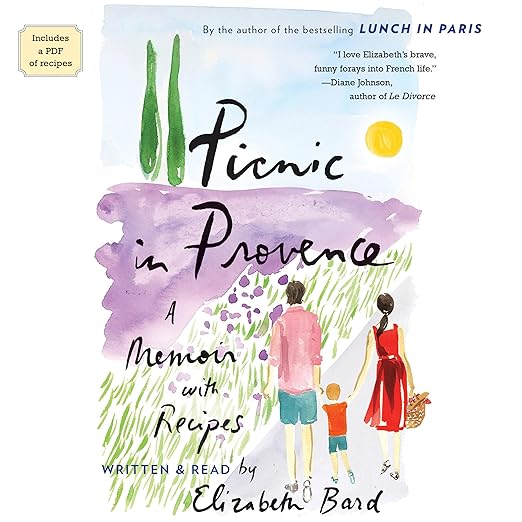
I listened to this one over two evenings in early spring, with a glass of something light and absolutely no intention of starting an ice cream business in Provence, which is either a failure of ambition on my part or evidence that Elizabeth Bard’s account of actually doing it is more honest than the premise suggests. Picnic in Provence is the book that happens after the charmed beginning. Lunch in Paris, Bard’s first memoir, traced the romantic falling-in-love arc, the American girl following a handsome Frenchman and discovering a way of life she hadn’t known to want. This book begins in the aftermath of that story, with the baby on the way and the next chapter requiring something other than romantic momentum to sustain it.
The impulse to move to a tiny Provencal village called Cereste came from a chance encounter with a house that had been the wartime home of a poet, with a buried manuscript and a garden full of heirloom roses. Bard tells this story with full awareness of how it sounds: impulsive, romantic, not quite rational. The self-awareness is part of what makes the book work. She is not writing a fantasy of French living. She is writing the reality of it, which includes the grinding logistics of starting a small artisanal ice cream business in a country where the administrative apparatus for such things is Kafkaesque by design, and the emotional complexity of becoming a mother in circumstances that were neither planned nor straightforward.
The Ice Cream Shop as Metaphor and Reality
The ice cream business that Bard and her husband Gwendal build in Cereste is the spine of the book’s middle section, and it is much more interesting than the premise suggests. They are not wealthy dilettantes. They are people with no professional background in food production who decide to make artisanal ice cream using local Provencal ingredients, including saffron, sheep’s milk yogurt, and fruity olive oil, and sell it in a village that does not obviously need an ice cream shop. The recipes that Bard includes, for stuffed zucchini flowers, fig tart, honey and thyme ice cream, read as genuinely functional rather than atmospheric decoration. Several reviewers report going straight to their kitchens after particular chapters, which is the best possible evidence that the culinary dimension of the book does its job.
The shop becomes a lens for everything else the book is about. Running it requires Bard to become comprehensible to the local community in ways that simply living there didn’t. It requires learning French institutional life from the inside rather than observing it from the outside. It requires her husband to take risks that his more cautious professional training hadn’t prepared him for. The business is where the book’s real subject, the work of making an actual life rather than a romantic interlude, becomes visible.
The Honest Chapter About New Motherhood
The section that multiple reviewers single out is Bard’s frank account of her difficulty relating to her newborn son in the early weeks and months. This is the passage most likely to produce either strong identification or strong discomfort depending on the reader’s own experience, and it’s the most significant departure from the mode of the first book. Lunch in Paris was, whatever its complexities, a story of increasing pleasure and belonging. Motherhood here arrives as something more ambivalent, more confusing, and Bard writes about that ambivalence without the retrospective resolution that would make it comfortable to read.
One reviewer, while preferring the first book overall, notes that the honest discussion of difficulty relating to a child should be comforting to others having the same problem. That’s the precise and important function this kind of writing serves. Bard is not confessing failure. She is describing something that many parents experience and that the cultural narrative around early parenthood largely suppresses. The memoir earns its place in the conversation about what expatriate life actually looks like when the romantic premise runs into the ordinary demands of human reproduction.
Bard Reading Bard Over Lavender Fields
The audiobook format suits this material well because Bard’s voice carries the comic timing that her writing requires. The French scene-setting benefits from being read rather than scanned: the descriptions of the Cereste market, the peaches that taste like sunshine, the lavender fields that reviewers describe as making them nostalgic for rural childhoods they may never have had, land better when paced by someone who lived them. The reader who reported wishing there was a third book after listening to this one is responding to exactly that quality: the sense that you have spent time in a specific place with a specific person, not simply consumed a product.
The comparisons to Pamela Druckerman’s Bringing Up Bebe that one reviewer makes are interesting calibration. Druckerman’s book is sharper in its argument and more journalistically structured. Bard is writing memoir rather than cultural analysis, which means the book is more uneven and more personal. Listeners who want the former should seek it out. Those who want the latter, the specific texture of one woman’s experience learning Provencal cuisine and something about herself in the same season, will find Picnic in Provence doing exactly what it sets out to do.
Who Should Pack for Cereste
Readers who loved Lunch in Paris and want to continue with Bard’s story will find this a genuine continuation rather than a disappointing sequel, provided they arrive expecting a quieter, more complex book. The pleasure here is not in the romantic charge of the first volume but in watching someone figure out what comes after the romance. Food lovers who want recipes that are actually usable will find the Provencal cooking woven through the chapters genuinely worth the attention. Those who wanted more of the Paris energy specifically will find Provence a different register, as the reviewer who titled their assessment Nice, Mais Ce N’est Pas Lunch in Paris accurately named. That’s honest enough to pass on.
Frequently Asked Questions
Do I need to have listened to Lunch in Paris first to get the most from Picnic in Provence?
Not strictly required, but the emotional baseline of this book is the aftermath of the first. The arc from Paris romantic adventure to Provencal family life is the organizing frame, and readers who don’t know where Bard started will miss some of what makes the maturation visible.
Are the recipes interspersed throughout the text genuinely usable, or are they primarily atmospheric?
Multiple reviewers report cooking from them with success. The stuffed zucchini flowers, fig tart, and honey and thyme ice cream recipes are described as adapted and translated for American measurements and available ingredients, rather than left in French culinary shorthand.
The book covers starting an artisanal ice cream business in France. How much of it is about the business logistics versus the lifestyle memoir?
The business is central rather than peripheral. Bard covers the French administrative process of setting up a small food business, the sourcing of local Provencal ingredients, and the reality of running a seasonal shop in a small village. It functions as both memoir and honest account of small entrepreneurship.
Is Elizabeth Bard’s narration of her own book suited to the material, or would a professional narrator serve better?
The self-narration is the right choice. The comic timing in her writing is present in her voice, and the emotional sections, particularly the passages about new motherhood, carry authenticity that would be hard to replicate with a third-party narrator who hadn’t lived the experience.