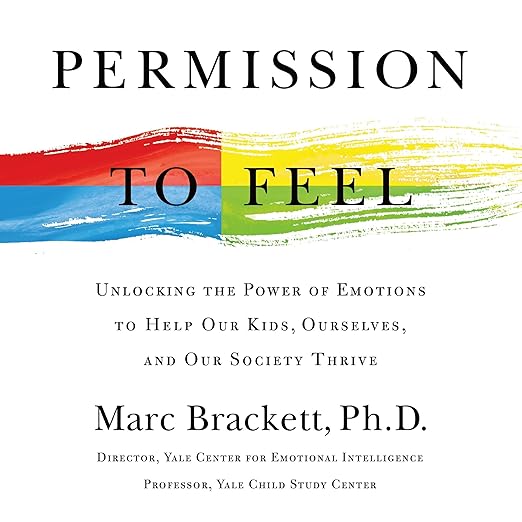
Marc Brackett's RULER system for emotional intelligence has been adopted by thousands of schools, and Permission to Feel, which he narrates himself, is the audiobook that explains why. Brackett is a professor at Yale's Child Study Center and founding director of the Yale Center for Emotional Intelligence, and what he brings to the narration is not the neutral authority of an expert explaining research. He brings the specific voice of someone who needed this work personally before he could give it to anyone else. The book opens with his Uncle Marvin, the first adult who ever asked Marc how he was feeling and waited for an honest answer. That personal origin is where the entire project begins.
The crisis Brackett identifies is not subtle. In his words: 'We have a crisis on our hands, and its victims are our children.' He is describing a generation of young people who are emotionally skilled enough to perform competence but not equipped to understand, name, or productively use what they are actually feeling. Shame about emotion, the sense that feelings are weaknesses to be hidden or overridden, is not a natural human state. It is learned. And according to Brackett's twenty-five years of research, it is catastrophically expensive in terms of mental health, academic performance, and basic human functioning.
The RULER framework he developed, an acronym for Recognizing, Understanding, Labeling, Expressing, and Regulating emotions, is not a self-help mnemonic. It is a teachable curriculum with documented outcomes. Brackett has conducted large-scale research and raised tens of millions of dollars to study this. The book is not opinion. It is the synthesis of a decades-long research program, written accessibly for readers who are not academic psychologists.
Reviewer SimpleSolutions describes coming to the book with a bias toward expecting 'an academic tome' and being surprised by its readability. Reviewer celticgoddess quotes the heart of the project: 'Emotion skills are the skills.' That compression captures Brackett's argument well. He is not saying emotions matter in addition to other competencies. He is saying that emotional skill is the foundation from which everything else, learning, relationships, leadership, health, operates.
The Best Parts of Permission to Feel
Brackett narrating his own audiobook is a meaningful choice for this particular material. The book's argument is that being heard and understood is foundational to emotional health. When the person making that argument is the one speaking it into your ears, a congruence exists that a professional narrator, however skilled, would lose. Brackett reads with the earnestness of someone who has spent a career on this subject and knows precisely what is at stake.
Reviewer robert pellegrine notes that reading the book made him 'wish how wonderful it would have been to have experienced this form of learning during my formative years.' That regret is the book's secondary emotional register: not just 'here is what we should do for children' but 'here is what we missed when no one did this for us.' Brackett does not exploit that regret. He channels it into a practical framework. But in audio, with the author's own voice, that undercurrent is more present than it would be on the page.
At seven hours and fifty-five minutes, Permission to Feel covers its research base thoroughly without becoming a literature review. Brackett moves between his personal history, specific case studies from schools that have implemented RULER, and the underlying science in a way that keeps the audiobook moving without sacrificing rigor. The pacing reflects someone who has given this material as a public speaker before and knows where the energy can flag.
Before You Commit to Permission to Feel
The RULER framework is presented with enough specificity that listeners can actually do something with it. This distinguishes Permission to Feel from many wellness audiobooks that are long on exhortation and short on application. Brackett explains what each step of the framework looks like in practice, how schools implement it, and what changes when it is in place. Reviewer educator robert pellegrine's enthusiasm reflects this practical dimension: the book is useful in a classroom, not only inspiring as an idea.
The stress and burnout section is particularly relevant for adult readers who came to this book via their children but find themselves recognizing their own emotional suppression patterns. Brackett's research shows that RULER reduces stress and depression and enhances academic achievement, but the same mechanisms operate in adults in workplaces. The book does not make this translation explicit in every chapter, but the implication is present throughout.
The personal dimension of Brackett's story, the bullying and suffering he experienced as a child, the transformative effect of one adult who actually asked how he was doing, frames the scientific material with exactly the right emotional weight. He is not separating the research from the personal. He is showing that the research came from the personal, which is how the best clinical research often does.
Should You Listen to Permission to Feel?
Parents, teachers, and school administrators will find the most direct applications here. Brackett's RULER framework is designed for institutional implementation, and the audiobook gives enough detail to understand both the what and the why of that implementation. Adult listeners who recognize their own emotional illiteracy in Brackett's descriptions of children who cannot name what they are feeling will also find this personally resonant. Marc Brackett's self-narration is the right choice for this material. Listen to it yourself first, then decide whether to recommend it to whoever teaches your children.
Common Questions
Is the Permission to Feel audiobook suitable for educators or is it primarily for parents?
Both. The RULER framework was developed for school implementation and is extensively discussed in that context. Parents will also find direct application, and the book speaks equally to adults who recognize their own emotional suppression patterns.
Does the audiobook explain the RULER framework in enough detail to use it?
Yes. Brackett walks through each component, Recognizing, Understanding, Labeling, Expressing, and Regulating emotions, with case studies and practical examples. It is not purely conceptual.
How does Marc Brackett perform as his own audiobook narrator?
He reads with the earnestness of a researcher who has spent twenty-five years on this subject. The narration is not professionally polished but has genuine conviction, and for material about the importance of being heard authentically, that quality is appropriate.
Is this audiobook primarily scientific or does it include personal narrative?
Both. Brackett opens with his own childhood experience of being unseen and the uncle who changed that. The personal narrative is woven throughout the science, making the research accessible without reducing its rigor.