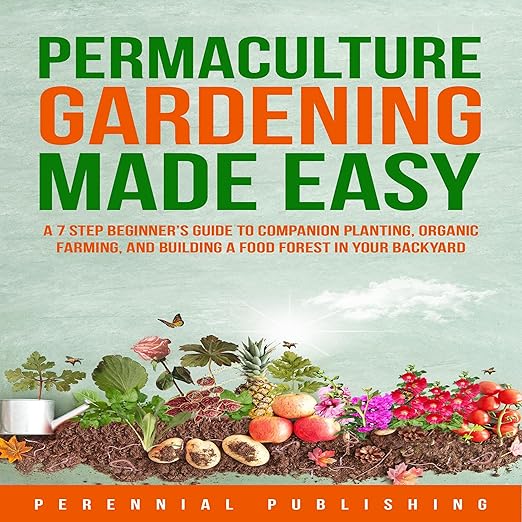
I started paying attention to permaculture during a period when I was trying to understand why some gardens feel alive and others feel like they're fighting themselves. I'd read enough to know the basic principle, observe and interact, use edges, work with nature rather than against it, but the practical gap between philosophy and raised bed always eluded me. Permaculture Gardening Made Easy landed in my queue during a spring when I was actually trying to do something with a plot of overgrown clay soil, and I listened to it twice: once while walking the site, once while making notes in the kitchen afterward.
The title announces its purpose honestly, and the book delivers on that promise. This is not an advanced permaculture text. It is not Bill Mollison's Permaculture: A Designers' Manual, which runs to over 600 pages and requires significant prior knowledge to navigate. Permaculture Gardening Made Easy is specifically aimed at the person who has heard the word permaculture, feels drawn to what it represents, and needs a structured way in that doesn't require an immediate design course.
From Permaculture Ethics to a Seven-Step Plan
The book's structure reflects its instructional purpose. It begins with the fundamentals, a brief history of permaculture, how the approach was developed by Mollison and David Holmgren in Australia, and the ethical underpinnings that distinguish permaculture from other sustainable gardening approaches. The phrase at the center of the synopsis captures this well: care for people and the Earth, and share what you have. That ethical frame is not incidental; it's what separates permaculture from techniques-based sustainable gardening.
From there, the book moves through the five permaculture zones (a spatial design concept organizing how you use land based on frequency of visit and harvest), plant selection, a seven-step planning guide, soil management, water systems, garden bed construction, and food storage. It's comprehensive in the way a good overview should be: covering the key areas without pretending any chapter is exhaustive on its own topic.
Warren Sandwell's Calm, Clear Instructional Voice
Warren Sandwell's narration is well-suited to instructional audiobooks. He reads with a pace that gives each concept time to land without feeling leisurely, and his delivery avoids the two failure modes common in this genre: the droning monotony of someone performing educational duty, and the aggressive enthusiasm of someone trying to make you excited about composting. He just explains things clearly, which turns out to be exactly what you want at hour two when you're processing information about guild planting.
The beginner-orientation is a genuine strength. One reviewer described it as using big words sparingly and explaining gardening terminology rather than assuming prior knowledge, a quality that distinguishes this from a lot of gardening content that pitches itself as introductory but assumes a reader who already knows the difference between loam and clay. Another reviewer who had already completed a formal Permaculture Design Course found the book a useful recap rather than new information, which suggests it functions accurately as a foundation-level text.
An Independent Publisher Credit, Refresher-Level Depth
The publisher credit, Perennial Publishing, is the same as the author credit, which is common for independent audiobook productions and is worth noting for listeners who use publisher name as a quality signal. The 4.7 rating across 118 reviews suggests the content serves its audience well, but the production context means you're getting an independent guide rather than a text with the editorial apparatus of a major publisher.
The most honest limitation is the one the title implies: this is an entry-level overview. Listeners who have already spent time with permaculture concepts, taken even an informal workshop, or read Toby Hemenway's Gaia's Garden will likely find the material more useful as a quick refresher than as new information. The seven-step planning guide and the specific sections on composting methods and varying garden bed options are probably the most practically useful chapters for anyone with some existing knowledge.
Best for First-Timers Before a Design Course
This is the right audiobook for someone who is new to permaculture and wants to understand its principles and practical applications before committing time or money to a design course. It's also a useful companion listen for someone who has recently moved to a new property and needs a starting framework for thinking about the land. Experienced permaculture practitioners, farmers with design backgrounds, or listeners who've already worked through an introductory text will find this covers territory they know. For those listeners, the next step is a design course or one of the denser foundational texts.
The Short Version
- Voice: Warren Sandwell delivers a measured, clear performance suited to instructional content, accessible without being condescending.
- Big ideas: Ecological design principles, sustainable food production, beginner-friendly permaculture entry
- Atmosphere: Grounded and encouraging, with genuine enthusiasm for soil and systems
- Worth it?: A solid introduction to permaculture design for complete beginners, though experienced gardeners will find it covers familiar ground.