Quick Take
- Narration: Gwen Steel’s conversational, encouraging delivery matches the book’s friendly-guide philosophy, making ten-plus hours of gardening instruction feel like advice from a knowledgeable friend.
- Themes: Working with rather than against nature, food sovereignty through self-sufficient garden design, beginner accessibility in sustainable practice
- Mood: Warm and motivating, with practical density underneath the encouraging tone
- Verdict: A genuinely comprehensive introduction to permaculture principles that earns its beginner billing without talking down to experienced gardeners who want a systematic framework.
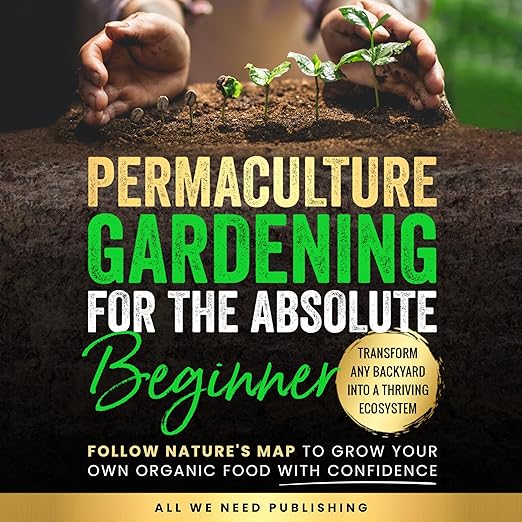
I started listening to this one in February, which is probably the most optimistic month for a gardener in a temperate climate. Everything is still theoretical, the seeds are ordered but not planted, and the gap between what you imagined last autumn and what the garden actually looks like is at its most forgiving. Permaculture Gardening for the Absolute Beginner is exactly the right book for that particular state of anticipatory hope, because it is structured to make the project feel possible regardless of where you are starting from.
The author writes under the All We Need Publishing imprint, and the gardening practitioner credited in reader reviews is Josie Beckham, whose voice comes through clearly in the prose: confident, encouraging, and genuinely interested in meeting the reader wherever they are rather than assuming prior knowledge. The book opens with the premise that permaculture is simply working with and replicating nature, which is an accurate and accessible framing of a concept that permaculture enthusiasts can sometimes make sound intimidatingly technical. From there it builds carefully, introducing twelve core principles and returning to them throughout in a way that reinforces rather than simply repeats.
The Twelve Principles as Organizing Architecture
The decision to anchor the book around twelve core permaculture principles and reference them consistently throughout is both pedagogically sound and formally useful for audio. When you are listening rather than reading, you cannot flip back to a reference table; instead, the principles need to be embedded through repetition and application, and this book handles that challenge well. By the time Beckham is discussing companion planting or water harvesting systems, the underlying principles that justify those choices have been introduced enough times that the connection feels natural rather than explained.
One reviewer who described this as potentially a new Bible for permies noted that at over seven hundred pages in the print version, the scope is genuinely comprehensive. The audio at nearly eleven hours gives a sense of that scope without feeling padded. The sequencing follows a natural logic: soil before seeds, water systems before planting plans, understanding your specific site before acquiring tools. This order reflects how permaculture practitioners actually think about a garden, starting with observation and working toward intervention, and it makes the audio version work well for listeners who want to learn the philosophy rather than just the techniques.
What Separates This from Generic Gardening Guides
Several reviewers who have been gardening for years described finding value in this book despite the beginner framing, and the reason is that permaculture as a system differs meaningfully from conventional gardening advice in ways that experienced gardeners can benefit from articulating explicitly. The book’s emphasis on reducing inputs, maximizing edge effects, using multiple functions for each element, and designing systems that become more productive over time rather than requiring consistent intervention represents a coherent philosophy that conventional gardening books often gesture at without fully developing.
The companion planting and guild sections drew specific praise from one reviewer who described the bonus sections as among the book’s most practically valuable content. In audio, these sections benefit from the clarity of Gwen Steel’s delivery, which maintains the same approachable warmth in the more technically detailed passages that characterizes the opening chapters. The book does not assume you have a large space or a significant budget, which reflects both permaculture’s inherent flexibility and a practical consideration for the majority of readers who are working with suburban plots rather than homesteads.
Gwen Steel’s Ten-Plus Hours
Narrating a gardening guide requires a specific quality of voice: capable of sustained friendliness without sliding into the performed perkiness that makes some self-help audio exhausting, and able to handle technical terminology without losing the accessible register that the content requires. Steel manages both. Her delivery has the quality one reviewer described as like having your best friend by your side, guiding you down the path of permaculture, and that is an accurate description of the experience. The audio includes reference to a companion PDF for visual material, which is worth noting for listeners who want to follow the spatial and design elements that garden planning necessarily involves.
The book has won over ten book awards and honors, according to its own cover copy, and the consistency of the reader response suggests those recognitions reflect something real. Reviewers across experience levels describe coming away with frameworks they will return to, which is the strongest possible outcome for a reference-oriented audio guide.
The companion PDF that comes with the Audible purchase addresses one of the inherent limitations of audio gardening instruction: the visual elements. Spatial design, companion planting charts, and soil testing diagrams are all easier to grasp on paper, and the PDF provides that support without requiring the listener to set down the audio entirely. For the eleven hours of listening, though, the concepts that translate best to audio are also the ones that matter most for the beginning gardener: the why behind permaculture choices rather than the specific what. Understanding why you plant nitrogen-fixers alongside fruit trees, or why water catchment is designed before planting begins, turns out to be information that lands well through a calm, clear voice rather than requiring a diagram to understand.
Who Should Put This On and Start Listening
This free audiobook is for anyone who has thought about growing their own food but felt intimidated by the complexity, for gardeners who want a systematic philosophical framework for what they have been doing intuitively, and for listeners who respond to instruction delivered with genuine warmth rather than clinical authority. The beginner framing is honest: the book does not assume prior knowledge and earns its accessibility claim. Experienced gardeners looking for advanced-level content on specific permaculture techniques such as swales, food forests at scale, or advanced companion planting design may find the scope satisfying but want to supplement with more specialized resources. Everyone else should simply start planting.
Frequently Asked Questions
Does Permaculture Gardening for the Absolute Beginner work for urban gardeners with small spaces, or is it aimed at people with large land?
It explicitly addresses any size space or budget, and the twelve core principles apply at small scale. Reviewers have described applying the content to suburban plots and container gardens, not just homesteads.
The synopsis mentions a companion PDF. How important is it, and does the audio work without it?
The audio works independently for the conceptual and philosophical content. The PDF matters most for the spatial design elements, companion planting guilds, and any charts or diagrams the text references. For pure principle learning, audio alone is sufficient.
Is this book grounded in a specific permaculture tradition or school of thought, or does it survey multiple approaches?
It is grounded in core permaculture principles as established by the Mollison-Holmgren tradition, working from the twelve core principles throughout. It does not extensively survey competing schools, which keeps the content focused and accessible.
How does the audio format compare to the print version for a book this reference-heavy?
The print version at over 700 pages is more useful for reference and re-reading specific sections. The audio at nearly eleven hours works well for the initial pass and for internalizing the philosophical framework. Many listeners will likely want both formats.