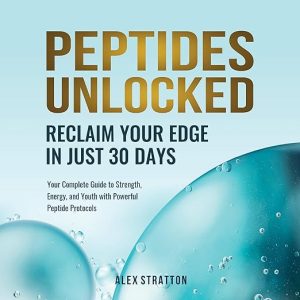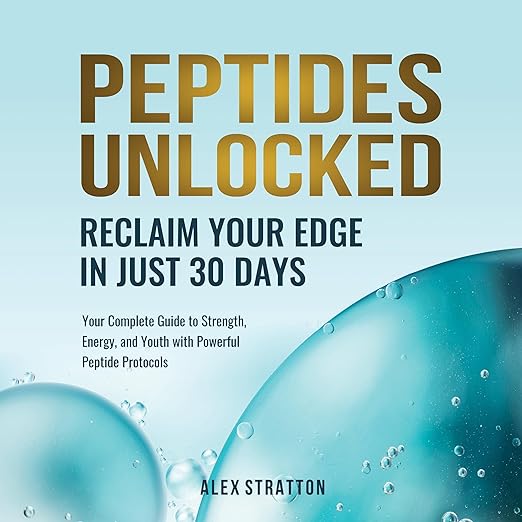
Peptide talk floods every fitness forum and wellness newsletter right now, usually pitched somewhere between miracle and scam, and I queued up this audiobook mainly to get a straight answer on which peptides are which. Alex Stratton delivers exactly that kind of clarity across a compact two-and-a-half-hour runtime, sorting individual compounds by actual legal and scientific status, FDA-approved, experimental, restricted in some countries, banned outright in others, rather than lumping them into one vague, hype-driven category. The audiobook covers fat loss, recovery, sleep, cognition, and healthy aging as separate goal-based tracks, and the promise, clarity without either miracle-protocol hype or blanket fear-mongering, is one this book mostly keeps.
Sorting Peptides by Actual Legal Status
Stratton's organizing principle, labeling each peptide by its actual regulatory status rather than treating the category as monolithic, is the single smartest structural choice in the book. JayTee's review calls it easy to follow 'even if you're new to the topic,' and that accessibility comes specifically from this classification system: a listener always knows whether the substance under discussion is a mainstream FDA-approved medicine or something living in a genuine legal gray area, which is exactly the distinction most hype-driven coverage of this subject blurs on purpose.
Jennifer Ordonez's review highlights the goal-based organization specifically, noting the book explains what each compound does and organizes everything into practical plans based on individual goals, whether that means losing fat, gaining muscle, or recovering faster. That structure, compound science first, application second, keeps the book from reading like either a dry pharmacology lecture or an unverified wellness-influencer pitch, threading a real needle that a lot of adjacent content in this space fails to manage.
The peptide landscape Stratton is describing sits inside a real and fast-shifting regulatory picture worth understanding on its own terms: a handful of peptide-based compounds, most famously the GLP-1 drugs that reshaped the weight-loss conversation in recent years, have full FDA approval and mainstream medical backing, while a much larger universe of other peptides circulates through compounding pharmacies, research-chemical suppliers, and gray-market international sources with wildly inconsistent oversight. That real landscape is exactly what gives the book's approved-versus-experimental-versus-banned framework its practical value; without that sorting mechanism, a listener has no reliable way to tell a legitimate, studied compound from something being sold on hope and marketing copy alone.
Avery Wade's Neutral Tone Fits Medical Nuance
Avery Wade's narration stays clean and neutral throughout, a real asset for quasi-medical content where an overly enthusiastic or alarmist tone could easily distort how a listener weighs genuinely serious regulatory nuance. Wade lets terms like 'restricted' and 'banned outright even as research continues' land with appropriate weight without editorializing, which matters enormously in a subject area where breathless hype on one side and reflexive dismissal on the other both distort the actual, more complicated picture Stratton is trying to lay out.
The reviewer identified only as 'reviewer reviews even more stuff' offers useful praise on exactly this point, calling the book 'beginner-friendly ... without feeling watered down,' and that balance, accessible but not dumbed down, is the harder needle to thread in health content generally. At just two and a half hours, the audiobook respects a listener's time without pretending the subject is simpler than it actually is, covering safety, sourcing, dosing, and storage with real specificity rather than vague reassurance.
Two and a Half Hours Without the Padding
The runtime-to-density ratio is worth noting on its own terms: at two and a half hours, this covers roughly the same conceptual ground a longer wellness book might stretch across six or seven, simply by cutting personal anecdote and case-study padding almost entirely. For a listener who wants the actual information without a memoir wrapped around it, that efficiency is a genuine selling point rather than a limitation.
None of that clarity would matter much if the narration itself dragged, but Wade's pacing keeps the compact runtime moving briskly enough that it never feels like a chore, even across the more technical stretches covering dosing and storage guidance.
The Peptide Planner Lives Outside the Audio
The downloadable Peptide Planner mentioned in the synopsis, designed to track protocols, dosing, progress, and safety checks over time, is a companion resource that exists outside the audio experience entirely, and how cleanly an audio-only listener can access and use it alongside the book is not something the listing clarifies. Anyone planning to actively implement a specific protocol, rather than just build general understanding, should expect to pair this audiobook with that separate downloadable material rather than treating the audio alone as a complete implementation toolkit.
It is also worth stating the obvious but essential caveat directly: this is general education, not personalized medical advice, and a two-and-a-half-hour audiobook cannot account for an individual listener's specific health conditions, current medications, or interactions. The book's own framing, sorting compounds by legal status and general risk category, is genuinely useful context, but anyone considering an actual peptide protocol, especially anything in the experimental or restricted categories the book itself names, needs a real conversation with a qualified clinician before acting on anything heard here.
The synopsis lists one more promise worth flagging on its own, 'Responsible discussion of stacking and emerging research', phrasing that signals Stratton is not just cataloging individual compounds in isolation but addressing the more complex, contested question of combining multiple peptides at once, an area where the actual research base is thinner and the risk of misuse is correspondingly higher. That the book flags this territory as needing extra caution, rather than glossing over it to keep the tone uniformly upbeat, is a meaningful signal of intent even within a short runtime.
Fitness-Forward Listeners Extract the Most Direct Value
Anyone who has scrolled past enough conflicting peptide claims on social media to want an actual sorted, source-aware overview is the exact right audience for this short audiobook. It suits commute-length or single-sitting listening well given the compact runtime, and the goal-based structure makes it easy to mentally bookmark the one or two sections most relevant to an individual listener's actual interest without needing to absorb the entire thing as one undifferentiated block.
Fitness-forward listeners already using or considering peptide-based supplements specifically, rather than complete beginners to health content generally, will likely extract the most direct value, since the goal-based protocol structure assumes at least a baseline interest in applying the material rather than just understanding it academically.
A clinician, not this or any general-interest audiobook, is still the right call for anyone managing an existing condition, taking other medications, or considering an experimental or restricted-status compound specifically. Listeners hoping for brand-name product recommendations or specific sourcing vendors will also come away without them, since the book stays intentionally general about where and how to obtain any given peptide. Within its stated scope, general clarity over a genuinely confusing subject, it does what it sets out to do efficiently and honestly.
Does the Peptides Unlocked audiobook give medical dosing advice I can follow directly?
It gives general education and goal-based frameworks, not personalized medical advice; anyone considering an actual protocol needs a real conversation with a clinician first.
How long is the Peptides Unlocked audiobook?
About two and a half hours.
Can I access the downloadable Peptide Planner mentioned in the book through the audiobook?
The planner is a separate companion resource; how cleanly it pairs with the audio-only edition isn't specified, so pairing it with a print or digital copy is the safer bet.
Is this audiobook useful for someone completely new to peptides?
Yes, multiple reviewers specifically praise how beginner-friendly the explanations are without feeling watered down.