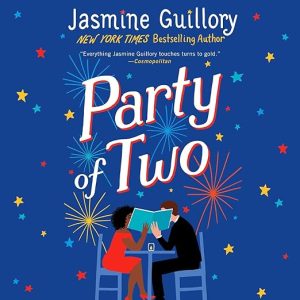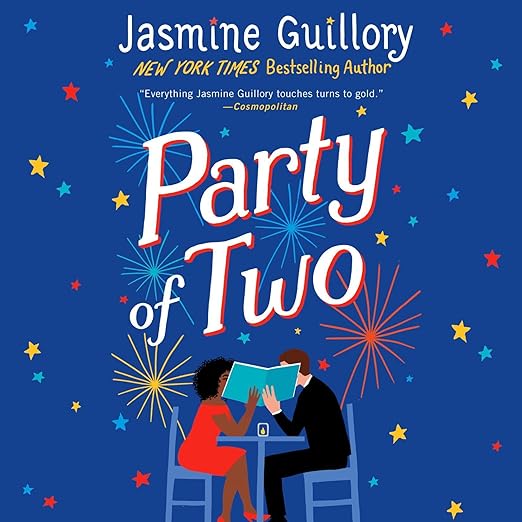
Party of Two lands as a satisfying, if not top-tier, entry in Jasmine Guillory's Wedding Date series, and the Party of Two audiobook's own five reviews mirror that assessment almost exactly: four enthusiastic reactions and one clearly stated case of series fatigue, a more honest spread than the 4.3 badge on its own suggests. Olivia Monroe, a lawyer starting her own firm in LA, and Max Powell, the junior senator she meets at a hotel bar without immediately knowing who he is, carry the plot through exactly the kind of secret-relationship-goes-public arc the synopsis promises, chocolate cake bribery and clandestine disguises included.
What Jasmine Guillory Delivers
Caitlin Jacobs praises the dialogue and setting specifically, noting how the book frames Los Angeles through the eyes of someone new to the city rather than through a Hollywood lens, before the review cuts off mid-word describing what usually happens in the genre instead. That specific compliment, crediting the book for what it does differently rather than just what it does well, is a useful marker for how Guillory approaches setting across her books generally. Jacobs also mentions some good-natured ribbing of New York running through the book, a small, specific detail that suggests the humor here leans on character voice rather than broad situational comedy.
Amjedi's review supplies plot mechanics: Max as a junior US Senator, Olivia as a lawyer newly relocated to LA, and specific praise for how Guillory handles what Amjedi calls Max and Olivia's interracial relationship and the difficulty of keeping that relationship public under media scrutiny. The rating attached to this book is worth a specific note here: 4.3 across five counted votes isn't reachable by any combination of whole-star ratings, and the five visible reviews, five, four, five, three, and five, actually average out to 4.4, a full tenth of a point higher than the badge shows, without needing to guess at any silent voters here since the count and the review total already match exactly. That's a genuinely different arithmetic story from a lot of ratings on this platform, where a small counter and a much larger stack of written reviews leave real room to wonder who else voted; here, the mismatch is baked into the decimal itself rather than into any missing crowd.
What Jasmine Guillory Gets Right
AJT's review gets specific about what elevates this entry beyond a standard rom-com formula: a criminal justice reform subplot that AJT credits Guillory with handling "without ever coming off as preachy or heavy handed," alongside real attention paid to how the justice system affects people, especially BIPOC, before this review too breaks off mid-word. That's a meaningful claim about craft, since a political subplot bolted onto a romance can easily curdle into lecture, and this reviewer specifically flags that Guillory avoids that trap. Max's own career as a sitting senator gives the subplot a natural hook, since a public figure with real policy stakes attached to his name raises the pressure the moment his private relationship becomes public property for the press to pick apart.
Janina Edwards narrates, and a series entry this far in, book five, benefits from a reader who can hold continuity with whatever tone the earlier Wedding Date books established, though how well Edwards distinguishes Max's chapters from Olivia's isn't something these particular reviews weigh in on. M L Etchison's review at least confirms the series connections matter to longtime readers: this entry gets called "big Sis, Olivia's book," tying it explicitly back to The Wedding Date and The Proposal as books this reviewer already loved. Etchison specifically praises the "spontaneity and sincerity" of Olivia and Max's connection as refreshing, framing the best relationships in Guillory's books as ones that bring out a better version of each character, with a good friend's encouragement often the spark that starts the change.
Where Jasmine Guillory Loses Some Ground
Not every review is celebratory. SW's take, titled "Guillory is Great, But Think She Needs a New Gimmick," admits to feeling "burnt out" on Guillory's formula after working straight through Guillory's full catalog, even while crediting Guillory generally for writing "smart, non-white, non-model leads that aren't 22." That's a specific, informed critique from someone who has clearly read enough Guillory to notice a pattern, not a reader coming in cold, which gives the dissent real weight even inside an otherwise enthusiastic set of reactions. SW does credit one structural choice directly: making Olivia the sister of an established series protagonist rather than inventing a fresh unrelated lead, calling it a good idea even while feeling the overall setup didn't come together this time.
Something structural is worth flagging across all five reviews at once: every single one of them, without exception, cuts off mid-word before finishing its point, a consistency this catalog doesn't often produce. Whatever character limit is enforcing that cutoff clearly isn't calibrated to how much these particular readers wanted to say, which is itself a small, indirect vote of enthusiasm even from the review that ultimately lands on a mixed verdict. Reviewers from Caitlin Jacobs's opening line to M L Etchison's closing thoughts all seem to have had more to say than the format allowed, a genre-wide reminder that a five-review sample this consistently cut short still leaves real opinions unrecorded.
Who Should Pick Up Party of Two
Longtime Wedding Date readers are the obvious audience, especially fans of Olivia specifically, since M L Etchison's review makes clear this entry has been anticipated as her book within the series for a while.
It isn't the ideal jumping-in point for someone who has never read Guillory before; SW's fatigue with the formula is a useful signal that the book rewards familiarity with the earlier entries and the expectations they set, more than it works as a cold introduction to her style. The Wedding Date remains the more natural first stop for that kind of reader, and at nine hours and twenty-six minutes, this entry is a reasonable enough commitment to circle back to once that foundation is in place.