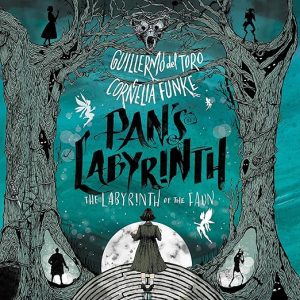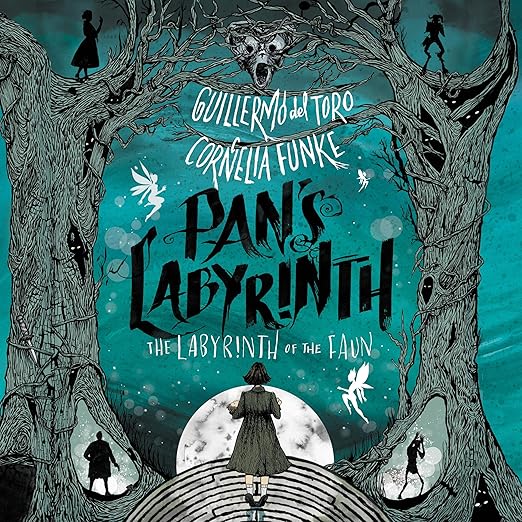
The Short Version
- Narration: Thom Rivera's performance suits the fairy-tale register of the prose, with enough darkness in his delivery to honor del Toro's vision without overwhelming younger listeners.
- Themes: War and childhood imagination as survival, the cost of obedience versus the cost of rebellion, myth as truth-telling
- Mood: Darkly enchanted, like sitting with a story that is beautiful and frightening at exactly the same moment
- Verdict: A faithful and enriched companion to the film that stands on its own for listeners who have never seen a frame of it.
I watched Pan's Labyrinth for the first time in a cinema in 2006, and I have carried it around since the way you carry films that do something to your understanding of what stories can be. So when Guillermo del Toro and Cornelia Funke's novel adaptation arrived, I came to it with the specific anxiety of someone who loves the source material too much. I listened to the first chapter and the anxiety left. This is not a transcript of the film. It is an expansion of it, a deepening, a novel that uses the world del Toro built and adds the interior life the screen format could only gesture at.
The collaboration between del Toro and Funke is a natural one. Funke is the author of Inkheart, a book about the power of stories to become real, which is exactly the territory del Toro has always worked in. Together they have produced something that functions differently from the film even when covering the same material: there are interpolated fairy tales within the narrative, short mythological stories that explain the folklore of the labyrinth world, that give the faun and the other creatures a history the film only implied. Roshani Chokshi described these as jewels that reframe the world around them, and that is a precise description.
What We Made of It
The novel is set in northern Spain in the aftermath of the Spanish Civil War, and the war's brutality is not softened. Ofelia's stepfather, the fascist Vidal, is as cold and methodical on the page as on screen, and the realist sections of the narrative carry genuine menace. Against this, Ofelia's underground kingdom functions as it does in the film: not as an escape from the real but as a way of processing and surviving it. Del Toro and Funke are careful not to resolve the ambiguity about whether Ofelia's fantasy world is real or imagined. The novel adds evidence for both interpretations, which makes it intellectually more interesting than simply resolving the question. Michael Grant's description of the book as a parable about the courage of young women amid the brutality of war is accurate, and it is the kind of parable that earns its ending.
Why Pan's Labyrinth: The Labyrinth of the Faun Works as an Audiobook
Thom Rivera's narration is sympathetic to the material. The fairy-tale interpolations require a slightly different register than the realist sections, and he navigates the tonal shifts without calling attention to them. The six-hour runtime is well paced, and the novel's structure, moving between Ofelia's two worlds in alternating chapters, maintains the tension the film generates through visual contrast. Listeners who know the film will find the expanded character interiority genuinely satisfying: Mercedes, the housekeeper, receives particular depth here, and the relationship between her and Ofelia has more room to develop than the film's runtime allowed. Listeners who do not know the film will find a complete and absorbing dark fantasy that requires no prior knowledge.
A Few Reservations
Some reader reviews come from people who received the physical book rather than the audiobook, which means references to illustrations and production quality are not relevant to the listening experience. The audiobook at six hours is compact, and listeners who want an extended immersion in this world may find it over too quickly. The darkness of the material is genuine: there is violence, there is death, and the wartime setting is rendered without sentimentality. This is marketed as suitable for readers of all ages, which is technically true but requires judgment about the specific listener; younger readers sensitive to wartime violence or ambiguous endings should be prepared.
The Right Listener for Pan's Labyrinth: The Labyrinth of the Faun
Essential for fans of the film who want to spend more time in that world and understand more of its internal mythology. Also worthwhile for listeners who love dark fantasy in the tradition of Neil Gaiman or Angela Carter, where fairy-tale logic and real-world brutality sit together without one canceling the other. Funke fans who know her work from Inkheart or Dragon Rider will find the collaboration's sensibility familiar. Not recommended for listeners who want resolution of the fantasy versus reality ambiguity; the novel, like the film, leaves that question deliberately open.