- Voice: Mike Chamberlain, experienced with both dense technical material and journalistic nonfiction, is a strong fit for this history's dual demands.
- Big ideas: wartime aviation, corporate and political history, covert government cooperation, commercial aviation's founding decades
- Atmosphere: Detailed and archival, closer to corporate history than battlefield narrative
- Worth it?: A rewarding listen for aviation history fans willing to take the full company story, not just the WWII third the title emphasizes.
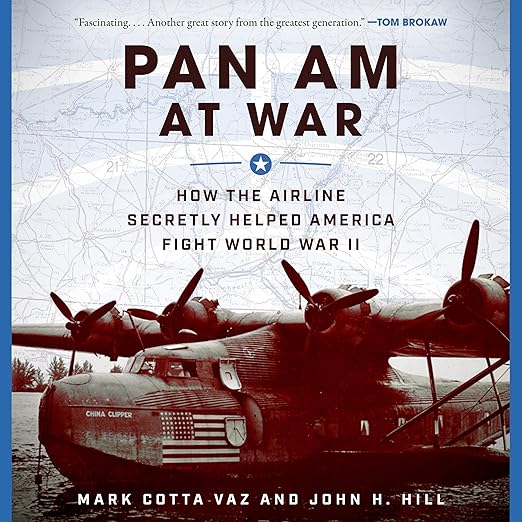
Mark Cotta Vaz built Pan Am at War out of declassified Freedom of Information Act filings and Pan American's own corporate archive, the kind of primary-source digging that separates genuine aviation history from nostalgic corporate hagiography, and that research shows in how specifically this audiobook can describe operations most wartime passengers never knew Pan Am was running. Narrated by Mike Chamberlain across twelve hours and thirty-three minutes, the book positions the airline as, in its own words, the 'wings of democracy,' publicly a civilian carrier and privately an instrument of American strategy.
The Review
The specific operations uncovered are genuinely striking: air bases built across Latin America to counter Axis interests threatening the Panama Canal, the 17,000-mile flight that carried President Roosevelt to the Casablanca Conference with Winston Churchill, and a delivery flight that carried uranium destined for the atomic bomb program. These aren't small footnotes, they're the kind of operational history that reframes a commercial airline as a genuine wartime asset.
The genre tag on this listing, science-engineering, undersells what the book actually is. This is narrative history built from archival research, not a technical engineering text, and listeners browsing by category looking for aviation engineering specifics, aircraft design, technical specifications, should know this is closer to a WWII-era corporate and political history with aviation as its setting than a book about how the planes themselves worked.
The Roosevelt flight deserves a beat of its own: it marked the first time a sitting American president traveled by air, a genuinely historic first buried inside a broader wartime logistics story, and the fact that a commercial airline's clipper aircraft and crew carried that responsibility says something about how much trust the government had already placed in Pan Am's civilian operation by 1943.
The uranium-delivery detail is a striking, almost cinematic image on its own, a commercial passenger airline quietly ferrying material for the atomic bomb program, and it crystallizes exactly the kind of hidden-in-plain-sight history the synopsis promises: operations invisible to the paying customers sitting a few rows away from cargo they could never have guessed the significance of.
Corporate wartime histories occupy a specific, still-underexplored niche relative to more traditional military history: companies that operated as quasi-extensions of government strategy without ever being formally nationalized, and Pan Am's case is an unusually well-documented example of that pattern precisely because so much of the relevant material eventually became available through Freedom of Information Act requests rather than staying permanently classified or lost to corporate archives that didn't survive.
Why Listen to Pan Am at War
Reviewer AvdRedr connects the book to Devereux's The Story of Wake Island and the real Pan Am Clipper flights that evacuated people from Wake Island as Japanese forces approached, a specific historical thread this book apparently follows in much greater depth than that earlier book had room for. That kind of connective tissue between related histories is exactly what a well-sourced narrative history should deliver.
Mike Chamberlain's prior narration credits line up unusually well with what this specific book needs: a database-internals technical title showed he can handle dense, technical material with reliable clarity, while Charles Duhigg's Smarter Faster Better showed attentive intelligence and smooth research-to-narrative transitions in long-form journalistic nonfiction. Pan Am at War sits right at the intersection of those two strengths, technical aviation and corporate detail wrapped inside a journalistic wartime narrative, which makes his casting here a strong fit on paper.
Vaz's research draws on both declassified government material and Pan American's own surviving corporate records, a genuinely useful combination since it means the book isn't limited to only the government's side of a story that, by its nature, involved a private company operating with unusual secrecy; internal company memory fills gaps that FOIA filings alone wouldn't cover.
Reviewer AvdRedr's specific memory of reading Devereux's Wake Island book first and coming to this one for more context is a useful model for how these two titles complement each other: one gives the ground-level evacuation account, the other supplies the corporate and strategic context surrounding why Pan Am was flying that route into danger in the first place.
The Caveats
Reviewer D W offers the single most important caveat for anyone considering this book: 'if you're buying this book based upon the title you'll be disappointed,' since the book is, by this reviewer's estimate, 'mostly about the first years of Pan Am' and the airline's founding and route expansion, with 'probably only 1/3' actually focused on the WWII period the title foregrounds.
That scope caveat doesn't mean the earlier material is filler, reviewer Private Buyer specifically praises the book's coverage of 1930s-through-1950s commercial aviation history as 'meticulously researched,' but it does mean listeners should adjust expectations: this is a full corporate history of Pan Am's rise with the war years as a major chapter, not a WWII military history that happens to be about an airline.
At twelve hours and thirty-three minutes, real room exists for both halves of the story, the founding and expansion years plus the wartime operations, to get proper depth rather than feeling rushed, which is some consolation for listeners specifically drawn in by the WWII framing.
The phrase 'wings of democracy,' Pan Am's own public branding at the time, captures the book's central tension precisely: an ostensibly civilian, democratic-values-branded airline was simultaneously running classified operations most of its own passengers, and much of the public, had no idea were happening. The book's real subject is that gap between image and operation, not just a chronological account of routes and expansion.
Who Should Pick Up Pan Am at War
Recommended for aviation history enthusiasts interested in the full arc of a major airline's early decades, WWII homefront and logistics readers curious about civilian infrastructure's wartime role, and anyone who enjoyed Wake Island-era aviation history and wants a deeper dive into the airline behind those evacuation flights.
It also rewards listeners interested in public-private wartime cooperation more broadly, how a nominally civilian company gets folded into a national strategic effort, a pattern with relevance well beyond this one airline and this one war.
Business history readers interested in how private companies navigate close, sometimes uncomfortable cooperation with government during wartime will find this a useful specific case study, even without a background interest in aviation itself.
Skip it if you specifically want a WWII-focused military history and nothing else, per reviewer D W's caveat, only about a third of the book covers that period directly, or if the science-engineering genre tag led you to expect technical aircraft engineering content rather than corporate and political narrative history.
Who narrates the Pan Am at War audiobook?
Mike Chamberlain, whose prior credits include both dense technical nonfiction and journalistic business narrative.
How long is the Pan Am at War audiobook?
Twelve hours and thirty-three minutes.