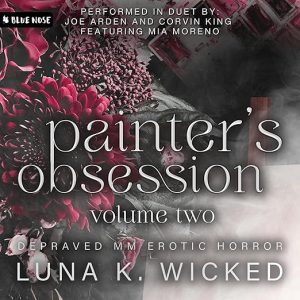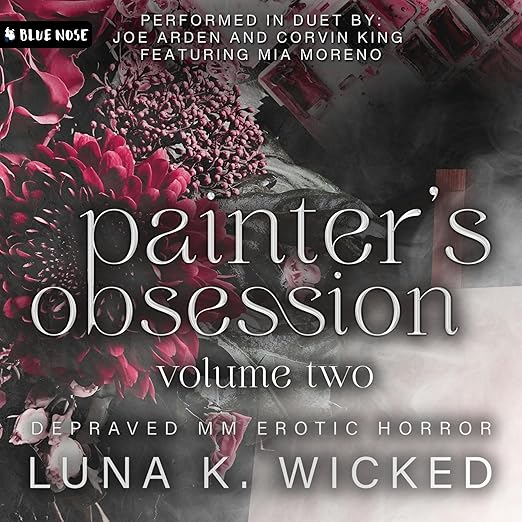
The craft question that haunts dark romance as a genre is this: when the relationship at the center of a story is explicitly harmful, what is the narrative actually arguing? Painter's Obsession: Volume II by Luna K. Wicked, narrated by Mia Moreno, earns its darkness by refusing to answer that question easily. This second installment of the Painter's Obsession series arrives with a clear disclaimer, Stockholm, toxic, and no happy ending, and the audiobook makes good on all three elements of that warning with a rigor that separates it from the genre's more superficial offerings. The word love in a reviewer's description of what this story is ultimately about is not a reassurance but a complication, and Moreno's narration holds that complication without flinching.
Volume II picks up the aftermath of the first installment's psychological damage, and the central formal challenge is that the narrator herself is no longer fully reliable. The blurring of identities, the harder it is to tell where he ends and I begin, is not a metaphor but a structural reality in Wicked's text. The story is told from inside a consciousness that has been genuinely reshaped by trauma, and Moreno's task is to make that interior experience audible without either dramatizing it for cheap horror effect or flattening it into a simpler emotional register. She does neither. At 5 hours and 7 minutes, she sustains the psychological complexity throughout, and the fact that reviewers described the listening experience in terms of emotional devastation rather than entertainment suggests the audiobook has succeeded at something genuinely difficult.
Moreno's Narration Earns Explicit Five-Star Praise
Moreno's narration received explicit five-star praise in the audiobook's reviews, with one listener rating both the story and the performance separately and standing by both. That dual quality is genuinely unusual in dark romance audio, where narrator casting is sometimes treated as secondary to the source material. Here the two are genuinely integrated: Moreno's delivery makes Wicked's most disturbing passages feel psychologically grounded rather than exploitative. The moments where Byron and Ren's childhood traumas are revealed are handled with a restraint that honors the gravity of the content without sensationalizing it.
Reviewer response has been intense. I don't know where to go from this and I am destroyed and broken are the kind of responses that mark an audiobook as having genuinely landed its emotional payload. But the review that is most illuminating is the one that calls this a story about love while acknowledging that love can create monsters. That framing, uncomfortable, layered, and refusing easy moral resolution, is precisely what Moreno's performance sustains. This is not a comfortable listen, and it is not meant to be.
Deserved Instead of Simply Satisfying
The trigger warnings are real and should be taken seriously. The content includes graphic depictions of psychological trauma, explicit sexual content, and relationship dynamics that are unambiguously harmful. Listeners who engage with dark romance as a genre already know that no happy ending and Stockholm are descriptions rather than critiques, but newcomers to the darker end of the romance spectrum should approach this audiobook with full awareness of what it contains.
For the audience it is designed for, the audiobook delivers something genuinely difficult to find: a dark romance narrative that comes full circle, in the words of one reviewer, and does so through earned psychological logic rather than convenient plot resolution. The ending is described as well deserved rather than satisfying, which is a meaningful distinction. Wicked is writing about how people who have survived terrible things sometimes cannot be saved from themselves, and the audiobook's second volume is where that argument reaches its conclusion. The willingness to follow that argument wherever it leads is the audiobook's most distinctive and most demanding quality.
What Byron and Ren Dealt With Growing Up
The layering of traumatic backstory is where Volume II distinguishes itself most clearly from the first installment. One reviewer noted that the things both Byron and Ren had to deal with growing up were so horrific, and it is the revelation of these histories that recontextualizes the entire dynamic of the previous volume. Moreno handles these reveals with great care, shifting her register to acknowledge the weight of information that has just changed the meaning of everything that came before it without signaling the shift so loudly that it becomes theatrical.
The novel's psychological horror dimension, noted explicitly by a reviewer, is worth attending to separately from the romance content. Wicked is using the dark romance framework to conduct an inquiry into how trauma is processed differently by different people, and the audiobook's second volume is where that inquiry reaches its most explicit articulation. Listeners who come for the romance will encounter something closer to psychological character study, and Moreno's narration makes sure that transition feels organic rather than jarring. The question this story ultimately asks, whether love that has been warped by trauma is still love or something else entirely, does not have a comfortable answer, and the audiobook does not pretend that it does.
Honest About Trauma With No Comfort Offered
This audiobook is strictly for adult listeners who have read or listened to Volume I of the series, have reviewed the trigger warnings carefully, and are prepared for dark psychological content without redemptive resolution. It is not suitable as an introduction to the series or as an introduction to dark romance as a genre. Listeners who want explicit content within a more traditional romance structure, with satisfying emotional resolutions and sympathetic protagonists, will find this audiobook actively frustrating. Those who want their dark fiction to ask real questions about trauma, identity, and the limits of love, and who can inhabit an ending that refuses comfort, will find this one of the more honest entries in its genre.
- Performance: Mia Moreno delivers the psychological deterioration of Luna K. Wicked's protagonist with controlled intensity, making the blurring of self and captor feel genuinely unnerving rather than melodramatic.
- What it covers: trauma and identity dissolution, toxic obsession, the psychology of captivity
- Feel: Deeply dark, psychologically unsettling, emotionally demanding
- Our call: This audiobook is for listeners who want their dark romance to ask genuinely hard questions about trauma, love, and the self, and who can accept a conclusion that refuses comfort.
Can this audiobook be listened to without first listening to Volume I of the Painter's Obsession series?
No. Volume II continues directly from the events and psychological state established in the first installment. Beginning here without that context will leave significant character history and emotional groundwork unexplained.
Does the audiobook narration handle the unreliable narrator effectively in audio format?
Mia Moreno's performance received a dedicated five-star review specifically praising both the narration and the story, which suggests that the audio format serves Wicked's unreliable first-person voice effectively. Moreno's controlled delivery maintains the ambiguity of the narrator's psychological state throughout.
Is this audiobook worth listening to if listeners want resolution and closure at the end?
No. The audiobook explicitly warns of no happy ending, and reviewers confirm that the conclusion is emotionally devastating rather than redemptive. It is absolutely the wrong choice for listeners who need resolution. It is the right choice for listeners who want a story that follows its dark logic to its natural conclusion.